When working with mass timber models in RFEM 6, especially in floor systems, using line releases or line hinges in combination with diaphragms (rigid or semi-rigid) can lead to incorrect assumptions, misleading results, and numerical instability. Here’s why this approach is generally discouraged:
Why Line Releases and Diaphragms Don't Mix Well
Axial releases break load paths:
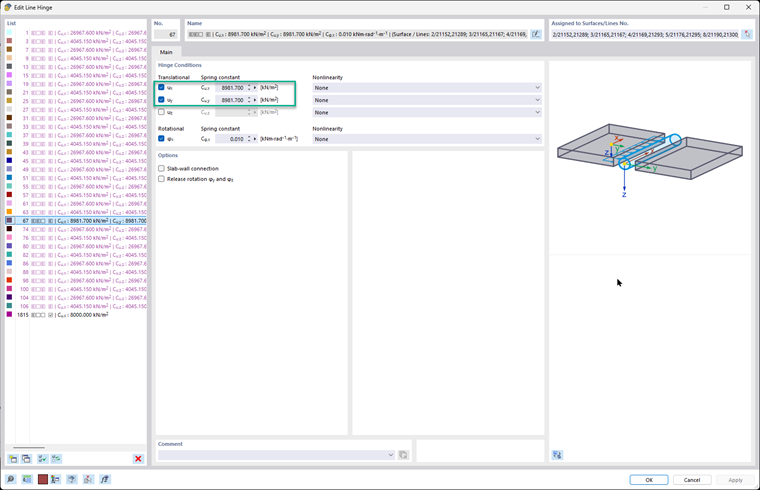
Line releases often include horizontal (axial) displacement releases, which break continuity between floor panels. However, RFEM's diaphragm implementation assumes a continuous in-plane connection between nodes. When these assumptions clash, the 3D global model behaves unrealistically.
Diaphragm overrides local behavior:
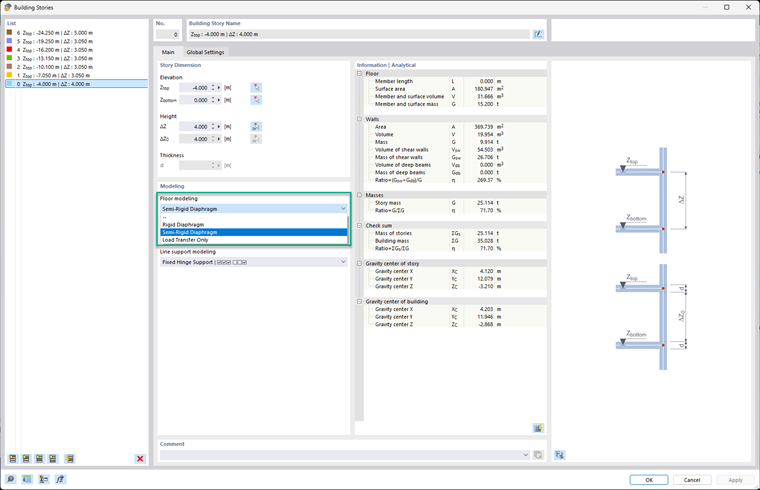
If you use a diaphragm—especially a rigid one—the software treats the entire floor system as a single in-plane element. It doesn’t recognize local discontinuities like slip or gaps introduced through line releases or line hinges. This can cause:
- Loss of load transfer to beams
- Zero bending moments in members where you expect structural action
- Incorrect force paths and deflections
No physical meaning for releases in diaphragm-based models:
In RFEM’s building model approach, the diaphragm (rigid or semi-rigid) enforces horizontal connectivity across all surfaces. That means line releases in the slab have no real effect—and can actually degrade the model’s stability or cause misleading conclusions.
Common Modeling Pitfalls
Model appears to calculate, but doesn't reflect real behavior:
With diaphragms in place, any line releases or hinges defined to simulate real-world slip or separation (e.g., between CLT panels) won’t be respected in the global 3D model. Worse, the Load Transfer feature will ignore members with releases, leading to unexpected zero-force results.
- Numerical Instability in Second-Order Analysis
Semi-rigid diaphragms introduce elastic flexibility, and when combined with multiple line releases, the model can become numerically unstable or fail in second-order (P-Delta) analysis.
Best Practice Recommendations
Avoid line releases and hinges in diaphragm-based models:
If you're using diaphragms (rigid or semi-rigid), do not model line hinges or releases to simulate inter-panel behavior.
Use full 3D modeling for realistic behavior:
If your goal is to capture slip, gaps, or non-linear behavior between mass timber panels, don’t use diaphragms at all. Instead:
- Model each floor panel with its real stiffness (flexural and axial)
- Use standard surface-to-surface or member-to-member connections
- Introduce non-linearities explicitly (e.g., springs or contact elements)
Be clear on the modeling intent:
Decide early: Do you want simplified floor behavior (use diaphragm) or detailed panel interaction (no diaphragm)? Combining the two leads to incorrect or unstable results.
Final Advice
Line releases and diaphragms serve different modeling philosophies:
- Diaphragms assume rigid or semi-rigid in-plane continuity.
- Line releases introduce localized flexibility or discontinuity.
Using both in the same floor system creates conflicts that RFEM cannot resolve meaningfully. For realistic and physically accurate mass timber modeling—especially where inter-panel behavior matters—ditch the diaphragm and model the structure fully in 3D.