


Description
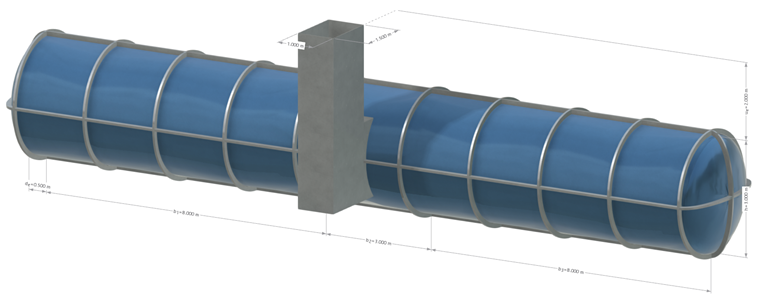
This model is a simplified representation of the supporting structure of an earth reservoir with a diameter of 3 meters. It consists of two 8-meter-long chambers connected in the middle by an maintenance and installation space. An access shaft is attached to this space, leading up to the top of the ground. The top of the ground is two meters above the container.
The tank is made of glass fiber reinforced plastic and stainless steel cross-sections. These materials were modeled using orthotropic plastic or isotropic plastic material behavior.
Foundation
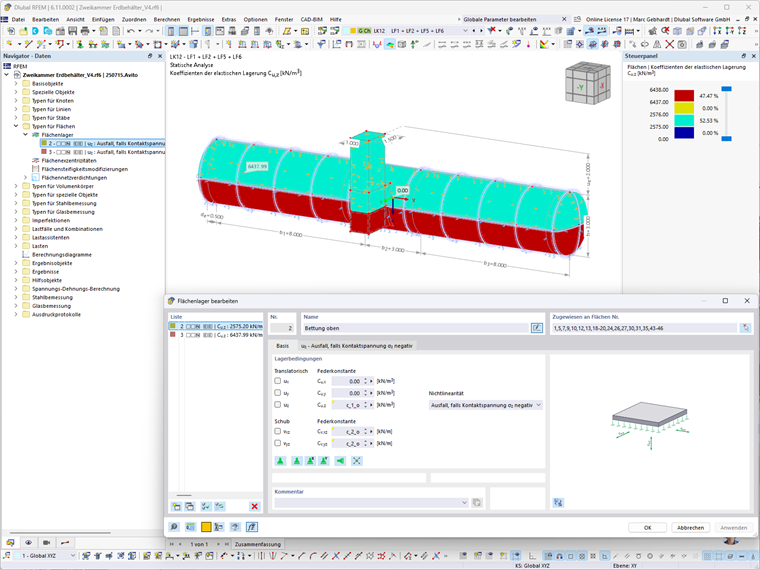
For the foundation, simplified constant surface springs were assumed on the upper and lower halves of the container. The calculation was performed using the modified two-parameter subgrade reaction modulus method according to Pasternak. The influence depth was determined to be 2.4 m. On the upper side, the foundation thickness was determined based on the earth covering (2 m). In addition, the spring stiffness was reduced about 50%. This is due to influences from improper support caused by the proximity of the ground surface and incomplete compaction during installation. The following image shows the display of the coefficients of the elastic foundation in the z-direction, as well as the corresponding input dialog box for the foundation parameters applied to the lower half.
Further information on modeling soil-structure interactions can be found in the following manual entry. More detailed methods for determining the interaction between structure and soil are also shown here.
Earth Pressure
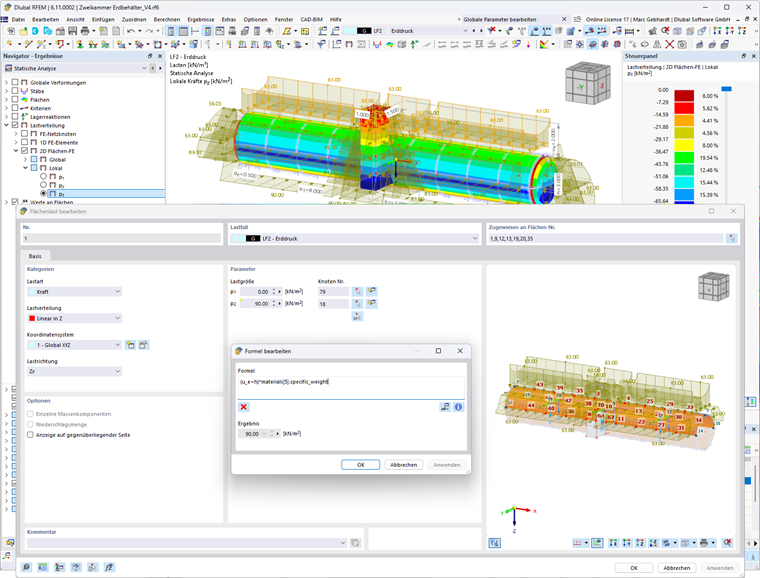
The earth pressure acting on the container results from the weight of the surrounding soil and increases with depth. The distribution can be assumed to be linear, starting with no load at the top of the ground. The load was applied in the three main global directions to the outer walls of the container. The following image illustrates the load application of the self-weight of the soil.
Filling
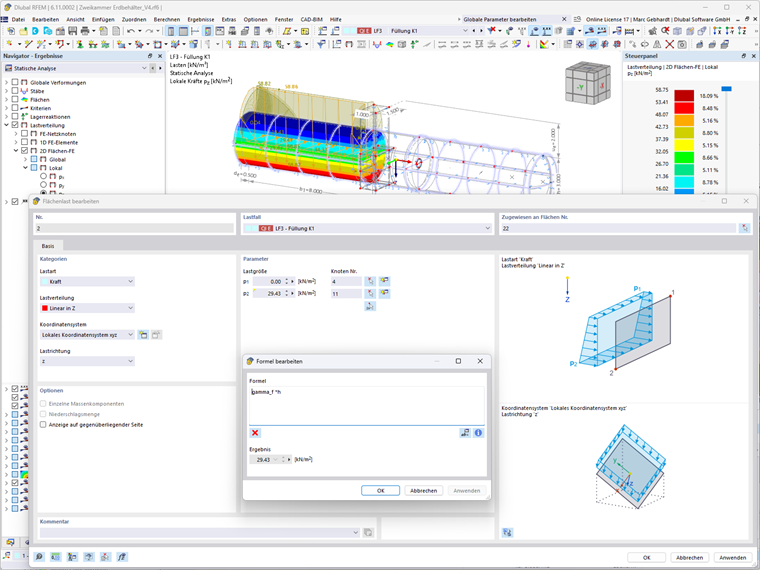
The two container chambers were filled independently of each other with the hydrostatic pressure resulting from the liquid filling. This results from the specific weight of the liquid and the filling height, increases linearly with depth, and acts perpendicularly on the container wall.
Further information on hydrostatic pressure on container structures can be found in the following technical article:
Buoyancy
Buoyancy from Groundwater
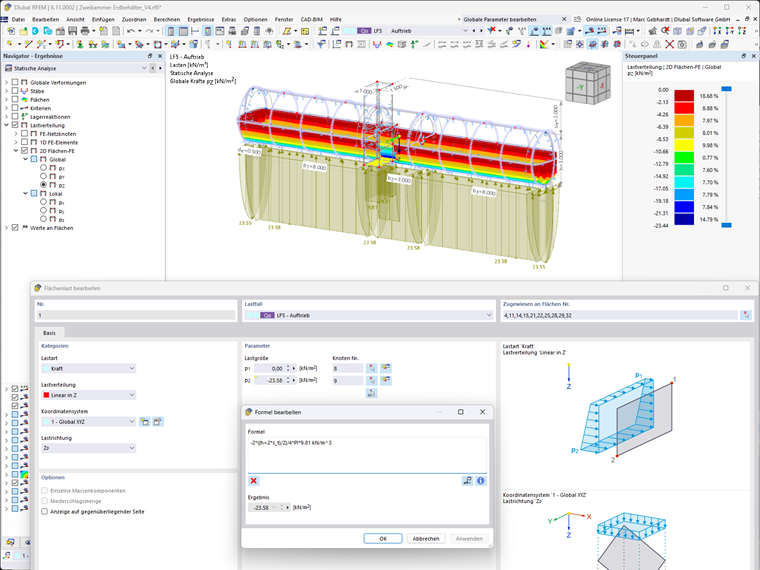
In this case, it is assumed that the container is temporarily half submerged in groundwater. The total load from buoyancy is calculated according to Archimedes' principle from the mass of the displaced water. Its effect is opposite to the acceleration due to gravity. The resulting force therefore acts in the negative z direction in our model. In addition, the load is distributed over the projected surface and a linearly increasing load in the z direction is assumed. To be on the safe side, this should lead to an overestimation of the load and increased ovalization of the tank. The following formula shows the surface load determined for these assumptions under constant distribution. The input is displayed in the image below.
Change in Earth Pressure from Groundwater
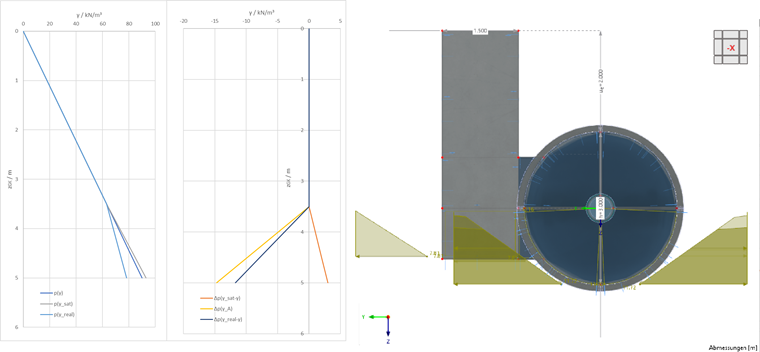
The temporary change in the groundwater level also changes the load resulting from the in-situ soil. The following formula shows how this change in load is determined. The image below shows the corresponding load distribution and the percentage change over depth.
Optimization
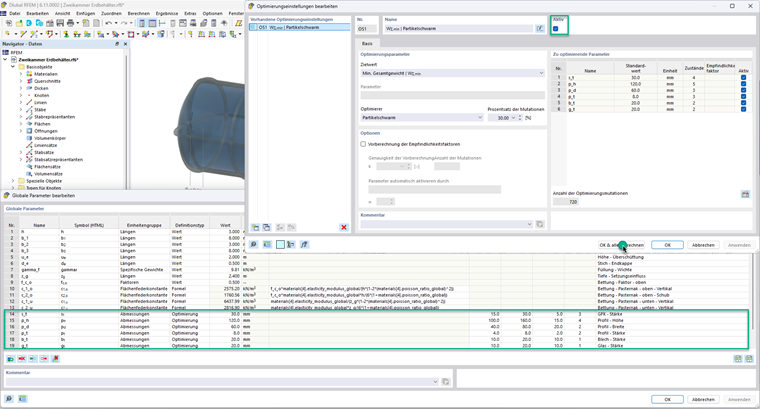
The following image displays the optimization settings and the associated parameterized dimensions of the support structure that were selected for optimization. By clicking the “OK & Calculate All” button, all optimization mutations can be calculated.
Final Remarks
Soil-Structure Interaction
For a realistic modeling of the interaction between the structure and the surrounding soil, it would be necessary to consider the soil as a 3D solid with nonlinear material behavior. Further information is available in the manual of the Geotechnical Analysis add-on under the following links:
- Online Manuals RFEM 6 | Geotechnical Analysis | Materials of Soil Type
- Online Manuals RFEM 6 | Geotechnical Analysis | Type of Soil Modeling | 3D | Finite Element Method
Stability/Buckling
The application of imperfections and the design against stability failure have been omitted in this article. However, design using the GMNIA method would be possible without any problems based on the nonlinear materials already used. Further information is available in the following technical article and webinar: