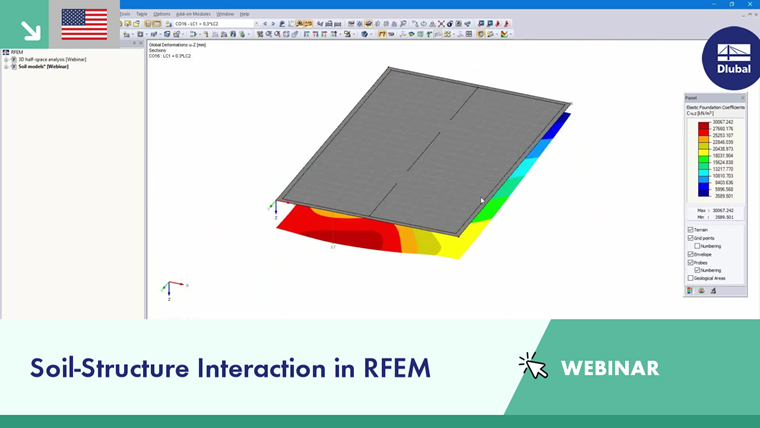
Various principles are available for simulating soil-structure interaction. This chapter describes the different modeling approaches with increasing levels of detail. It should be noted that a more detailed simulation of soil-structure interaction with higher accuracy usually also increases the modeling and computing effort. The following image shows the different methods schematically.

2D | Subgrade Reaction Modulus Method
In the two-dimensional simulation of the soil, equivalent springs are arranged at the base area of the foundation.
In the Subgrade Reaction Modulus Method (also known as Winkler bedding), the stiffness of these springs is described as constant based on the linear relation between the contact pressure and the resulting settlement.
The shear stiffness and the adjacent soil are neglected, resulting in a settlement pit instead of a subsidence basin. This interaction behavior is most realistic for dry, homogeneous sand, as the shear stiffness is very low in this case.
In order to consider shear stiffness and the adjacent soil and to represent a more realistic settlement behavior, various modifications of this method have been developed.
2D | Modified Subgrade Reaction Modulus Method
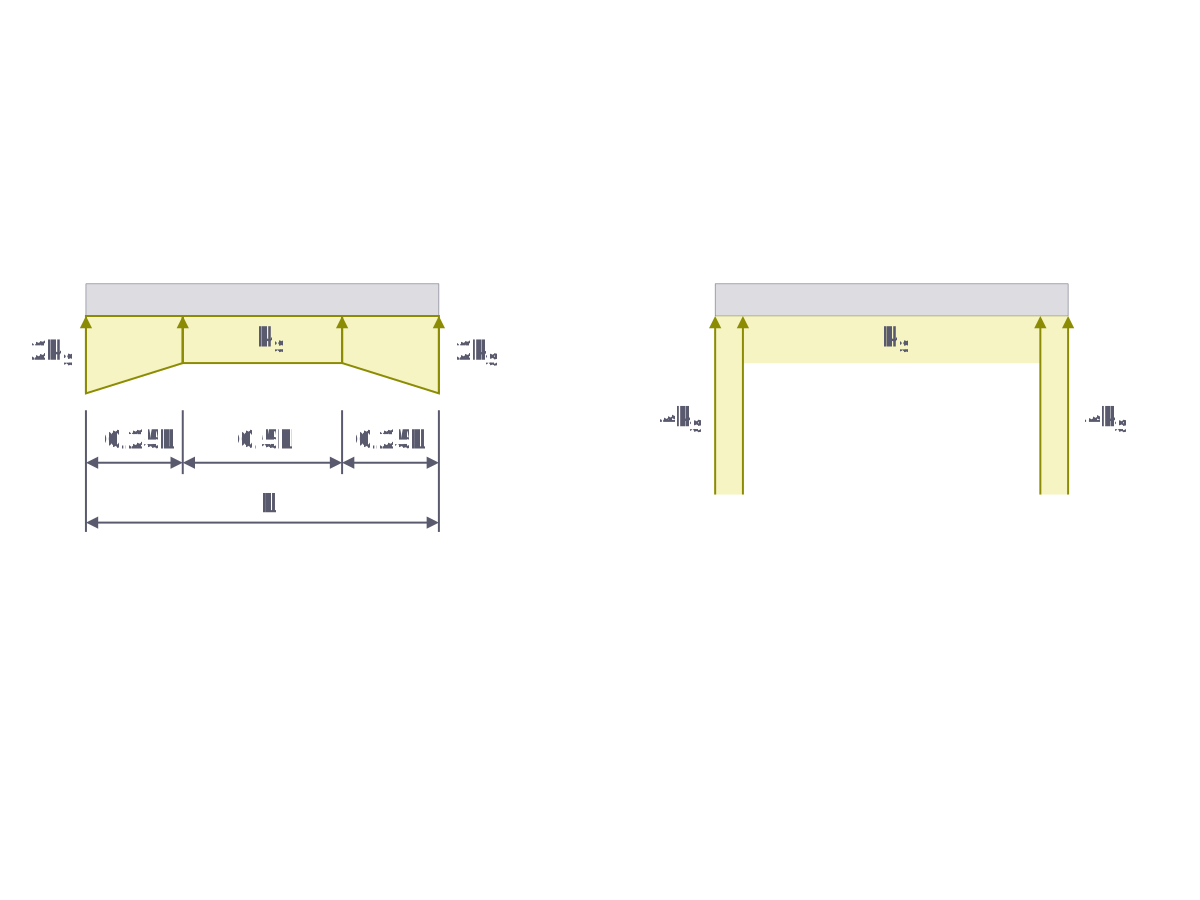
The simplest modifications increase the spring stiffness in the edge area in order to simulate the stiffening caused by the formation of a subsidence basin. The following image shows the method according to Dörken and Dehne [1] on the left, where an area of a quarter of the foundation dimension is increased linearly to twice the stiffness. Opposite this, the increase in the subgrade modulus reaction according to Bellmann and Katz [2] is shown, where the stiffness is increased by a factor of 4 in the outer FE element row.
2D | Modified Two-Parameter Subgrade Reaction Modulus Method with Foundation Overlap
For a more realistic consideration of shear capacity and adjacent soil areas, the soil model is modified by applying a foundation overlap without relevant stiffness. This should extend far enough so that the settlements at its edge are negligible. The advantage of this is that adjacent foundations can also be taken into account in addition to the shear capacity.
The calculation of the modulus of subgrade reaction c1,z in the vertical direction and the shear capacity c2,v can be performed using the two following methods according to Pasternak or Barwaschow [3].
|
E0 |
Modulus of elasticity of the soil |
|
v |
Poisson's ratio of the soil |
|
H |
Foundation thickness |
|
E0 |
Modulus of elasticity of the soil |
|
v |
Poisson's ratio of the soil |
|
H |
Foundation thickness |
2D | Modified Two-Parameter Subgrade Reaction Modulus Method with Equivalent Springs
According to Kolar and Nemec [5], the subsidence basin can be simulated using the efficiently subgrade method by arranging equivalent springs. These additional springs are applied to the outer lines and corner points of the foundation. The determination can be made using the following formulas.
|
k |
Line spring |
|
K |
Single spring |
|
s0 |
Range of subsidence basin (settlement around 1% of that at the foundation edge) |
|
c2,v |
Shear capacity (here, equal in x and y) [reference values from 0.1 c1,z for loose sand to 1.0 c1,z for solid rock] |
2D | Constrained Modulus Method (Elastic Half-Space)
An even more accurate simulation of the soil model is possible using the constrained modulus method (elastic half-space) [6]. By recording any soil layer, the subsidence basin, and the iterative calculation of the soil-structure interaction, this method can be used to calculate realistic distributions of the elastic foundation coefficients.
The distribution of the foundation parameters under the foundation plate is required for calculating the contact pressures. At the same time, it depends on these pressures. Based on the complex interaction between the soil and the structure, it is not possible to determine the foundation parameters in a simple calculation. For the first iteration step, it is necessary to select initial values for the foundation parameters. With these initial values, a finite element analysis of the model can be performed. The result is the distribution of the contact pressures.
The contact pressures from the first iteration step are entered as input variables for a new calculation. Together with the stiffness moduli of the soil layers entered, the settlement can be calculated for each finite element. The foundation parameters are calculated from the settlement and the base pressure. In the next iteration step, the new foundation parameters replace the old ones and a new finite element analysis is started, which in turn provides a new base pressure distribution. As convergence criteria, the new distributions of the contact stresses and settlements at the foundation surface are compared with the old ones. The iterative calculation is continued as long as the deviation does not fall below a certain convergence limit and the maximum number of iterations has not been reached. If the convergence limits of two consecutive iteration steps are not reached, the iteration is terminated. The foundation parameters of the last iteration step are output as the result. The following shows the schematic sequence of the calculation using the constrained modulus method (elastic half-space).
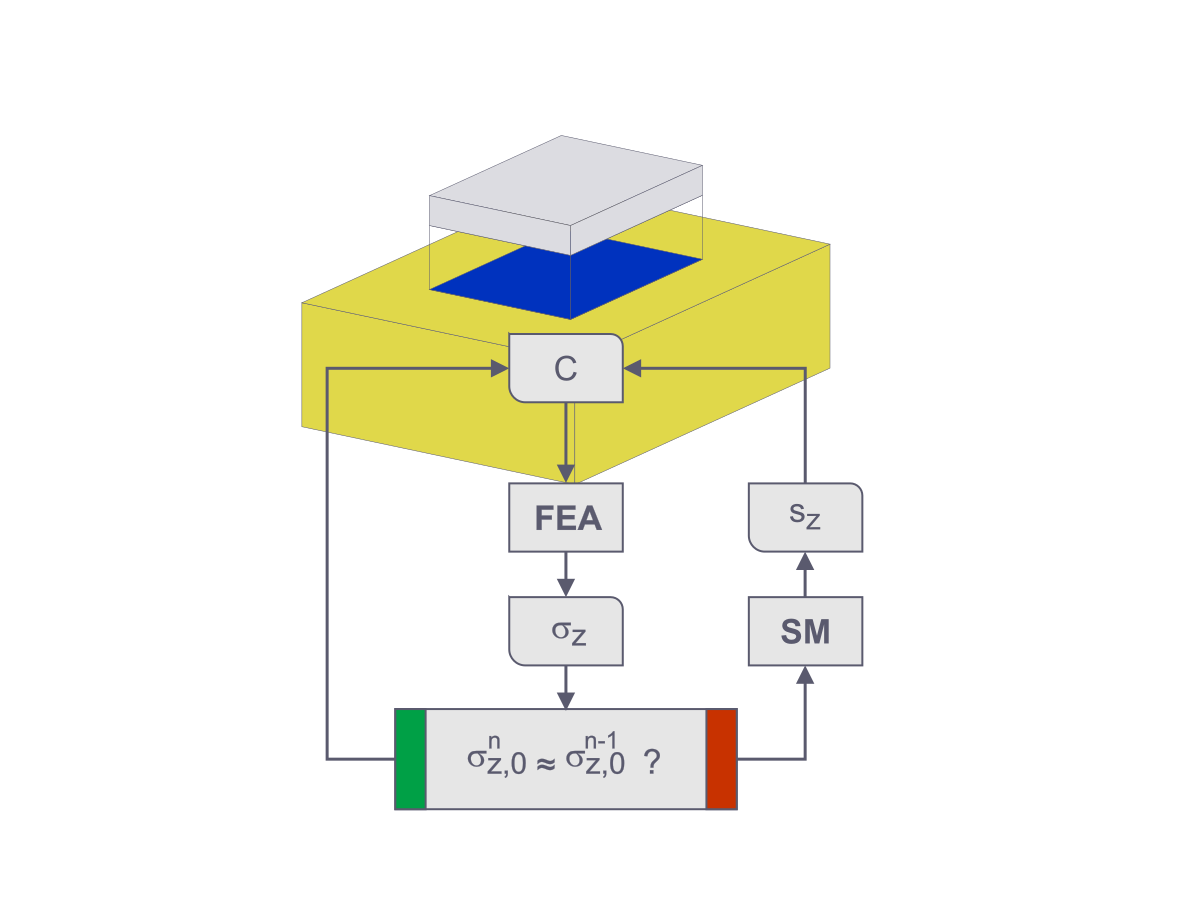
A governing intermediate variable in the iterative calculation of the foundation parameters is the settlement sz. For the stress distribution due to the load, the subsoil is assumed to be a homogeneous half-space with linear-elastic, isotropic material according to the Boussinesq model. This is displayed in the following image. The settlement components are taken into account up to a limit depth, which is either determined by a negligible increase in stress from the load compared to the self-weight stress of the soil, or by assuming an incompressible layer (for example, solid rock). The stress is integrated layer by layer. The settlements are calculated together with the associated stiffness modulus. The foundation parameters are calculated using the base pressure 𝜎z and the settlements sz.
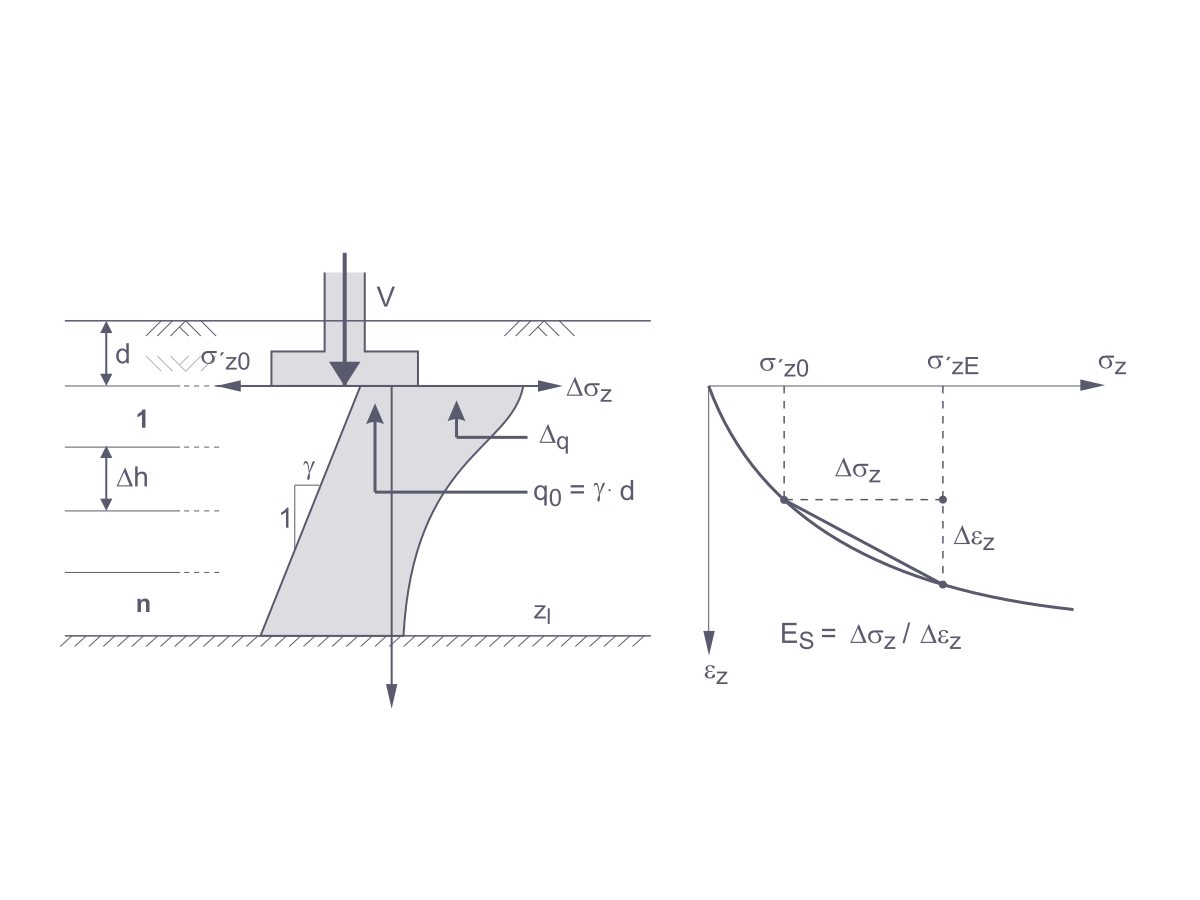
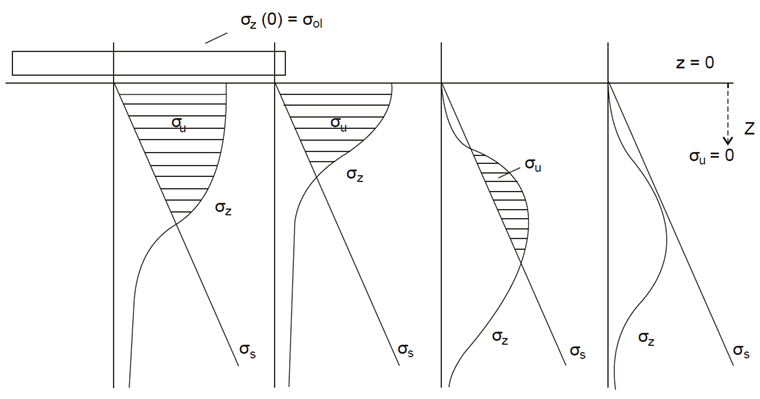
To indirectly achieve an increase in stiffness over depth, the stress from the load can be reduced using the factorized initial stress (from the soil self-weight). This may result in behavior that is more physically reasonable. Only the resulting overloads are then used for the settlement calculation.
In this method, the foundation parameters are derived from the equality of the potential energy from the 3D and 2D models. A complete description can be found in the dissertation [7]. In addition to the vertical stress-strain relation, the shear stiffness in zx and yz are also included here. It is important to note that this corresponds to an elasticity matrix reduced to the diagonal (Ez and G) and that the problem is transferred from 3D to 2D by integrating along the z-axis. This results in the following relation for determining the foundation parameters for vertical (“Cu,z”) and shear deformation (“Cv,xz” and “Cv,yz”). To avoid numerical problems, the latter are not calculated directly from the distortion, but in the so-called isotropic form. The mutual influence of these foundation parameters and the contact stress also necessitates the iterative determination of the soil-structure interaction mentioned at the beginning.
|
σz |
Stress in the vertical direction |
|
εz |
Strain in the vertical direction |
|
w0(x,y) |
Deformation of the ground surface, depending on a location |
|
H |
Thickness of the deformed zone |
|
G |
Shear modulus |
|
w(x,y,z) |
Settlement (deformation in the vertical direction), depending on a location |
|
w0(x,y) |
Deformation of the ground surface, depending on a location |
|
H |
Thickness of the deformed zone |
Furthermore, linear foundations (“Cl,u,z”) are derived from these foundation parameters at the edge lines to model the stiffening effect of the subsidence basin. However, it is strongly recommended to provide a foundation overlap that is extended at least far enough so that the settlements at its outer edge have completely subsided.
|
C1 |
Vertical foundation parameter of the edge element |
|
C2 |
Shear foundation parameters of the edge element |
3D
The most realistic, but also most complex simulation of soil-structure interaction is possible by modeling the existing conditions in a 3D FE analysis. The interaction of adjacent foundations is recorded via their geometric relationship through three-dimensional meshing and compatibility. Any geometric and material conditions can be taken into account realistically. The structural behavior of the soil can be modeled realistically using special nonlinear material models. It is important to consider the initial state, as most nonlinear material models depend on the three-dimensional stress state. This can be illustrated by the failure surface of the modified Mohr-Coulomb model. If, at the hydrostatic axis under pressure from all sides, one is further away from the origin, the tolerable stress changes before the flow criterion is reached are greater.