📝 Introduction
In modern structural and wind engineering, the accurate determination of wind loads plays a decisive role in ensuring the safety, serviceability, and economic efficiency of buildings and civil infrastructure. Traditionally, engineers rely on code-based static wind load calculations such as those outlined in Eurocode 1991-1-4 or ASCE 7-22 to determine design loads. These approaches use simplified analytical formulas derived from wind tunnel experiments and empirical data, providing standardized load cases that are generally sufficient for conventional structures.
However, with the rise of computational fluid dynamics (CFD) in engineering practice, a powerful alternative has emerged that offers far greater insight and precision. CFD wind simulations are increasingly recognized not only in research but also in applied engineering design, particularly for complex and wind-sensitive structures.
It is important to emphasize that the application of CFD simulations in RWIND is not intended to replace codified static wind load calculations, but rather to complement and enhance them. This approach is fully consistent with Eurocode EN 1991-1-4, Clause 1.5, which explicitly permits the use of “proven and/or properly validated numerical methods to obtain load and response information, provided that appropriate models of the structure and of the natural wind are applied.” Similarly, ASCE 7-22, through reference to ASCE 49, recognizes that while CFD is increasingly applied in wind engineering, its use must be carefully controlled. Since there is currently no dedicated standard detailing the full procedures for CFD in this context, ASCE emphasizes that any application of CFD to determine wind loads on the Main Wind Force Resisting System (MWFRS), Components and Cladding (C&C), or other structures must undergo peer review and a Verification and Validation (V&V) study to ensure the accuracy and reliability of the results.
⚠️ Limitations of Code-Based Static Wind Load Calculations
While standards provide robustness and reliability, they are inherently conservative and generalized. Their limitations include:
- Simplified assumptions: Codes assume idealized building shapes (e.g., rectangular forms, gable roofs) and cannot fully capture the complexity of modern architectural designs.
- Limited directional resolution: Wind directions are typically reduced to a few discrete cases (0°, 90°, etc.), overlooking critical angles that may govern load response.
- Insufficient local detail: Only global coefficients are provided, which may not represent localized effects such as corner vortices, facade suction, or channeling between structures.
- Generic wind profiles: Standards use simplified terrain categories and logarithmic or power-law profiles that may not fully reflect site-specific meteorological conditions.
For typical low-rise, regular structures, these limitations may not significantly impact safety. But for tall, slender, irregular, or aerodynamically sensitive structures, they can lead to overly conservative or unsafe designs.
🚀 Advantages of CFD Wind Simulation
CFD wind simulation overcomes many of the above limitations by directly solving the Navier–Stokes equations for airflow around structures. Its advantages include:
1) Accurate Representation of Complex Geometries
Unlike code-based methods, CFD can handle any architectural or structural shape, from free-form facades to slender towers, cable-supported roofs, and solar panel arrays. This allows the aerodynamic effects of real-world geometry to be captured without oversimplification.
2) Detailed Surface Pressure Distribution
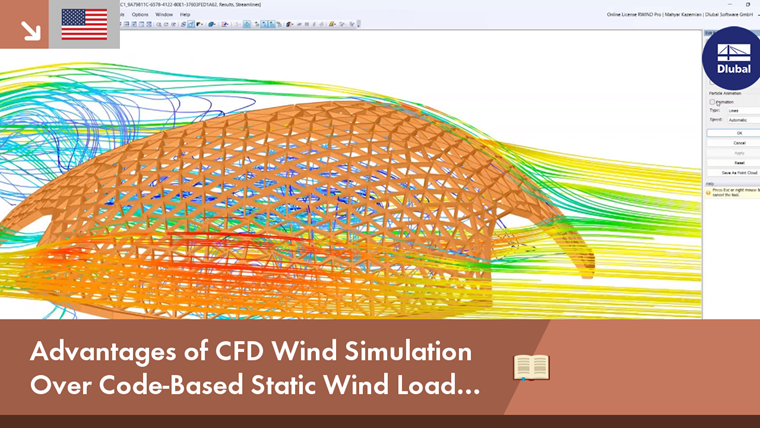
CFD provides spatially resolved pressure fields across every surface, allowing engineers to identify hotspots of suction or stagnation that standards cannot resolve. This enables more efficient structural design and the possibility to optimize facade cladding, anchorage, and connections.
3) Capture of Local Wind Phenomena
Dynamic effects such as vortex shedding, flow separation, channeling between buildings, and downwash can be modeled. These effects are critical for tall buildings, pedestrian comfort studies, and structures prone to aerodynamic forces.
4) Wind Direction Flexibility
CFD simulations can be run for any arbitrary wind angle, providing a continuous understanding of load response instead of being restricted to discrete directions in codes. This leads to more robust identification of governing load cases.
5) Site-Specific Wind Profiles
By incorporating measured meteorological data or mesoscale simulation results, CFD can generate customized inlet boundary conditions that reflect the unique terrain, roughness, and atmospheric stability of a project site.
6) Integration with Structural Analysis Tools
Modern workflows allow seamless transfer of CFD-derived surface pressures into Finite Element Method (FEM) programs such as RFEM. A major advantage lies in the ability to incorporate these loads into standardized load combination formats such as ASCE Load and Resistance Factor Design (LRFD) or Eurocode combinations. This ensures that CFD-derived wind effects are considered in the same framework as other load actions (e.g., dead loads, imposed loads, snow, seismic), while maintaining full regulatory compliance.
7) Enhanced Safety and Optimization
CFD not only improves accuracy but also reduces over-conservatism. By pinpointing true governing loads, engineers can design lighter, more efficient, and sustainable structures without compromising safety.
8) Capturing both Compression and Suction with CFD
CFD clearly shows both compressive and suction loads, giving users a complete understanding of wind effects across the entire structure.
💡 Practical Considerations
Despite its advantages, CFD is not without challenges:
- Computational demand: High-fidelity simulations, especially using Large Eddy Simulation (LES), require significant computational resources.
- Specialized expertise: Reliable CFD requires proper model setup, turbulence modeling, and validation against experimental or field data.
- Validation requirements: For regulatory approval, CFD results often need to be benchmarked against wind tunnel testing or established standards.
Nonetheless, advances in computing power, numerical methods, and cloud-based solvers are making CFD increasingly practical and accessible.
🏗️ Application Scenarios Where CFD Adds Value
CFD is particularly valuable for:
🏢 High-rise buildings and slender towers
🪞 Facade and cladding systems
🏟️ Long-span roofs, stadiums, and bridges
🌊 Offshore and coastal structures
☀️ Solar trackers, wind turbines, and antenna systems
🌆 Urban wind environment and pedestrian comfort studies
🚠 Cable cars and ropeway pylons
🏭 Industrial facilities, chimneys, and cooling towers (stack effects, emissions)
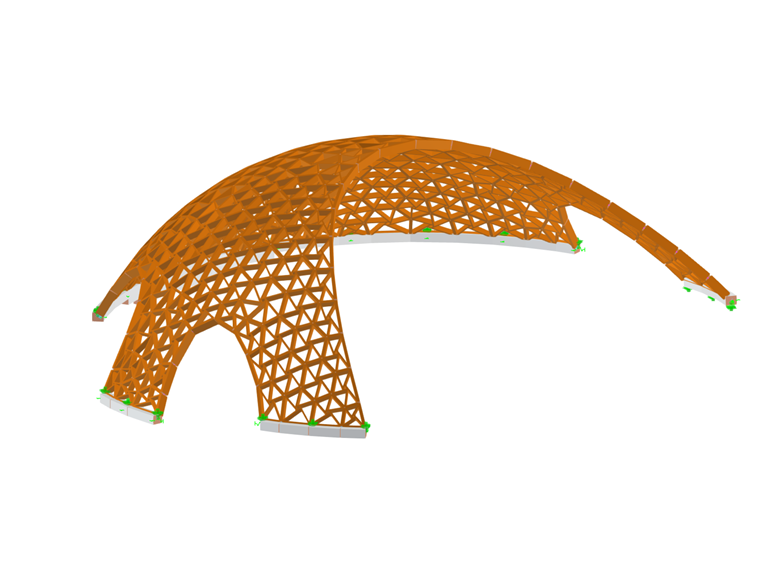
🎢 Lightweight and special structures such as tensile membranes, roller coasters, or timber gridshells
⚡ Transmission line systems and pylons
🏛️ Heritage structures and cultural landmarks requiring site-specific protection
🏗️ Temporary and construction-stage structures
In the following case study, CFD provides insight into both global structural loads and localized effects, enabling more reliable engineering decisions.
🔍 Conclusion
While code-based static wind load calculations remain indispensable for many standard applications, they are inherently limited in their ability to reflect complex geometries, local effects, and dynamic phenomena. CFD wind simulation, by contrast, provides a physics-based, site-specific, and geometry-resolved solution that aligns with the growing complexity of modern architecture and structural engineering. As regulatory bodies increasingly acknowledge the reliability of CFD when properly validated, its role in engineering practice will continue to expand. Ultimately, combining code-based conservatism with CFD-based precision represents the most effective path toward safe, efficient, and innovative designs.