


This manual describes the Multilayer Surfaces add-on for the RFEM 6 program. It can be used for the calculation of cross-laminated timber, glass surfaces (laminated and insulating glass), or fibre-reinforced plastic composites. It can also be used in concrete structures, lightweight structures, or element structures to analyze layer elements. The Beam Panel thickness type is also possible in the add-on. A beam panel allows you to define a 3D object consisting of members and surfaces. An example of this would be a timber panel wall.
Options for Layer Models
You can create layers using the material library available in RFEM or define them freely as a user-defined structure. Since the parameters of multilayer surfaces are also used in other add-ons, such as Stress-Strain Analysis or Timber Design, these add-ons are also covered in this manual. For a full description of these design add-ons, please refer to the respective manuals.
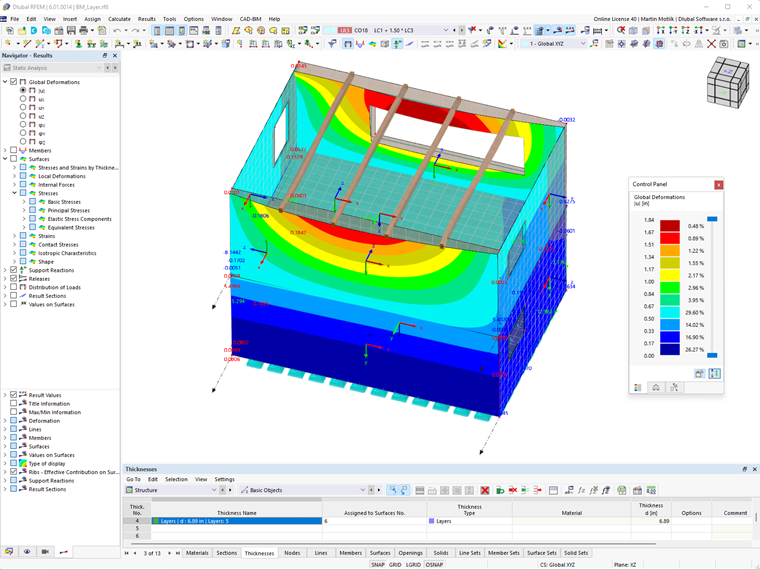
Any material models can be defined for the layers. A combination of material models—such as isotropic and orthotropic materials—is also possible. It is possible to specify linear or nonlinear coupling conditions between the layers. Orthotropic materials are applied directionally in the individual layers with the angle β.
Activating Multilayer Surfaces Add-on
You can activate or deactivate the use of the Multilayer Surfaces add-on in the Add-ons tab of the model base data.
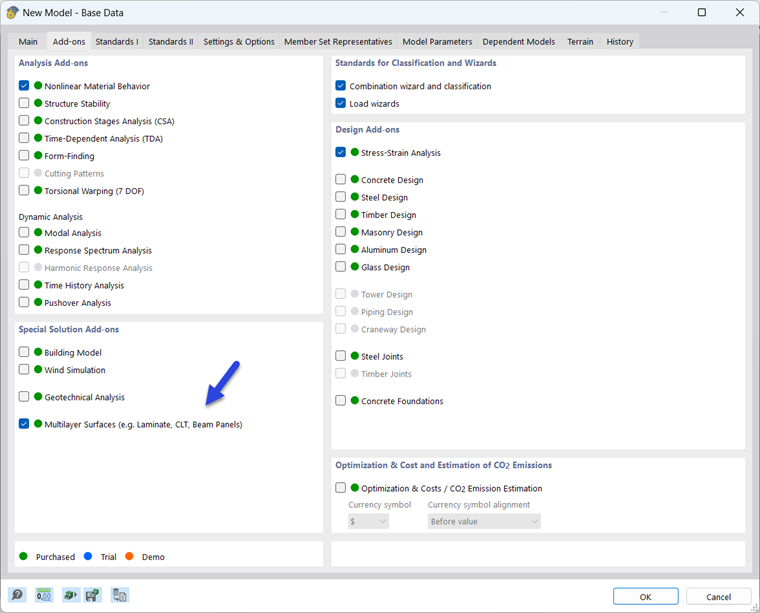
A green dot in front of the add-on description means that a license is available. An orange or blue dot indicates that you can only use the add-on as a demo or trial version with a limited range of functions.
Once you have activated the special-solution add-on, the user interface is extended by new entries in the navigator, tables, and dialog boxes. This means that the parameters of multilayer surfaces are fully integrated into the RFEM program user interface.