


The default integration method in RFEM is a Gauss-Lobatto quadrature with nine integration points. This default setting is sufficient for most cases. In order to accurately model nonlinear stress-strain curves (for example, in steel fiber-reinforced concrete), it may be useful to increase the number of integration points. Therefore, when using nonlinear material, it is possible to define the number of integration points in each layer between three and 99 user-defined points (see the image Adjusting Integration Points for Layers ). However, please note that a higher number of integration points results in a longer calculation time.
Furthermore, there are three different integration methods you can select from (see the image Specifying Integration Method ):
- Gauss-Lobatto quadrature
- Simpson's rule
- Trapezoidal rule
These integration methods—also known as quadrature formulas—are explained below. In general, it can be assumed that Gauss-Lobatto quadrature provides the highest accuracy for a fixed number of integration points without significantly increasing the computing time. Only in special cases does the use of the trapezoidal or Simpson's rule lead to a better result.
Quadrature Formulas
The goal of a quadrature formula is to calculate a numerical approximation of an integral. To do this, support points are selected in the integration area and the function evaluations at these points are added together with weighting. The calculation of the moment is used as an example for the following explanations.
Here, ‘‘d’’ is the height of any layer in a multilayer surface. An attempt is then made to approximate the integral as follows:
This requires “n” support points −d/2 ≤ z1 < z2 < . . . < zn ≤ d/2 over the height of the layer as well as scalar weights ω1, . . . , ωn that are specific to the respective quadrature formula.
RFEM always uses an odd number n = 2k + 1 of support points and selects at least the top, middle, and bottom of the layer as integration points. This results in z1 = −d/2, zk = 0, and zn = d/2. This is necessary so that the stress values at these points can be calculated accurately and then displayed in the program. If an even number of support points is specified, the next higher odd number is used for calculation.
The degree of accuracy of a quadrature formula is specified by its order “p”. This is the highest degree of a polynomial that is integrated exactly.
Trapezoidal Rule
A simple example of a quadrature formula is the trapezoidal rule. Here, two outer edges of the integration area are selected as support points; that is, z1 = −d/2 and z2 = d/2. The trapezoidal rule is of the geometrically linear analysis, because linear functions are integrated exactly, but quadratic functions are not.
In the variant of the summed trapezoidal rule used in RFEM, the integration interval is divided into n−1 subintervals at equal distances when n integration points are selected, and the trapezoidal rule is applied to each of these subintervals.
The following image shows an example of the summed trapezoidal rule for five integration points.

Simpson's Rule
The Simpson's rule is a large deformation analysis quadrature formula that uses three integration points—two at the edges and one in the middle of the integration area. The weights are selected in such a way that the approximate solution corresponds to the integral over a parabola that passes through these three points. With z1 = −d/2, z2 = 0, and z3 = d/2, the formula is
Also here, RFEM uses a summed quadrature. With an uneven number n of support points, (n−1)/2 equally long subintervals result, to which Simpson's rule can be applied. The image shows this again as an example for five integration points.
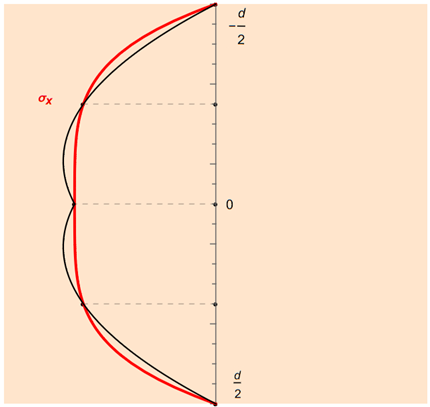
Gauss-Lobatto Quadrature
In the Gauss-Lobatto quadrature, the two boundary points z1 = −d/2 and zn = d/2 are always specified as support points, and all other integration points are selected so that the highest possible order is achieved. This is p = 2n − 3. For n = 3, the Gauss-Lobatto quadrature corresponds to the Simpson's rule; for n = 5, for example, the result is: