


Description
This example examines the punching shear analysis of an interior column according to CSA A23.3-19 [1]. The geometry and loading were taken from interior column C2 of Example 1 in the "CAC Concrete Design Handbook - 4th Edition", pages 5-13 and 5-14 [2].
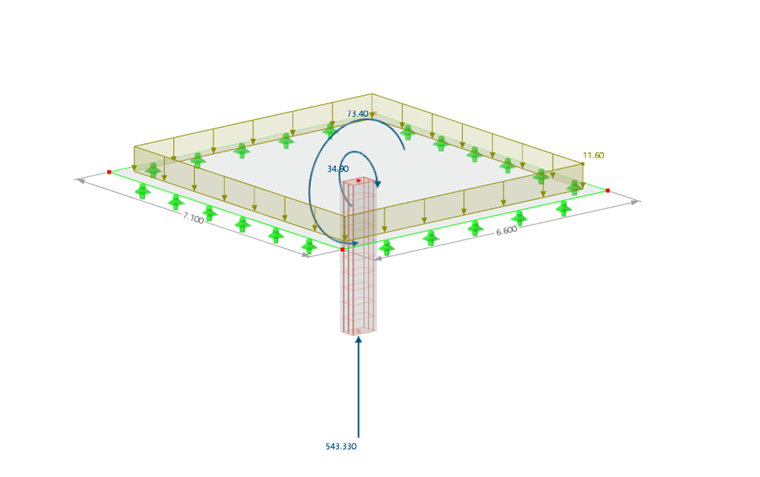
| Materials | Concrete | Design value of concrete compressive strength | f'c | 25 | MPa |
| Reinforcing steel | Design value of yield strength | fy | 400 | MPa | |
| Geometry | Slab | Slab thickness | h | 250 | mm |
| Average static effective height | d | 210 | mm | ||
| Column | Length | lColumn | 3.000 | m | |
| Width | b | 600 | mm | ||
| Height | h | 400 | mm | ||
| Loads | Area load | Reinforced concrete slab | p | 11.6 | kN/m² |
| Internal forces | Forces | Penetrating shear force of the column | Vf,res | 537.85 | kN |
| Moments | Slab moment in the first direction | Mf,1,sl | 73.40 | kNm | |
| Slab moment in the second direction | Mf,2,sl | 34.90 | kNm |
\(
\)
\(
\)
\(
\)
Analytical Solution:
\(
\)
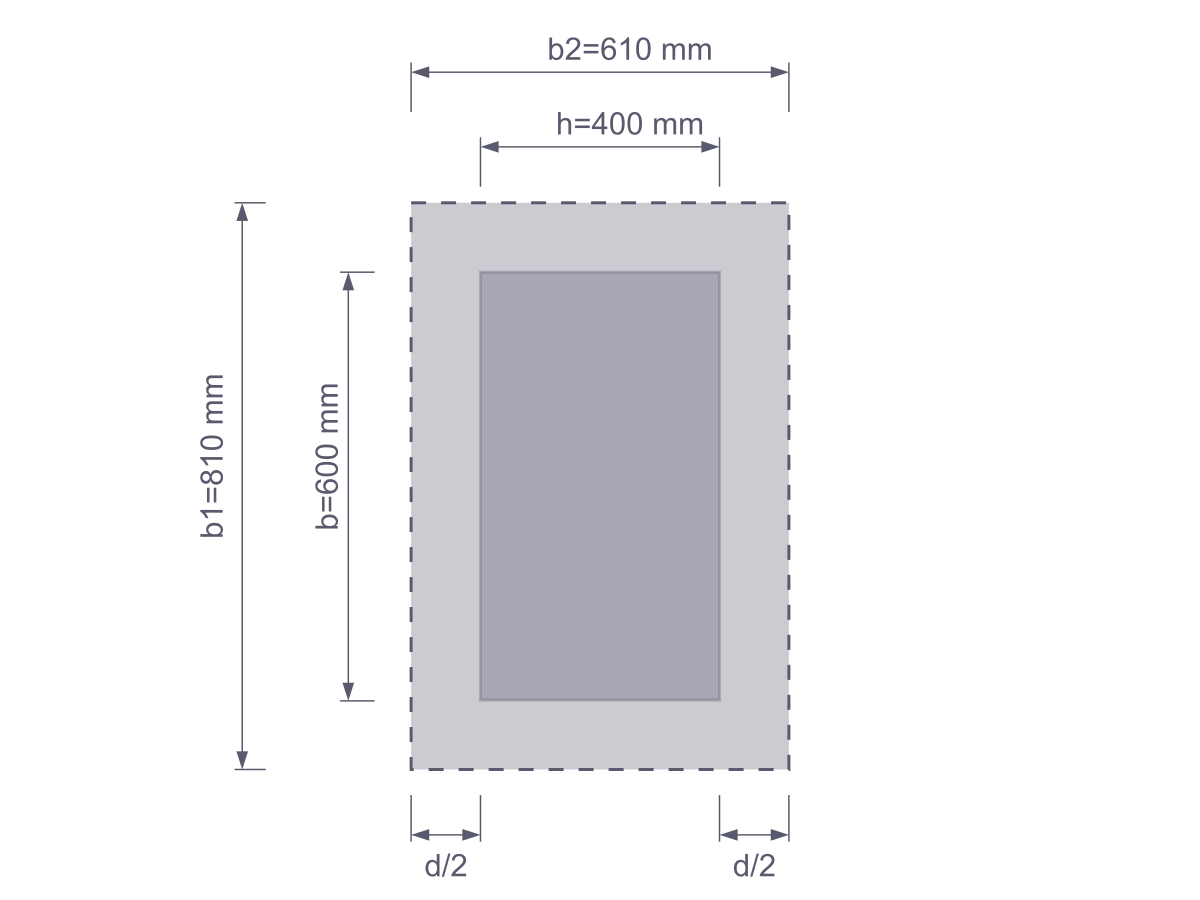
1. Calculation of the Geometric Quantities:
Dimension of the critical circular section parallel to the eccentricity:
\(
\mathsf{b_{1} = b + d}
\)
\(
\mathsf{= 600 + 210}
\)
\(
\mathsf{= 810\,mm}
\)
\(
\)
\(
\mathsf{b_{2} = h + d}
\)
\(
\mathsf{= 400 + 210}
\)
\(
\mathsf{= 610 mm}
\)
\(
\)
Length of the critical section:
\(
\mathsf{b_{o} = 2 \cdot (h + b + 2 \cdot d)}
\)
\(
\mathsf{= 2 \cdot (400 mm + 600 mm + 2 \cdot 210 mm)}
\)
\(
\mathsf{= 2840 mm}
\)
\(
\)
2. Calculation of the Action:
The indices "1" and "2" refer to the principal axes in the system.
- The subscript "1" refers to the global X-axis.
- The subscript "2" refers to the global Y-axis
\(
\)
Thus, the following "polar" moments of inertia result in:
\(
\mathsf{J_{c} = 2\left(\dfrac{b_{1}\,d^{3}}{12} + \dfrac{d\,b_{1}^{3}}{12}\right) + 2(b_{2}\,d)\left(\dfrac{b_{1}}{2}\right)^{2}}
\)
\(
\mathsf{J_{1} = 2\left(\dfrac{810 \cdot 210^{3}}{12} + \dfrac{210 \cdot 810^{3}}{12}\right) + 2\left(610 \cdot 210\right)\left(\dfrac{810}{2}\right)^{2}}
\)
\(
= \mathsf{ \; 6.1873875 \times 10^{10}\,mm^{4}}
\)
\(
\)
\(
\mathsf{J_{2} = 2\left(\dfrac{610 \cdot 210^{3}}{12} + \dfrac{210 \cdot 610^{3}}{12}\right) + 2\left(810 \cdot 210\right)\left(\dfrac{610}{2}\right)^{2}}
\)
\(
= \mathsf{ \; 4.0532975 \times 10^{10}\,mm^{4}}
\)
\(
\)
Reduced shear force due to load transfer within the critical circumferential section:
\(
\mathsf{\Delta V_{f} = p \cdot b_{1} \cdot b_{2}}
\)
\(
\mathsf{= 11.6\,kN/m^{2} \cdot 0.810\,m \cdot 0.610\,m}
\)
\(
\mathsf{= 5.73\,kN}
\)
\(
\)
The reduced shear force is calculated as follows:
\(
\mathsf{V_{f,res} = V_{f} - \Delta V_{f}}
\)
\(
\mathsf{= 543.58\,kN - 5.73\,kN}
\)
\(
\mathsf{= 537.85\,kN}
\)
\(
\)
The calculated plate moment in the first direction at the centroid of the critical circular section:
\(
\mathsf{ M_{f,1,sl} } = \mathsf{ \; M_{f,1} \; + \; V_{f,res} \; \cdot \; e_{1,sl} }
\)
\(
= \mathsf{ \; 73.40\,kNm \; + \; 537.85\,kN \; \cdot \; 0.0\,mm }
\)
\(
= \mathsf{ \; 73.40\,kNm}
\)
\(
\)
The contribution of the Eccentric shear forces of the transmitted moment in the first principal direction:
\(
\mathsf{ \gamma_{v,1} } = \mathsf{ \; 1 \; - \dfrac{1}{1 \; + \; \left( \dfrac{2}{3} \right) \; \cdot \; \sqrt{\dfrac{b_{1,1}}{b_{2,1}}}} }
\)
\(
\)
\(
= \mathsf{ \; 1 \; - \dfrac{1}{1 \; + \; \left( \dfrac{2}{3} \right) \; \cdot \; \sqrt{\dfrac{810\,mm}{610\,mm}}} }
\)
\(
= \mathsf{ \; 0.434460}
\)
\(
\)
The component of the moment transmitted by eccentric shear forces in the second principal direction:
\(
\mathsf{ M_{f,2} } = \mathsf{ \; M_{f,2} \; - \; V_{f,res} \; \cdot \; e_{2,sl} }
\)
\(
= \mathsf{ \; -34.90\,kNm \; - \; 537.85\,kN \; \cdot \; 0.0\,mm }
\)
\(
= \mathsf{ \; -34.90\,kNm}
\)
\(
\)
With the fraction of the Calculated plate moment in the second direction, which is absorbed by the support
\(
\mathsf{ \gamma_{v,2} } = \mathsf{ \; 1 \; - \dfrac{1}{1 \; + \; \left( \dfrac{2}{3} \right) \; \cdot \; \sqrt{\dfrac{b_{1,2}}{b_{2,2}}}} }
\)
\(
\)
\(
= \mathsf{ \; 1 \; - \dfrac{1}{1 \; + \; \left( \dfrac{2}{3} \right) \; \cdot \; \sqrt{\dfrac{610\,mm}{810\,mm}}} }
\)
\(
= \mathsf{ \; 0.366502}
\)
\(
\)
Shear stress due to the reduced shear force:
\(
\mathsf{\nu_{fv} = \dfrac{V_{f,res}}{b_{o} \cdot d}}
\)
\(
\mathsf{\nu_{fv} = \dfrac{537.85\,kN}{2.840\,m \cdot 0.210\,m}}
\)
\(
\mathsf{\nu_{fv} = 0.9040\,MPa}
\)
\(
\)
The applied maximum shear stress is calculated as follows:
\(
\mathsf{
\nu_{f}
=
\nu_{fv}
- \dfrac{\gamma_{v,1} \cdot M_{f,1,sl} \cdot e_{1}}{J_{1}}
+ \dfrac{\gamma_{v,2} \cdot M_{f,2,sl} \cdot e_{2}}{J_{2}}
}
\)
\(
\mathsf{
= \; 0.9040\,MPa
\; - \;
\dfrac{0.434460 \cdot 73.40\,kNm \cdot (-405\,mm)}{6.1873875 \times 10^{10}\,mm^{4}}
\; + \;
\dfrac{0.366502 \cdot (-34.90\,kNm) \cdot (-305\,mm)}{4.0532975 \times 10^{10}\,mm^{4}}
}
\)
\(
\mathsf{
= 1.204\,MPa
}
\)
\(
\)
3. Calculation of the Resistance:
Ratio of the long side to short side of the support:
\(
\mathsf{ \beta_{c} } = \mathsf{ \; \dfrac{max\left( b, \; h \right)}{min\left( b, \; h \right)} }
\)
\(
= \mathsf{ \; \dfrac{max\left( 0.600\,m, \; 0.400\,m \right)}{min\left( 0.600\,m, \; 0.400\,m \right)} }
\)
\(
= \mathsf{ \; 1.50}
\)
\(
\)
Punching shear resistance of the slab without shear reinforcement according to 13.3.4.1 (a):
\(
\mathsf{ \nu_{c(a)} } = \mathsf{ \; \left( 1 \; + \; \dfrac{2}{\beta _{c}} \right) \; \cdot \; 0.19\; \cdot \; \lambda \; \cdot \; \Phi _{c} \; \cdot \; min\left( \sqrt{f'_{c}}, \; f'_{c,max} \right) }
\)
\(
= \mathsf{ \; \left( 1 \; + \; \dfrac{2}{1.50} \right) \; \cdot \; 0.19\; \cdot \; 1.00\; \cdot \; 0.65\; \cdot \; min\left( \sqrt{25.00\,MPa}, \; 8.00\,MPa \right) }
\)
\(
= \mathsf{ \; 1,441\,MPa}
\)
\(
\)
Punching shear resistance of the slab without shear reinforcement according to 13.3.4.1 (b):
\(
\mathsf{ \nu_{c(b)} } = \mathsf{ \; \left( \dfrac{\alpha_{s} \; \cdot \; d}{b_{o}} \; + \; 0.19 \right) \; \cdot \; \lambda \; \cdot \; \Phi _{c} \; \cdot \; min\left( \sqrt{f'_{c}}, \; f'_{c,max} \right) }
\)
\(
= \mathsf{ \; \left( \dfrac{4.00 \; \cdot \; 210\,mm}{2.840\,m} \; + \; 0.19 \right) \; \cdot \; 1.00 \; \cdot \; 0.65 \; \cdot \; min\left( \sqrt{25.00\,MPa}, \; 8.00\,MPa \right) }
\)
\(
= \mathsf{ \; 1.579\,MPa}
\)
Punching shear resistance of the slab without shear reinforcement acc. 13.3.4.1 (c):
\(
\mathsf{ \nu_{c(c)} } = \mathsf{ \; 0.38\; \cdot \; \lambda \; \cdot \; \Phi _{c} \; \cdot \; min\left( \sqrt{f'_{c}}, \; f'_{c,max} \right) }
\)
\(
= \mathsf{ \; 0.38\; \cdot \; 1.00\; \cdot \; 0.65\; \cdot \; min\left( \sqrt{25.00\,MPa}, \; 8.00\,MPa \right) }
\)
\(
= \mathsf{ \; 1,235\,MPa}
\)
\(
\)
Minimum punching resistance of the slab without shear reinforcement:
\(
\mathsf{ \nu_{c} } = \mathsf{ \; min\left( \nu_{c(a)}, \; \nu_{c(b)}, \; \nu_{c(c)} \right) }
\)
\(
= \mathsf{ \; min\left( 1,441\,MPa, \; 1,579\,MPa, \; 1,235\,MPa \right) }
\)
\(
= \mathsf{ \; 1,235\,MPa}
\)
\(
\mathsf{ \nu_{r} } = \mathsf{ \; \nu_{c} }
\)
\(
= \mathsf{ \; 1.235\,MPa}
\)
\(
\)
4. Comparison of Action and Resistance:
\(
\mathsf{\eta_{13.3.4} = \dfrac{\nu_{f}}{\nu_{r}}}
\)
\(
\mathsf{\eta = \dfrac{1.204\,MPa}{1.235\,MPa}}
\)
\(
\mathsf{\eta \approx 0.975}
\)
\(
\mathsf{\eta = 0.975 \;\leq\; 1 \quad \Rightarrow \quad \text{Proof fulfilled}}
\)
The introduction of a Shear reinforcement is not required.
\(
\)
Results
The results from RFEM 6 are presented below.
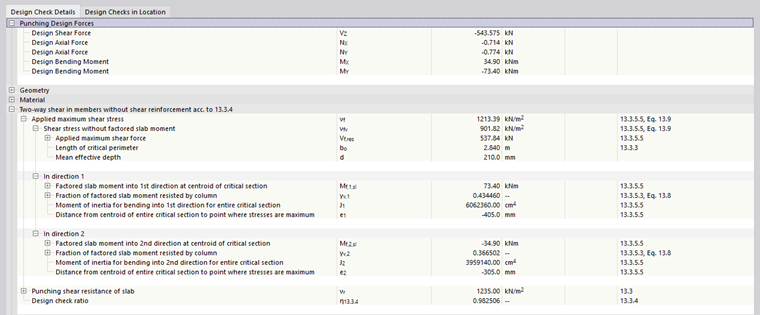
The results from RFEM 6 are compared with the reference results below.
| Punching shear according to RFEM 6 according to CSA A23.3 | |||||
| Parameter | Symbols | Unit | RFEM | Analytical solution | Ratio |
| Maximum punching shear force | Vf | kN | 543.58 | 543.58 | 1,000 |
| Acting reduced punching shear force | Vf,res | kN | 537.84 | 537.85 | 1.000 |
| Maximum moment in the first direction | Mf,1,sl | kNm | 73.40 | 73.40 | 1.000 |
| Maximum moment in the second direction | Mf,2,sl | kNm | 34.90 | 34.90 | 1.000 |
| Polar moment of inertia in the first direction | J1 | mm4 | 6.0623600 * 1010 | 6.1873875 * 1010 | 0.980 |
| Polar moment of inertia in the second direction | J2 | mm4 | 3.9591400 * 1010 | 4.0532975 * 1010 | 0.978 |
| Total stress from shear force and Moments | vf | MPa | 1.223 | 1.204 | 1.016 |
| Shear resistance | νc(a) | MPa | 1.441 | 1.441 | 1.000 |
| Shear resistance | νc(b) | MPa | 1.579 | 1.579 | 1.000 |
| Minimal shear resistance | νc(c) | MPa | 1.235 | 1.235 | 1.000 |
| Design Ratio | η | [-] | 0.982 | 0.975 | 1.007 |
\(
\)
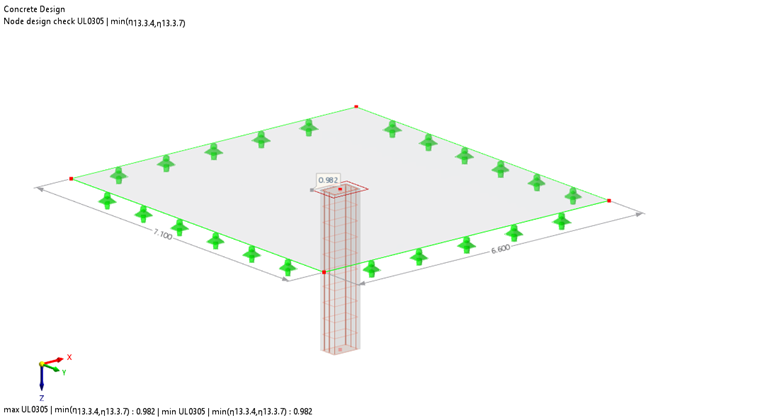
Evaluation
The results from RFEM 6 agree very well with the reference solution.
RFEM 6 calculates slightly lower (approximately 2%) values for the polar moment of inertia than the manual calculation. RFEM 6 calculates the polar moment of inertia according to ACI 421.1R.
The approach in ACI 421.1 is applicable to general circular geometries and is very well suited for a software solution.
In contrast to the analytical formula, which is only applicable to rectangular circular sections, ACI 421.1R neglects the inertial component \(\mathsf{\dfrac{b\,d^{3}}{6}}\).
The smaller polar moment of inertia according to ACI 421.1R results in a conservative approach to punching shear design.