


In statically indeterminate structures, a torsional moment may occur at ribs (for example, downstand beams) even though no direct external torsional load is applied. This so-called compatibility torsion arises from the asymmetrical load distribution from the adjacent slab surface and the associated deformation due to the compatibility conditions.
Usually, the plate bending that is eccentric to the beam axis is transferred to the downstand beam by the load-bearing plate width. If the adjacent slab areas are of different widths, are loaded differently, or are only present on one side (for example, in edge or corner downstands), a resulting bending moment arises whose line of action is no longer located in the center of gravity of the beam cross-section. This leads to an additional torsional moment in the downstand beam in order to ensure deformation compatibility between the slab and the beam (see the image).
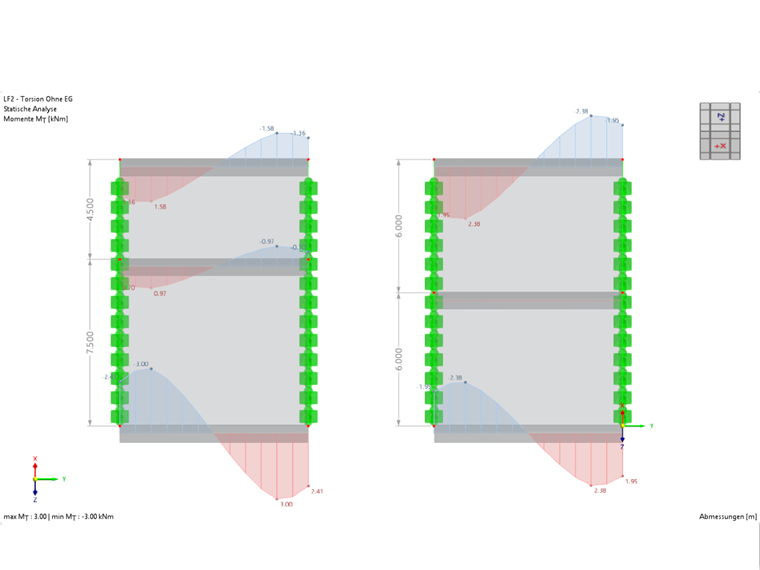
The larger the cross-sections of the downstand beams or the stiffer they are, the greater the transferred torsion is, as the structure cannot absorb the deformation caused by constraints in a “soft” manner.
It is possible to neglect the existing torsion in the design. This is done directly via the ultimate limit state settings of the members concerned.