


1. Introduction
In many engineering CFD simulations, particularly in external aerodynamics and wind engineering applications, near-wall turbulence is commonly modeled using standard wall functions rather than resolving the viscous sublayer directly. A typical example is the nutkWallFunction used in OpenFOAM (and applied in RWIND), which estimates the turbulent viscosity at the wall based on the logarithmic law of the wall and empirical turbulence modeling assumptions. This modeling strategy allows simulations to be performed with relatively coarse meshes, leading to a significant reduction in computational cost and simulation time, which is practical for large-scale engineering problems such as buildings, bridges, and urban wind simulations.
However, the simplifications introduced by standard wall functions also impose important limitations on the accuracy of near-wall flow prediction. These limitations can influence quantities such as wall shear stress, boundary-layer development, and local pressure distributions, and therefore must be carefully considered when interpreting aerodynamic results, assessing model accuracy, or conducting validation studies against experimental data.
This article discusses the key consequences and technical implications of using standard wall-function approaches in aerodynamic CFD simulations under the assumption of very high y⁺ values that lie outside the recommended or accepted range. It also highlights the situations in which this modeling strategy is appropriate, as well as cases where its limitations may affect the reliability of the results.
2. Background: Wall Functions in Aerodynamic CFD
Near solid walls, turbulent boundary layers contain multiple regions:
- Viscous sublayer (low 𝑦+)
- Buffer layer
- Logarithmic region (high 𝑦+)
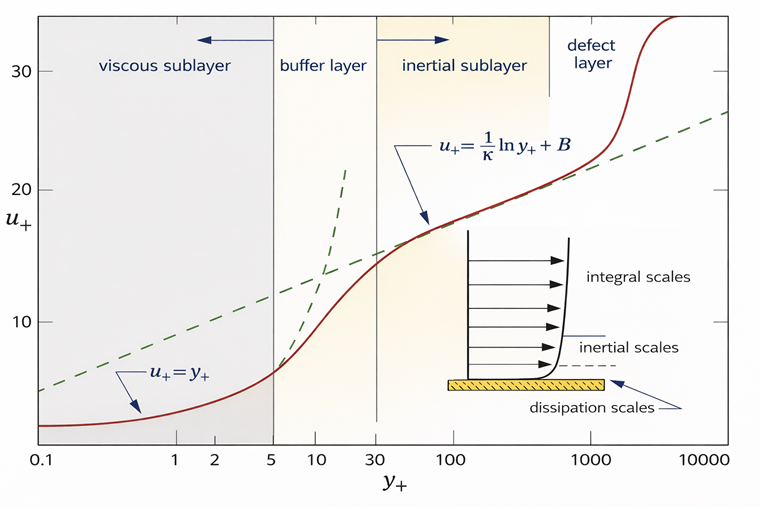
Standard wall functions assume:
- The first computational cell lies within the logarithmic region (typically 𝑦+>30).
- The near-wall velocity profile follows the logarithmic law of the wall.
- Turbulent viscosity and shear stress are estimated using empirical relations instead of resolving small-scale flow structures.
This modeling strategy is widely used in:
- External aerodynamics
- Wind engineering simulations
- Large-scale environmental flow simulations
because it allows stable solutions with relatively coarse meshes.
3. Advantages of the Current High-y⁺ Wall-Function Approach
The use of standard wall functions with high 𝑦+ values offers several practical benefits for engineering CFD simulations. By avoiding the need to resolve the viscous sublayer, this approach allows the use of coarser meshes, resulting in reduced computational cost and faster simulations while still capturing the overall flow behavior relevant for many large-scale aerodynamic studies.
- High computational efficiency
Allows the use of relatively coarse meshes near walls, significantly reducing the number of computational cells and simulation time.
- Reduced computational cost
Avoids the extremely fine mesh required to resolve the viscous sublayer (𝑦+≈1), which would dramatically increase CPU and memory requirements.
- Suitable for large computational domains
Efficient for simulations involving large-scale environments such as urban areas, terrain models, and complex building clusters.
- Numerical robustness and stability
Standard wall-function approaches are generally less sensitive to mesh irregularities and tend to produce stable solutions for complex geometries.
- Efficient for parametric studies
Enables fast comparison of multiple design alternatives, building orientations, or environmental conditions.
- Well suited for early-stage design studies
Provides rapid aerodynamic insight during conceptual design phases when detailed boundary-layer resolution is not required.
- Effective for capturing global flow behavior
Accurately represents large-scale flow patterns such as wake regions, flow acceleration zones, and general wind distribution.
- Practical engineering compromise
Balances computational efficiency and acceptable engineering accuracy when the main interest is overall aerodynamic behavior rather than detailed near-wall physics.
4. Key Disadvantages in Aerodynamic Simulations
4.1 Reduced Near-Wall Resolution
Standard wall functions do not resolve the viscous sublayer. Consequently:
- Detailed velocity gradients close to the wall are not captured
- Near-wall turbulence structures are approximated rather than computed
- Local flow physics may be oversimplified
This limitation directly impacts aerodynamic accuracy when wall-bounded effects dominate.
4.2 Inaccurate Wall Shear Stress and Skin Friction
Wall functions estimate wall shear stress from empirical log-law relationships. This may cause:
- Errors in skin friction drag
- Reduced accuracy in total drag prediction for streamlined bodies
- Inaccurate shear stress distribution along surfaces
For aerodynamic performance analysis, these deviations can be significant
4.3 Limitations in Predicting Flow Separation
Wall functions assume equilibrium boundary layer behavior, which becomes invalid in:
- Strong adverse pressure gradients
- Rapid flow deceleration
- Complex geometry-induced separation
Typical consequences include:
- Incorrect prediction of separation onset
- Errors in reattachment location
- Inaccurate wake structure
Since separation strongly influences aerodynamic forces, this represents a major drawback
4.4 Reduced Accuracy in Wake and Recirculation Regions
Because near-wall turbulence is not fully resolved:
- Shear layer development may be inaccurately modeled
- Recirculation zones may be incorrectly sized
- Vortex structures may be overly diffused
This affects aerodynamic load estimation and flow visualization
4.5 Sensitivity to y⁺ Placement
Wall-function validity depends on appropriate placement of the first near-wall mesh cell:
- High 𝑦+ → log-law valid
- Low 𝑦+ → assumptions break down
- Intermediate 𝑦+ (buffer region) → modeling uncertainty increases
Poor mesh design can therefore introduce hidden errors even when simulations appear numerically stable.
4.6 Limited Capability for Transitional Flows
Standard wall functions assume fully turbulent flow conditions. As a result:
- Laminar-to-turbulent transition cannot be captured accurately.
- Boundary layer development may be misrepresented.
This is important for aerodynamic applications involving:
- Low turbulence intensity
- Smooth surfaces
- Airfoil flows
4.7 Reduced Accuracy for Local Pressure Peaks
Empirical wall modeling may smooth pressure gradients near surfaces, leading to:
- Underprediction or overprediction of peak pressure coefficients
- Reduced accuracy in local load assessment
- Potential errors in structural design loads
4.8 Dependence on Empirical Log-Law Assumptions
Wall functions rely on simplified empirical models that assume:
- Fully developed turbulent boundary layers
- Smooth flow development
- Moderate pressure gradients
When real aerodynamic conditions deviate from these assumptions, accuracy decreases
5. Engineering Trade-Off: Accuracy vs Efficiency
Despite the disadvantages, standard wall functions remain widely used in engineering CFD because they provide several important practical benefits:
- Improved numerical stability
- Reduced mesh requirements
- Lower computational cost
- Greater accessibility for engineering applications, allowing simulations to be performed within realistic time and resource limits
In practical engineering workflows, extremely high-resolution simulations that fully resolve the viscous sublayer are often computationally very expensive and not always feasible for routine design tasks. Therefore, wall-function approaches represent not only a trade-off between accuracy and cost, but also a practical modeling strategy that makes aerodynamic simulations accessible for everyday engineering applications. As also highlighted in the article, highly detailed and computationally intensive simulations are often not yet practical in typical engineering projects where time and computational resources are limited.
For these reasons, standard wall-function approaches are often acceptable for:
- Flow visualization
- Early-stage design studies
- Conceptual aerodynamic assessment
- Topographic or terrain-related wind studies
- Global load estimation
However, they may not be suitable for applications where detailed near-wall flow physics are critical, such as:
- Peak pressure calculations
- Local façade pressure design
- Transient simulations involving detailed flow fluctuations
- Local effects near sharp edges or corners
- Precise separation and reattachment analysis
Table 1 classifies aerodynamic CFD applications according to their suitability when using a high-𝑦+ standard wall-function approach where the viscous sublayer is not resolved. Applications focused on global flow behavior are recommended, some analyses requiring moderate accuracy are conditionally recommended, while studies that depend on detailed near-wall physics are not recommended.
Table 1: Applicability of RWIND Aerodynamic CFD Simulations Under High-y⁺ Standard Wall-Function Assumptions
| No | Application | Main Objective | Recommendation | Technical Justification |
|---|---|---|---|---|
| 1 | Global wind loads on buildings | Overall forces and moments | 🟢 Recommended | Dominated by large-scale pressure distribution; detailed wall shear resolution less critical |
| 2 | Façade design | Cladding pressure zoning | 🔴 Not Recommended | local peak pressures near edges and corners may be underpredicted |
| 3 | Pedestrian wind comfort | Velocity at 1.5–2 m height | 🟢 Recommended | Primary focus on velocity field; near-wall shear stress has limited influence |
| 4 | Urban wind flow studies | Wind distribution in city blocks | 🟢 Recommended | Large-domain efficiency prioritized over detailed wall-layer resolution |
| 5 | Flow visualization | Streamlines and wake structures | 🟢 Recommended | Qualitative trends robust despite near-wall simplification |
| 6 | Parametric design comparison | Relative performance trends | 🟢 Recommended | Consistent modeling assumptions allow reliable comparative assessment |
| 7 | Roof uplift (mean suction) | Average roof pressures | 🟡 Conditionally Recommended | Mean suction acceptable; localized corner peaks highly mesh-sensitive |
| 8 | Bluff body mean drag/lift | Global aerodynamic coefficients | 🟡 Conditionally Recommended | Mean forces captured reasonably; separation location less precise |
| 9 | Detailed separation study | Exact separation and reattachment location | 🔴 Not Recommended | Equilibrium wall-function assumption invalid under strong adverse pressure gradients |
| 10 | Skin friction drag analysis | Friction drag breakdown | 🔴 Not Recommended | High y+ prevents accurate wall shear stress and boundary layer gradient resolution |
| 11 | Airfoil or vehicle aerodynamics | Lift and drag performance | 🔴 Not Recommended | Requires y+ approximately 1 and resolved viscous sublayer |
| 12 | Local peak pressure | Cp peaks at sharp edges | 🔴 Not Recommended | High y+ smooths pressure gradients and underestimates local extrema |
| 13 | Transient vortex shedding | Dominant shedding frequency | 🔴 Not Recommended | Fluctuation amplitude less reliable |
| 14 | Elevated terrace wind study | Local acceleration zones | 🟡 Conditionally Recommended | General trends captured; edge effects uncertain |
| 15 | Research-grade validation | Publication-level fidelity | 🔴 Not Recommended | High-fidelity validation requires wall-resolved or enhanced near-wall modeling |
6. Conclusion
Standard wall-function approaches such as nutkWallFunction provide a practical and efficient method for modeling turbulent boundary layers in aerodynamic simulations. However, the reliance on empirical log-law approximations introduces important limitations, including reduced accuracy in near-wall physics, less reliable separation prediction, and sensitivity to mesh design. Engineers should understand these disadvantages when interpreting simulation results, performing CFD validation, or comparing simulations with experimental data.