Description
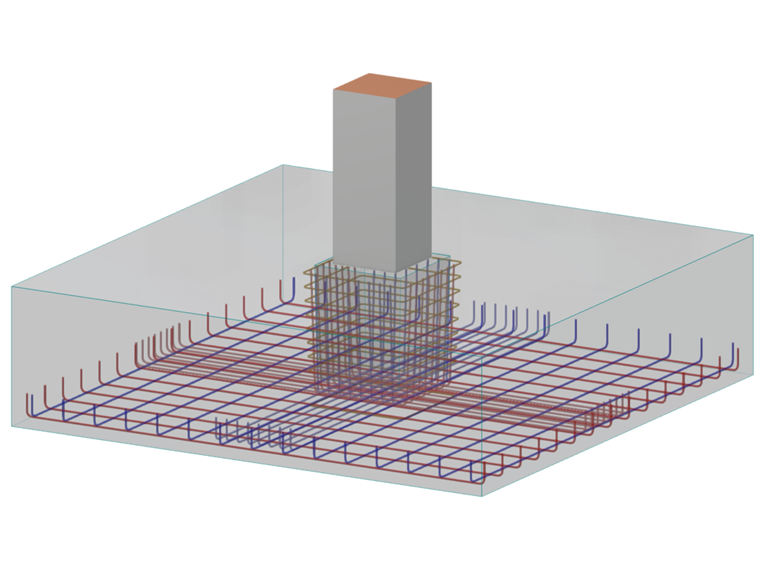
A square block foundation with rough bucket sides [1] is to be designed to support a precast reinforced concrete column, following the guidelines outlined in DIN EN 1992-1-1/NA 1.5.2.5 and 1.5.2.6. The design will take into account typical building loads, primarily permanent loads. According to the geotechnical report, the soil is non-cohesive and frost-free. It should be noted that the geotechnical design is not included in this example.
The column is constructed using concrete grade C40/50, while the block foundation is composed of concrete C30/37. The reinforcement steel used is B500B (highly ductile).
The self-weight of the slab is neglected in the bending design of the foundation. This is because the self-weight and the resulting soil pressure are in equilibrium and do not produce bending moments. The specific weight of the concrete C30/37 is therefore set at 0 kN/m².
| Materials | Concrete C40/50 | Modulus of Elasticity | E | 35000 | N/mm2 |
| Design value of concrete compressive strength | fcd | 22.667 | N/mm2 | ||
| Concrete C30/37 | Modulus of Elasticity | E | 33000 | N/mm2 | |
| Design value of concrete compressive strength | fcd | 17.000 | N/mm2 | ||
| Reinforcing steel B500S(B) | Design yield strength of reinforcement | fyd | 434.783 | N/mm2 | |
| Geometry | Column | Section width | b | 400.000 | mm |
| length | l | 1.000 | m | ||
| Block Foundation | Bucket height | h | 0.650 | m | |
| Column embedment depth | d | 0.600 | m | ||
| Column allowance - top - x-direction | atx | 75.0 | mm | ||
| Column allowance - bottom - x-direction | abx | 50.0 | mm | ||
| Column allowance - top - y-direction | aty | 75.0 | mm | ||
| Column allowance - bottom - y-direction | aby | 50.0 | mm | ||
| Loads | Permanant loads | Permanent load 1 | LC1 | ||
| Permanent load 2 | LC2 | ||||
| Imposed loads | Imposed load 1 | LC3 | |||
| Imposed load 2 | LC4 |
The applied loads for each load case acting on the column at the height of the foundation are described in the table below:
| Load Case | Type | Fx | Fz | My |
| [kN] | [kN] | [kNm] | ||
| LC1 | Permanent | 40.0 | 460.0 | 84.0 |
| LC2 | Permanent | 0 | 1350.0 | 20.3 |
| LC3 | Variable | 44.0 | 518.0 | 95.0 |
| LC4 | Variable | 44.0 | 1500.0 | 22.50 |
The example investigates the following load combinations:
| Load Combination | Assigned Load Cases |
| CO1 | LC1 and LC3 |
| CO2 | LC2 and LC4 |
Internal Forces
| Parameter | Description | Unit | Reference solution | RFEM 6 solution | ||
| CO1 | CO2 | CO1 | CO2 | |||
| VZ | Design Shear Force | kN | 1398.0 | 4073.0 | 1398.0 | 4072.5 |
| NX | Design Axial Force | kN | 120.0 | 0.0 | 120.0 | 0.0 |
| MY | Design Bending Moment | kNm | 256.0 | 61.0 | 255.9 | 61.15 |
| My,+add | Design bending moment in the Foundation Base | kNm | 352.0 | 61.0 | 351.9 | 61.15 |
| σz,min | Minimum Compressive Strength at Compressive Stress in Soil Joint | kN/m² | 77.1 | 439.0 | 77.0 | 439.0 |
| σz,max | Maximum Compressive Strength at Compressive Stress in Soil Joint | kN/m² | 234.0 | 466.0 | 234.0 | 466.0 |
| Mx,(bottom),d | Design moment in x-direction for bottom reinforcement | kNm | 535.0 | 1172.0 | 534.74 | 1171.59 |
| Mxy,(bottom),d | Design moment in y-direction for bottom reinforcement | kNm | 394.0 | 1147.0 | 393.77 | 1147.09 |
CO2 is the governing load combination for the bending design in both directions
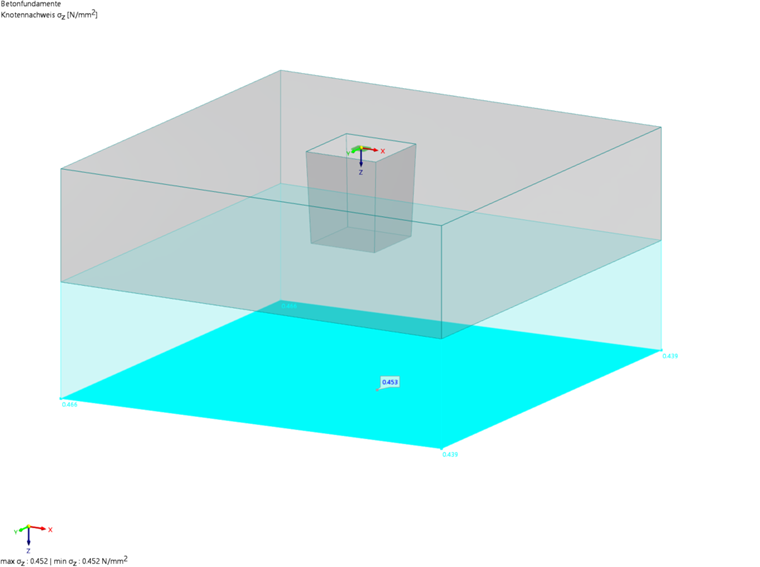
Bending Design
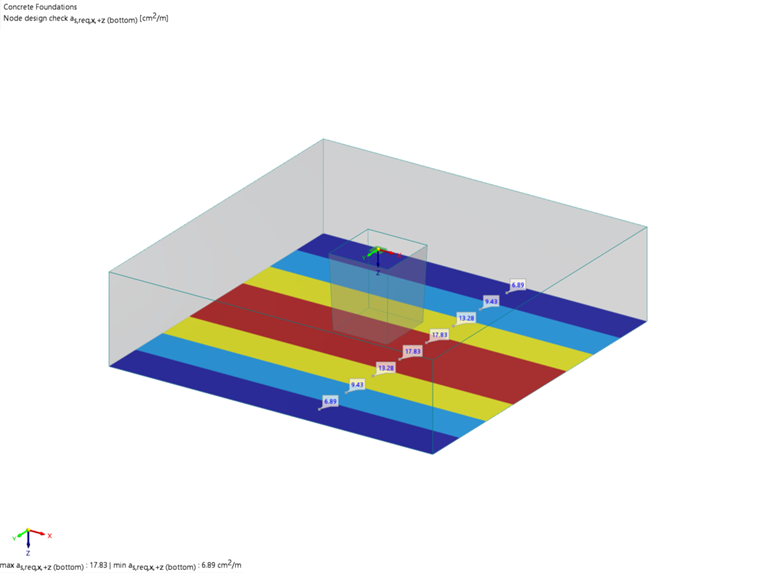
The foundation slab is divided into eight strips for each direction. The required steel cross-section per meter of each individual strip is dertermined. Further information on the definition of reinforcement areas and design strips can be found in the manuel of concrete foundations. The required reinforcement in the x-direction is summarized in the table below:
| Parameter | Description | Unit | Reference solution | RFEM 6 solution | Ratio |
| as,stat,1,x,(bottom) | Statical longitudinal reinforcement area due to bending in strip 1 | cm2/m | 6.640 | 6.890 | 1.03 |
| as,stat,2,x,(bottom) | Statical longitudinal reinforcement area due to bending in strip 2 | cm2/m | 9.500 | 9.430 | 0.99 |
| as,stat,3,x,(bottom) | Statical longitudinal reinforcement area due to bending in strip 3 | cm2/m | 13.280 | 13.280 | 1.00 |
| as,stat,4,x,(bottom) | Statical longitudinal reinforcement area due to bending in strip 4 | cm2/m | 18.030 | 17.830 | 0.99 |
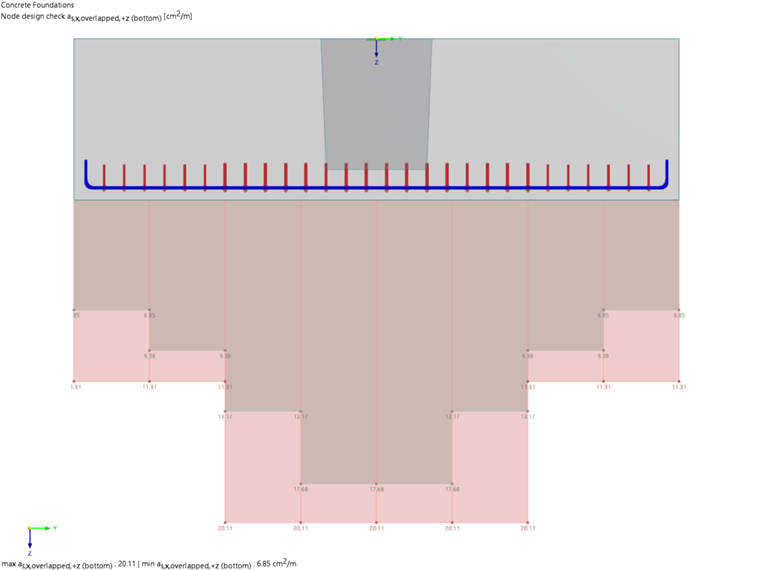
An example of a provided plate reinforcement in the x-direction is given in the table below. Three areas with different requirements for the reinforcement are defined. More information about the reinforcement distribution areas can be found in the concrete foundation manual.
| Direction | Reinforcement area | As | Width | Diameter | Spacing |
| x-direction | Area I (bottom) | 11.31 cm²/m | 0.750 m | 12.0 mm | 0.100 m |
| x-direction | Area II (bottom) | 20.11 cm²/m | 1.500 m | 16.0 mm | 0.100 m |
Area III is identical to area II.
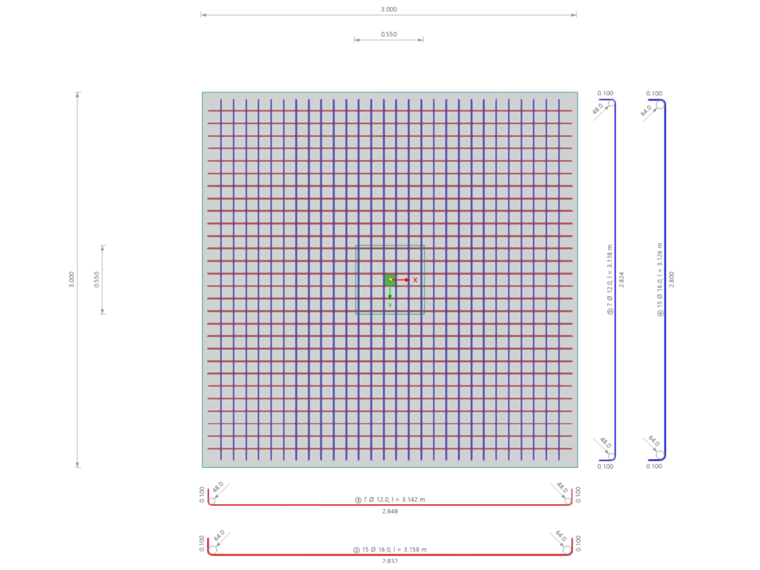
The graphic below shows the required and provided reinforcement in the x-direction:
Punching Shear Resistance
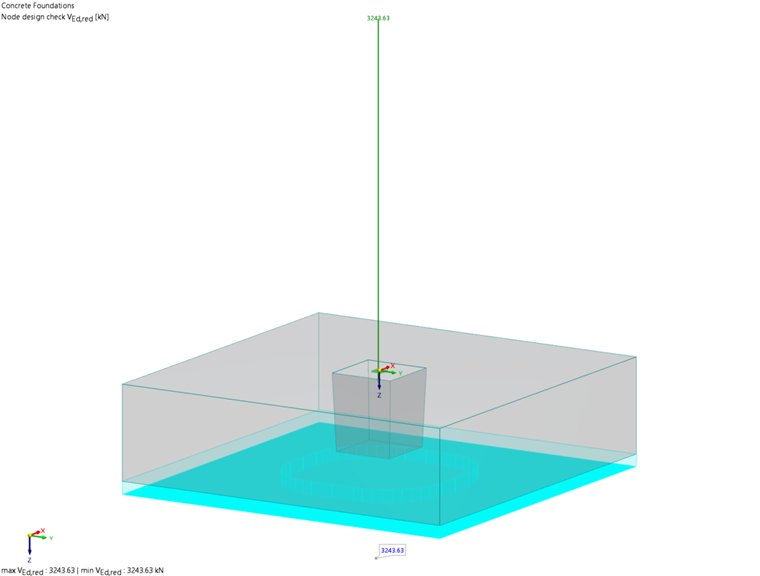
In this section, the provided plate reinforcement is adjusted to the reinforcement set in the calculation example to match the effective depth and reinforcement ratio. The distance from load application area to critical perimeter lw,it is set to 0.7 ⋅ d = 0.518m. The factor for the relieving soil stress inside the control perimeter kred is set to 1.0, meaning that the soil pressures within the punching cone are fully considered and therefore act with their maximum relieving effect.
| Parameter | Description | Unit | Reference solution | RFEM6 solution | Ratio |
| acrit (lw,it) | Distance from load application area to critical perimeter | m | 0.518 | 0.518 | 1.000 |
| u1 | Length of the critical perimeter | m | 4.855 | 4.855 | 1.000 |
| β | Factor beta | – | 1.1 | 1.1 | 1.000 |
| Acrit | Area of the critical punching perimeter | m² | 1.832 | 1.832 | 1.000 |
| ΔVEd,red | Uplift force within the punching perimeter | kN | 828.00 | 828.87 | 0.999 |
| VEd,red | Reduced maximum shear force | kN | 3243.00 | 3243.63 | 1.000 |
| vEd,red | Reduced design shear stress | kN/m² | 992.85 | 993.19 | 1.000 |
| vRd,c | Punching shear resistance without shear reinforcement | kN/m² | 820.00 | 821.04 | 0.999 |
| η | Design Ratio | 1.21 | 1.21 | 1.00 |
Punching reinforcement is therefore necessary.
The graphic below shows the soil stress inside the control perimeter and the reduced maximum shear force
Load transfer from the column to the block foundation
In the reference example, the anchorage reinforcement for transferring the load from the column into the block foundation is designed using the truss model in accordance with DAfStb Heft 399.
RFEM 6 determines the anchorage reinforcement based on the equivalent beam model, also following DAfStb Heft 399.
| Parameter | Description | Unit | Reference solution | RFEM6 solution | Ratio |
| Asw,req,B,v,x | Required reinforcement area of vertical stirrups in bucket | cm2 | 8.08 | 4.78 | 1.69 |
| Asw,req,B,v,y | Required reinforcement area of horizontal top stirrups in bucket | cm2 | 8.08 | 4.78 | 1.69 |
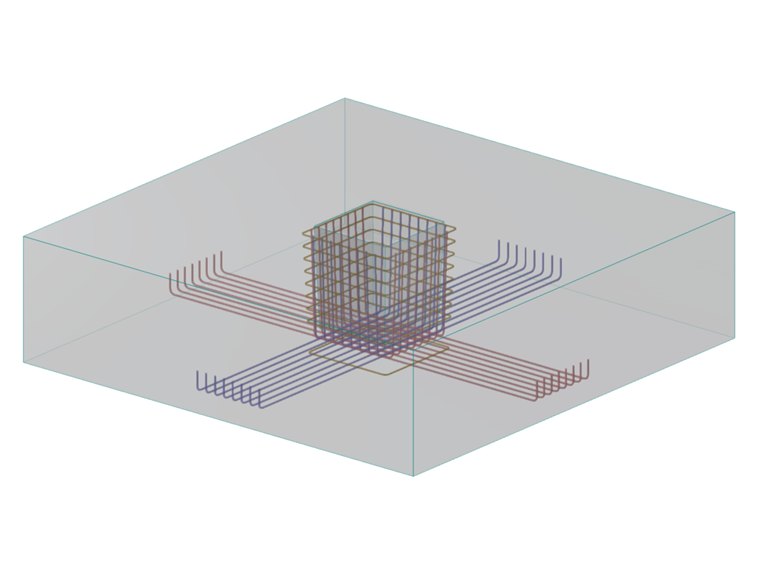
An example of the bucket reinforcement layout is shown in the figure below.
Conclusion
RFEM 6 provides reliable results for the bending reinforcement of the foundation slab. Deviations in the block anchorage reinforcement are attributed to the use of different calculation approaches: the reference example applies the truss model, while RFEM 6 uses the equivalent beam model.