Description
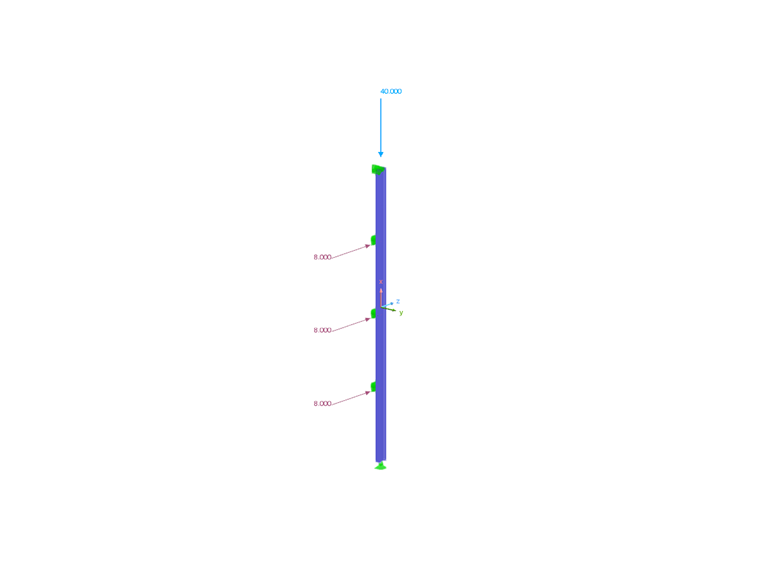
The example shows the cross-section resistance design and stability analysis according to DIN EN 1993-1-3:2010-12 [1] for a frame column.
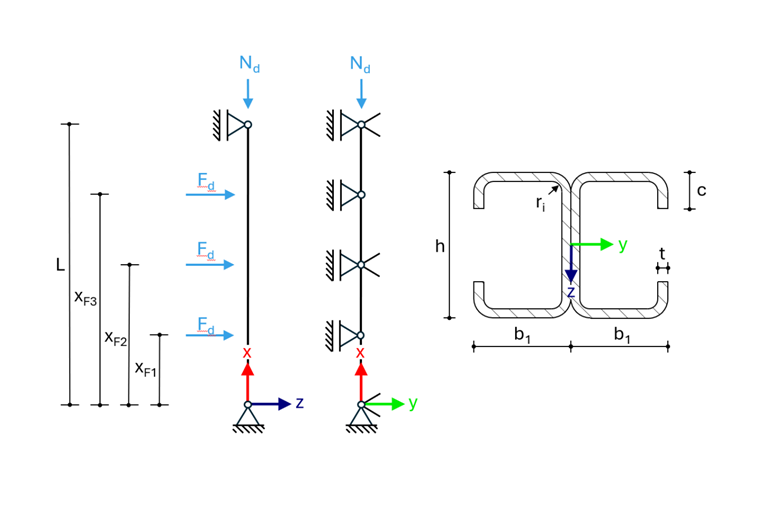
The column is designed as a simply supported beam in the z-direction. It is laterally supported in the y-direction at one-third of the column height. In addition, rotation about the x-axis is prevented in the column center.
The cross-section consists of two C-sections arranged back-to-back and connected by pairs of bolts in the web area. The connection is designed in such a way that local buckling across the entire web width is not prevented.
The column is subjected to an axial compressive force and three lateral loads.
The model is based on Example L from the design examples in ECCS-TC7 [2].
| Material | Modulus of elasticity | E | 210,000.00 | N/mm² | |
| Poisson's ratio | ν | 0.30 | |||
| Shear modulus | G | 80,769.23 | N/mm² | ||
| Basic yield strength S350GD | fyb | 350.00 | N/mm² | ||
| Partial safety factor for the cross-section resistance | γM0 | 1.00 | |||
| Partial safety factor for the component resistance against stability failure | γM1 | 1.00 | |||
| Geometry | System | Column height | L | 8,000.00 | mm |
| Distance of the load application from the base | xF1 | 2,000.00 | mm | ||
| Distance of the load application from the base | xF2 | 4,000.00 | mm | ||
| Distance of the load application from the base | xF3 | 6,000.00 | mm | ||
| Length of the rigid load application | ss | 64.00 | mm | ||
| Cross-Section | Height | h | 250.00 | mm | |
| Width of the partial cross-section | b1 | 80.00 | mm | ||
| Thickness | t | 2.50 | mm | ||
| Inner radius | ri | 5.00 | mm | ||
| Stiffening height | c | 40.00 | mm | ||
| Loads | Compressive force | Nd | 40.00 | kN | |
| Transverse load | Fd | 8.00 | kN | ||
RFEM Settings
Modeled in RFEM 6.11.0011
First-order analysis
Isotropic linear-elastic material model
Results
| Reference Value | ECCS | RFEM 6 | Deviation |
| Shear resistance according to 6.1.5 | |||
| Shear load-bearing capacity Vb,Rd | 150.90 kN | 150.90 kN | 0.00 % |
| Utilization η | 0.08 | 0.08 | 0.00 % |
| Local load introduction according to 6.1.7 | |||
| Cross-section resistance for local load introduction Rw,Rd | 59.24 kN | 59.24 kN | 0.00 % |
| Utilization η | 0.14 | 0.14 | 0.00 % |
| Combined stress from compression and bending according to 6.1.9 | |||
| Limit compressive force Nc,Rd | 551.00 kN | 518.21 kN | 5.95 % |
| Utilization η | 0.61 | 0.61 | 0.00 % |
| Combined stress from bending and local load introduction or support reaction according to 6.1.11 | |||
| Moment resistance Mc,Rd | 59.94 kNm | 59.93 kNm | 0.02 % |
| Utilization η according to (6.28c) | 0.54 | 0.54 | 0.00 % |
| Flexural buckling about y-axis according to 6.2.2 | |||
| Elastic critical buckling load Ncr,y | 700.14 kN | 700.10 kN | 0.01 % |
| Load-bearing capacity for flexural buckling Nb,y,Rd | 409.04 kN | 393.57 kN | 3.78 % |
| Flexural buckling about z-axis according to 6.2.2 | |||
| Elastic critical buckling load Ncr,z | 2001.65 kN | 2001.63 kN | 0.00 % |
| Load-bearing capacity for flexural buckling Nb,z,Rd | 481.10 kN | - | - 1) |
| Torsional buckling and lateral-torsional buckling according to 6.2.3 | |||
| Elastic critical buckling load Ncr,T | 924.29 kN | 939.24 kN | 1.62 % |
| Load-bearing capacity for torsional buckling or lateral-torsional buckling Nb,T,Rd | 408.57 kN | 393.33 kN | 3.73 % |
| Bending and centric compressive force according to 6.2.5 | |||
| Ideal elastic critical moment for lateral-torsional buckling Mcr for destabilizing effect of transverse loads | 133.18 kNm | 222.07 kNm | 66.74 % 2) |
| Utilization η | 0.81 | 0.77 | 4.93 % |
1) The load-bearing capacity for flexural buckling is not calculated, as the flexural buckling design may be omitted according to EN 1993-1-1, 6.3.1.2(4).
2) The ideal elastic critical moment for lateral-torsional buckling is calculated in [2&# 93; is calculated for a simplified structural system according to ENV 1993-1-1:1992, Appendix F, Table F.1.1. In RFEM, however, the calculation is performed using an eigenvalue analysis on the real structural system, which results in a higher ideal elastic critical moment for lateral-torsional buckling.