General Project Presentation
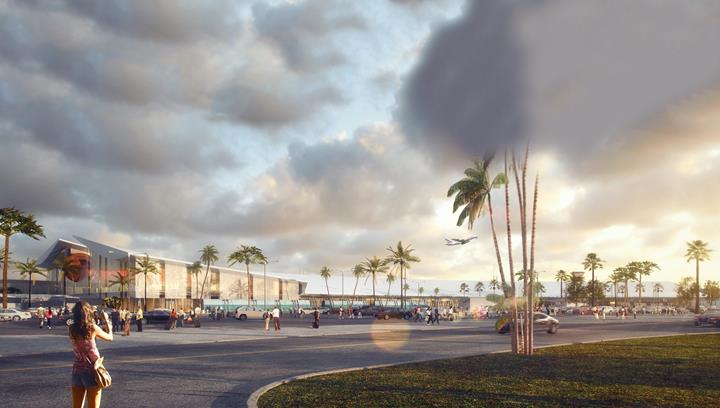
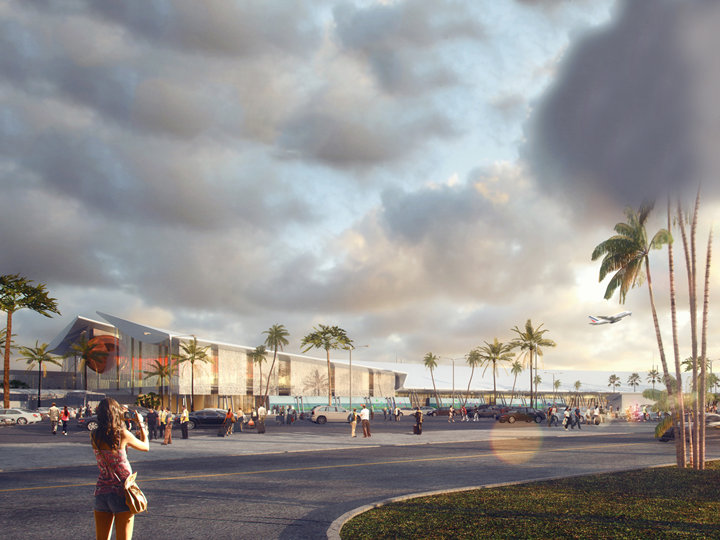
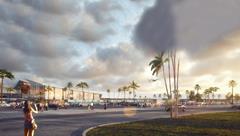
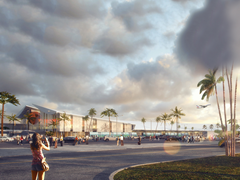
The airport extension features an architectural approach designed to blend seamlessly into the existing environment. The original building was designed to evolve, and this extension allows it to reach its full potential. The designers have gone beyond continuity by rethinking the entire project in light of the geographical, cultural, and historical specificities of Martinique, which were absent from the original design. This is the challenge of the architectural approach.
As a result, the functional organization of the site has been completely redesigned. The linearity of the original layout has been abandoned in favor of a looped organization, optimizing passenger and luggage flows, and increasing the space available for security checks, check-in counters, and sorting systems. This new configuration gives a more seamless and coherent layout, while restoring the large central hall's spatial and symbolic identity. The project also introduces a striking feature: a monumental red sphere, evoking Mount Pelée, dear to Aimé Césaire, becomes an iconic visual signal, visible from the ground and from the sky. It embodies the imagination of the place and connects the project to the poetic and territorial memory of the island.
Technical Details and Modeling
The extension project faces numerous technical challenges due to the connection between new structures and the existing building, as well as the extreme seismic conditions of the site. Two major areas were given particular attention: the east extension, which is a new building but immediately adjacent to the existing terminal, and the elevation of a part of the original building, which had been planned since the initial design in the 1990s, but had not been built until now.
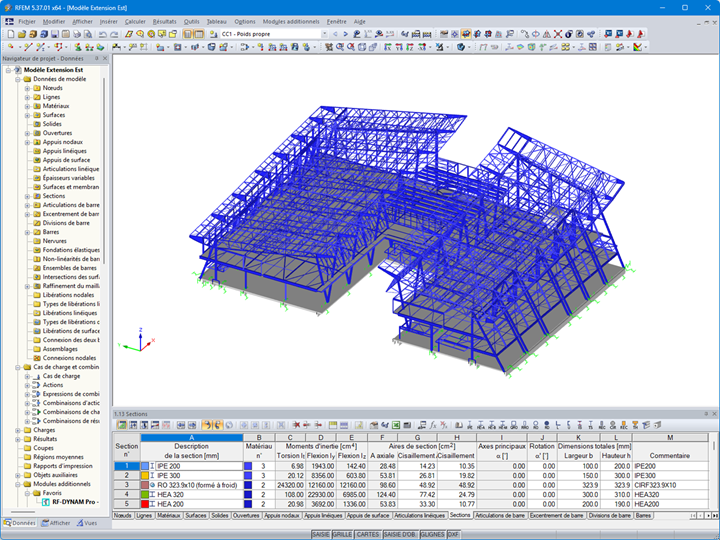
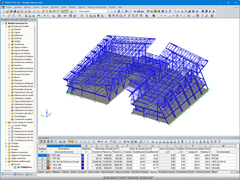
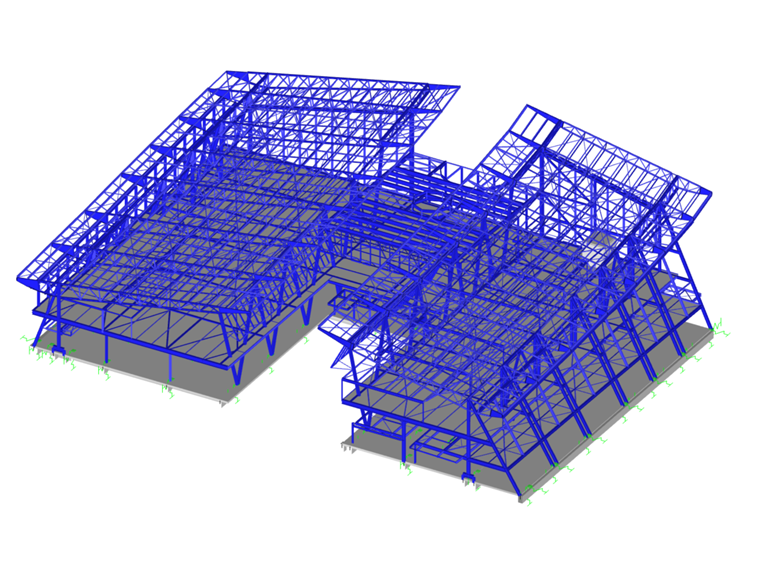
Detailed structural models were developed for both interventions. For the extension, the geometry of the frame structure was generated from wireframe models derived from the architectural models, which were accurately converted into elements that could be used by the engineering tools.
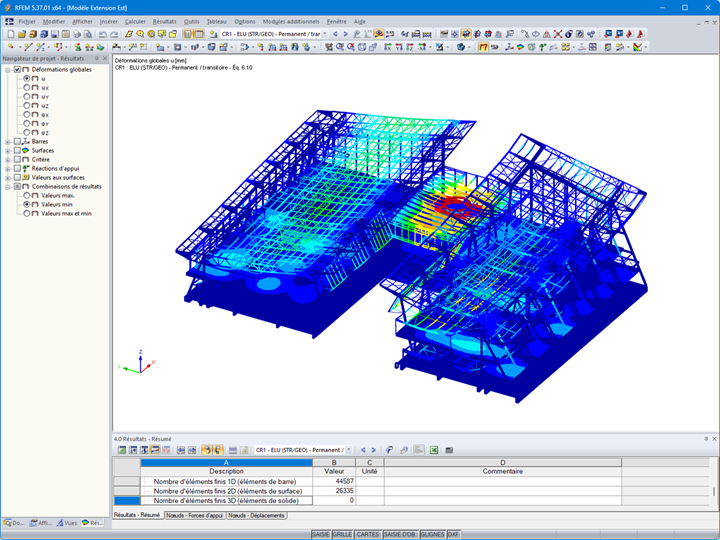
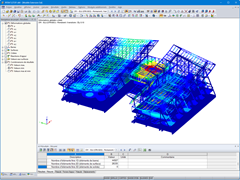
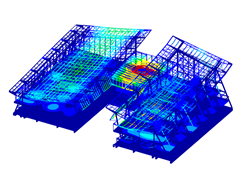
The existing structure was remodeled based on the DOE and a point cloud file. Each structural substructure was analyzed using an iterative dynamic analysis method, gradually refining the support stiffness based on the structural responses obtained. This method proved essential to achieve satisfactory convergence, particularly in a context where the site is classified as Seismic Zone 5, Importance Category IV, and rests on Class D soil.
Furthermore, the nature of the equipment itself requires large, unobstructed interior spaces, which severely constrained the positioning of the stability elements. Their integration therefore had to meet a dual requirement of mechanical performance and functional usability. Due to the large size of the structure and the high number of structural elements modeled, calculation times became a critical factor. Managing this complexity required fine-tuning of the numerical simulations and structuring the models using element groups to optimize the computer processing.
In the existing building, certain areas are reinforced using solid bars (Detan/Halfen system) Ø52 mm acting in pure tension. The design of these rebars in the context of the new extensions required non-linear calculations to guarantee their behavior under the modified seismic conditions.
Finally, the overall strength analysis of the existing structure after the construction work required a number of models to be created, incorporating regulatory changes that had come into effect since the building was originally constructed. These models covered a wide range of conditions: variation in response spectra, adjustment of the behavior coefficients of metal and concrete materials, and recalculation of deep foundations. This comprehensive approach resulted in a rigorous design that complies with all regulations.
Calculation Tools
RFEM software was used for modeling and design of the entire project. It was used to accurately address the geometric complexity of the building, the interactions between new and existing structures, and the constraints associated with the high seismicity of the site, which is classified as Zone 5. Several add-on modules were used in a targeted manner. The RF-DYNAM Pro add-on module was used to perform modal analysis and seismic design according to Eurocode 8, with a detailed definition of response spectra adapted to local conditions. The steel structures were designed using RF-STEEL EC3. The model was structured into different sections, structural element groups were used, and the mesh was optimized to keep calculation times down without compromising the accuracy or regulatory compliance of the results.
Conclusion
The Aimé Césaire Airport extension project is an engineering and architectural challenge that combines functional, technical, and cultural issues. This large-scale project, carried out in a difficult environment, demonstrates that it is possible to combine operational continuity, innovative construction, and regional integration to create a sustainable, efficient, and symbolically powerful airport.
| Location | Airport Martinique Aimé Césaire BP279, Le Lamentin 97285, Martinique France |
| Project Management | SAMAC (Martinique Aimé Césaire airport operating company) Frantz Thodiard, Chief Executive Officer |
| Client | Inso et Condotte d’Acqua Joint Venture |
| Project Management | Architect: AIA Architectes Engineering: AIA Ingénierie |
| Local Engineering Office | CETE Ingénierie |