


This blog post is about the Duge Bridge in China. Together, we will take a closer look at this exciting structure. We take a look at the specifics and challenges of such an extreme construction project. For the Duge Bridge in China is the highest bridge in the world – and undoubtedly one of the most impressive.
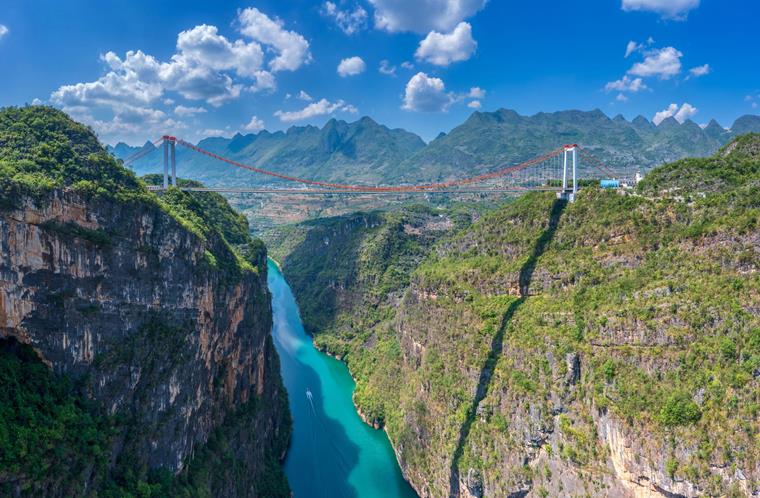
In Germany, we love our highways. It takes no time at all to get to your mother-in-law's and back; at Easter and Christmas they enable us to have extensive family gatherings. Long distances are covered quickly. But highways are extremely important, especially for our economy. It is no different in China. And where highways alone are not enough to connect places with each other, bridges come into play.
Because they allow you to overcome even the deepest chasms. Such as the more than 500 m (1,640 ft) deep valley in the Chinese province of Guizhou, through which the Beipan River flows. To avoid this natural barrier between the economically important cities of Liupanshui (Guizhou province) and Xuanwei (Yunnan province), a driving time of about 4 hours was necessary until 2016. After all, Southwest China is very mountainous.
But China is apparently a friend of superlatives, especially when it comes to stimulating its own economy using constructions. The plan: The People's Republic planned to build the world's tallest bridge as a part of the G56 highway with a length of 3,000 km (1,948 miles). The Duge Bridge was to connect the two important provinces of Guizhou and Yunnan, at a height of 565 m (185 ft) above the Nizhu River. The 4-hour driving time mentioned above would be reduced to 1 hour. However, building such a bridge under the circumstances—especially at this location—presented some challenges for the construction team.
Before we turn to the technical side, let's take a brief look at the history of similar structures. After all, this is not the first time a bridge like the Duge Bridge has overcome such deep chasms. The achievement of architects and engineers in bridge construction is simply impressive.
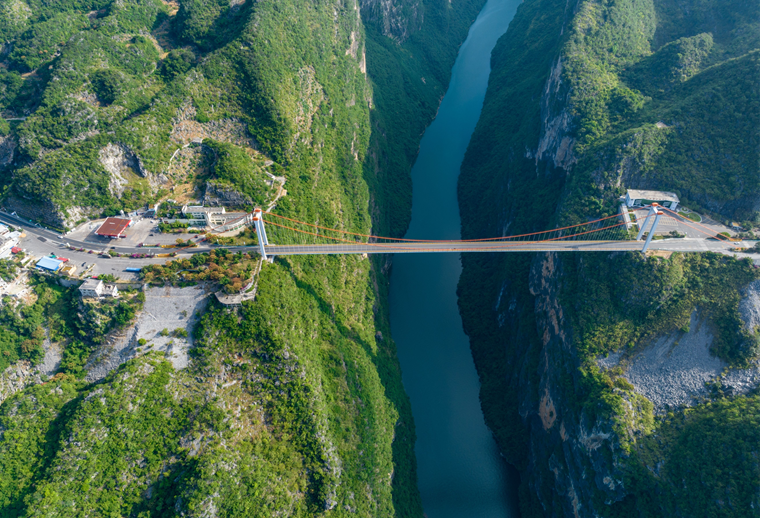
Aiming High with Bridges
Possible Inspirations for Duge Bridge
Bridges connect: cities, regions, and even entire countries. Above all, bridges connect people. What would our economy be without a single bridge? So it's understandable that even in the most difficult of environments, there should be opportunities to quickly get from A to B.
This project has always motivated the brightest and most daring minds in the construction industry to dare to build bridges that are ever more impressive. We will take a brief look at some of them below. After all, they may have been a source of inspiration for the Duge Bridge in China.
Royal Gorge Bridge (Colorado, USA)
One of the most impressive bridges is undoubtedly the Royal Gorge Bridge in the US state of Colorado. It is also one of the tallest bridges in the world. It spans the Akansas River at a height of 291 m (955 ft). The river, a tributary of the Mississippi River, is best known for its popular whitewater rafting tours.
The bridge was completed and opened in 1929 and was titled the tallest bridge in the world until 2001. Unlike the other bridges in this article, it is not used for the transport of people or goods, but it draws people from all over the world to the national park as a tourist attraction. To this day, it has a permanent place on every to-do list of vacationers in the region: Whether a walk with a view or—for all those who like it even more spectacular—bungee jumping directly above the Arkansas River.

Liuguanghe Bridge (China)
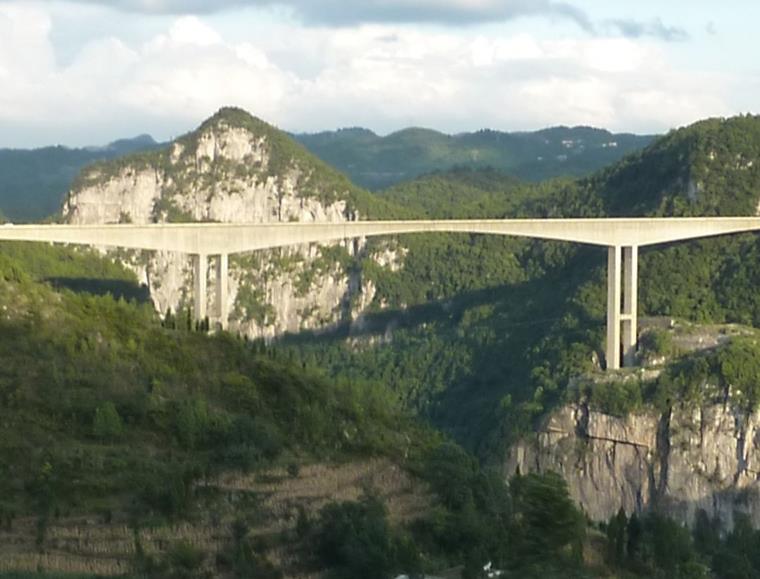
In 2001, the Liuguanghe Bridge replaced the Royal Gorge Bridge as the tallest bridge in the world. It leads a national highway over the Wu River, a tributary of the famous Yangtze River. With a width of 11 m (36 ft), it provides space for two lanes, including the emergency lane. Some people also like to use the latter as a walkway, as there is a parking lot at the southern end of the bridge.
With a length of 550 m (1,804.5 ft), it requires two pillars that were built 240 m (787.4 ft) apart and support a single-cell prestressed concrete box girder. It is true that it has not been the tallest bridge in the world since 2003, but no structure has been able to deprive it of the title "World's Tallest Box Girder Bridge".
Sidu River Bridge (China)
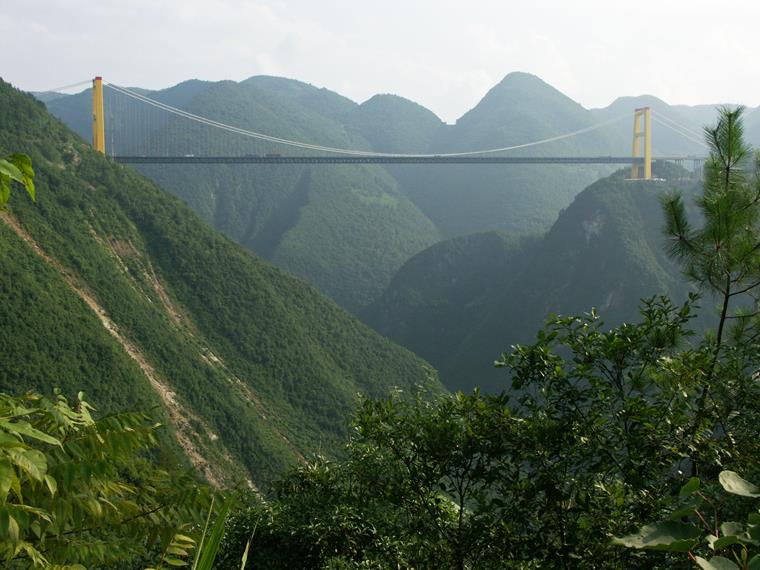
In contrast, the 1,100 m (3,828 ft) suspension bridge across a valley in the southwest of the Chinese province of Hubei through which the Siduhe River flows, is twice as long. The Siduhe Bridge was 496 m (1,627 ft) above the river bed when it opened on November 15, 2009. It became the tallest bridge in the world on November 1, 2009. For a budget equivalent to around €80 million, the G50 highway would run from Shanghai to Chongqing and connect the two cities, each with a population of millions.
The construction required some innovative tricks, because building at such a height was a real challenge. In October 2006, the first auxiliary suspension cable, with a length of 1,300 m (4,265 ft), was installed. But not with conventional methods. It was shot with a military rocket across the gorge from west to east.
Duge Bridge Above Clouds
Technical Challenges in Construction
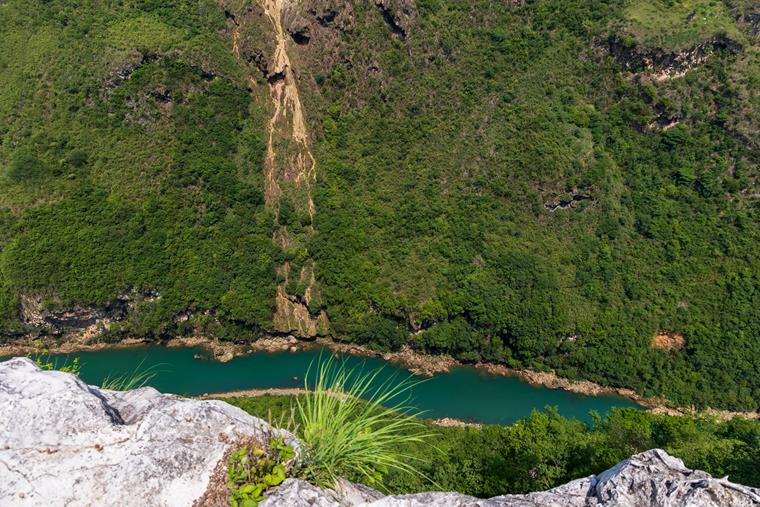
To understand why the Duge Bridge is such a masterpiece, it is worth taking a look at Beipan Canyon. Here we find beautiful, almost spectacular, surroundings. The gorge cuts a furrow almost 600 m (1,967 ft) deep into the landscape. Building a bridge here that would even carry two lanes and numerous vehicles safely across the canyon was a completely new challenge for engineering.
The first plans to implement this incredible project came together very quickly. China wanted to set new standards, as with the last two highest bridges in the world. This time, the new structure was intended to break all previous records: with a roadway located 565 m (1,854 ft) above the river bed.
To achieve this, the responsible parties decided on a prestressed concrete cable-stayed bridge. Moreover, vehicles were intended to take no longer than an hour to cross the main span of 720 m (2,365.5 ft). However, this would take a few more years. The construction of the Duge Bridge was full of challenges. We will take a closer look at these features in the following text.
Environmental Impacts of Duge Bridge Construction
The height of the deck girder was a challenge in itself. Because the concrete had to withstand the temperature changes—for decades, at best. And that is not all: The strong winds blowing in the ravine called for creative solutions in the bridge's construction.
Aerodynamic design was mandatory so that the Duge Bridge would not end up like the Tacoma Narrows Bridge in 1940. That bridge fell victim to the crosswinds and natural frequencies caused by the wind. Over 70 years later, research in construction was advanced enough to safely rule out such risks.
Let's take a small step back. At Beipan Canyon, what strikes an observer at first glance is not the temperature or the wind. But a far bigger—or harder—problem. Because in order to create enough stability, you need a proper foundation. And the pillars had to be embedded deep into the mountainside for a reliable foundation.
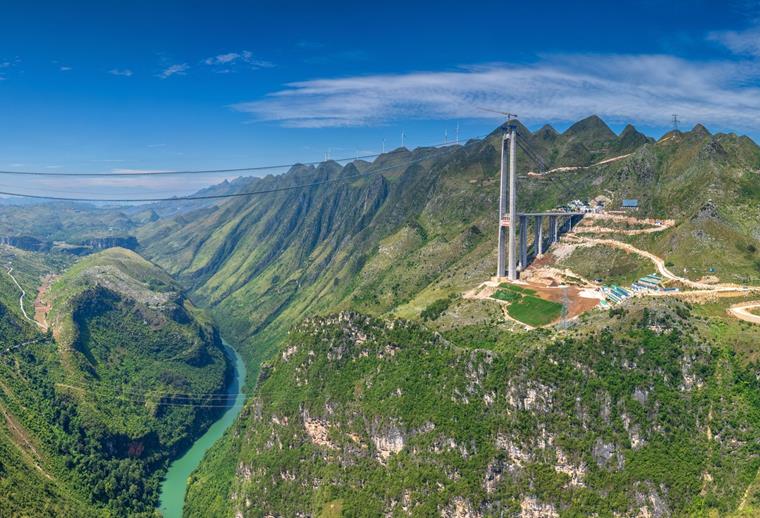
Two H-shaped reinforced concrete pylons were used, each with a height of about 269 m (985 ft), while the deck girder consists of a steel truss with an orthotropic steel deck. The entire structure is supported by 112 pairs of stay cables. 25,000 t (27,557 US t) of weather-resistant steel were used in the construction: quite a colossus.
Duge Bridge: Extreme Construction
Such an extraordinary bridge challenges even experienced engineers. In order to connect the bridge sections to each other, a cantilever construction method was chosen. The two bridge sections were assembled bit by bit, starting from the pillars towards the center.
To ensure that everything fit in the end, the responsible parties used a special technique. Using precise GPS measurement system, it was possible to guarantee that both bridge sections were aligned with each other with an accuracy of 2 mm (0.08 in). This is an impressive achievement for such a large bridge.
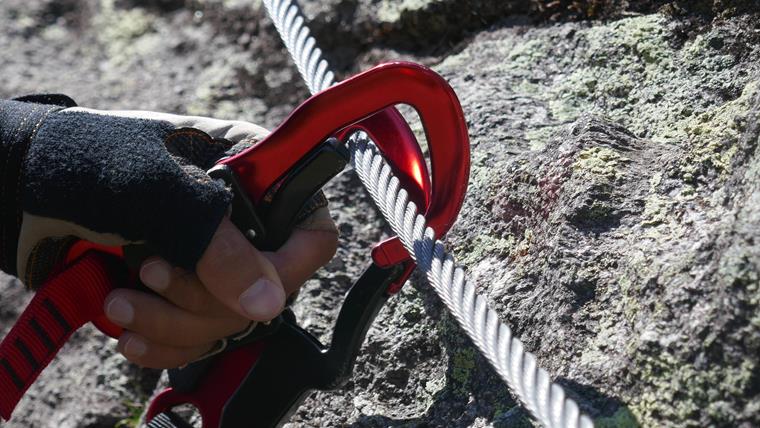
As simple as it sounds, putting a bridge together from both sides step by step towards the center: The canyon did not make it easy for the workers. Many of them had to wear special mountaineering equipment. Otherwise, they would not have been able to reach the more difficult sections.
Setting aside the high safety risks, the work on the Duge Bridge could certainly be enjoyed as well: The construction workers transported both their colleagues and the building material using zip lines and temporary rope bridges. Not for people who are afraid of heights!
Opening of Duge Bridge
After four years of construction, the Duge Bridge opened on December 29, 2016, to traffic. With a total length of 1,341 m (4,436 ft), it is undoubtedly a striking construction. And yet, it almost disappears into its surroundings, without disturbing the picturesque scene of the gorge too much.
In less than two hours instead of more than four, from Liupanshui to Xuanwei: This was a real plus for the region's economy. Exactly what the China Communications Construction Company (CCCC) invested in, at the equivalent of €130 million. For comparison: The total cost of the BER Airport in Berlin amounted to more than €7.3 billion. €770 million was invested in noise protection alone.
Earthquake: Reinforcement Test for Duge Bridge
It looked impressive when it opened. After all, the title of the world's tallest bridge is no coincidence. However, the following year, the bridge reinforcement had to undergo its first major test.
In 2017, a strong earthquake measuring 6.5 in magnitude struck the Chinese province of Sichuan. This was also clearly noticeable in Beipan Canyon, the gorge below the Duge Bridge. However, the bridge withstood the tremors without any damage. It is well prepared for the future, because earthquakes in southern China have been increasing in recent years.
Conclusion on Duge Bridge
Worthy Successor?
As of 2016, the Duge Bridge was the tallest bridge in the world. But that will change soon. Because another Chinese architectural wonder has long been waiting in the wings. But at least the title stays in the country.
The reason for this is the construction of the Huajiang Canyon Bridge in Guinzhou province. The structure is to be completed by June 2025.
With a length of more than 2,800 m (9,186 ft), it is almost twice the length of the Duge Bridge. And with the same construction time. Maybe we can learn a thing or two for Germany.
But please always observe our standards, because a normal slice of toast is 20 cm (7.8 in) in size. Everything has to be in order, right?
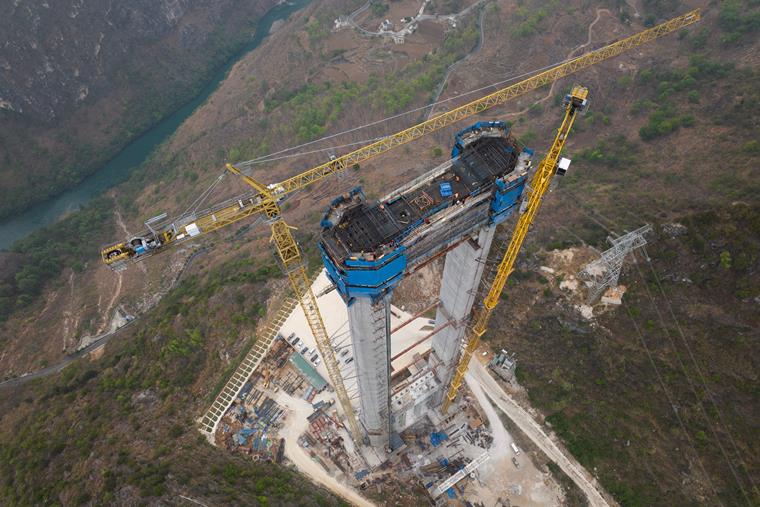
The height of the Huajiang Canyon Bridge is 625 m (2,050 ft) from the bottom of the gorge, significantly higher than that of the Duge Bridge. This undoubtedly makes it a dignified successor.
It will be difficult to obtain good pictures of this bridge as well. In the case of the Duge Bridge, many even assumed that the photos were not real, as close-ups were hard to find. However, there is a simple explanation for this:
Almost every drone, no matter how good, has crashed while taking a picture of the Duge Bridge. One should not underestimate the winds in a ravine. And probably not the creativity of certain people who sense conspiracies everywhere.
In any case, we are excited to see what China will offer us in terms of construction in the next few years. How often they want to outdo themselves and whether construction has a limit. Because if that's the case, China will probably be the first country to find out.