


In Dlubal's Building Model add-on, selecting the appropriate story type is crucial for accurately modeling a building's behavior. Each story type serves specific purposes, influencing the analysis and results. Whether you're focusing on dynamic behavior, simplifying structural complexity, or modeling secondary elements, choosing the right story type ensures precise results. This article provides an overview of the different story types available in the add-on and highlights their respective use cases.
1. Default Story Type
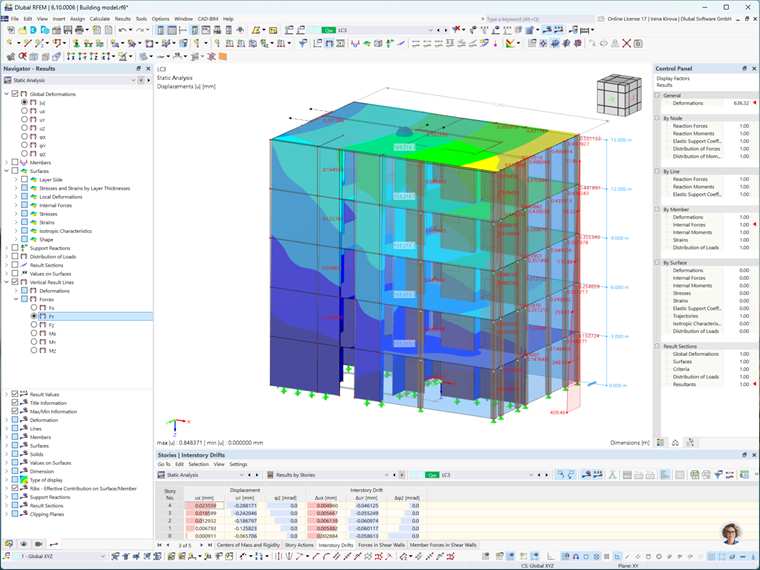
The Default story type is used when specific results, such as mass and story-by-story outputs, are required, excluding detailed local analyses of slabs and walls. It is particularly suited for general assessments of dynamic building behavior, where the primary focus is on the building's mass and performance in dynamic scenarios.
The model is analyzed using a global 3D calculation, with no partial 2D analyses for slabs and walls. This results in the creation of tables for dynamic analysis, focusing on the building's overall dynamic behavior during scenarios like seismic activity, without delving into local deformations or bending.
Real-World Scenario:
Consider a high-rise office building undergoing seismic analysis. In this scenario, the focus is on the overall building mass and how it responds to dynamic loads. The analysis is performed globally, providing a general view of the building’s dynamic behavior during an earthquake, rather than a detailed analysis of individual floor deformations. This is where the Default story type excels, as it simplifies the process and focuses on the building's mass rather than localized stiffness effects.
2. Rigid Diaphragm
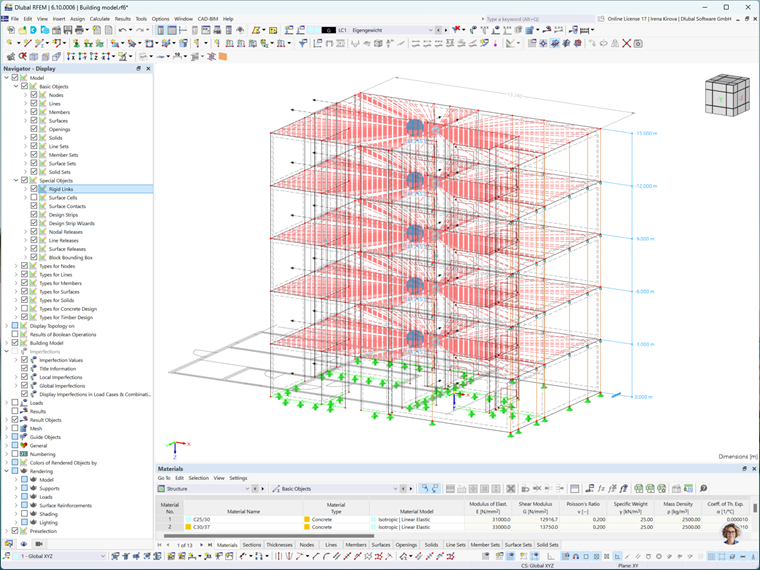
The Rigid Diaphragm story type assumes that the slabs have infinite rigidity in the 3D calculation, meaning that the results between slabs and walls are separated. It is ideal for traditional structural analysis, where floor flexibility is not a critical consideration. Rigid links are applied at each FE node, coupling the horizontal displacements. While flexibility is not captured, this type simplifies the model for a more efficient analysis.
Real-World Scenario:
Consider a multistory residential building with reinforced concrete floors. In this scenario, the floor rigidity is assumed to be high enough that the bending of slabs can be neglected for the overall structural analysis. The Rigid Diaphragm story type is chosen to simplify the model, making it more efficient for analysis while focusing on the global behavior of the structure.
3. Semi-Rigid Diaphragm
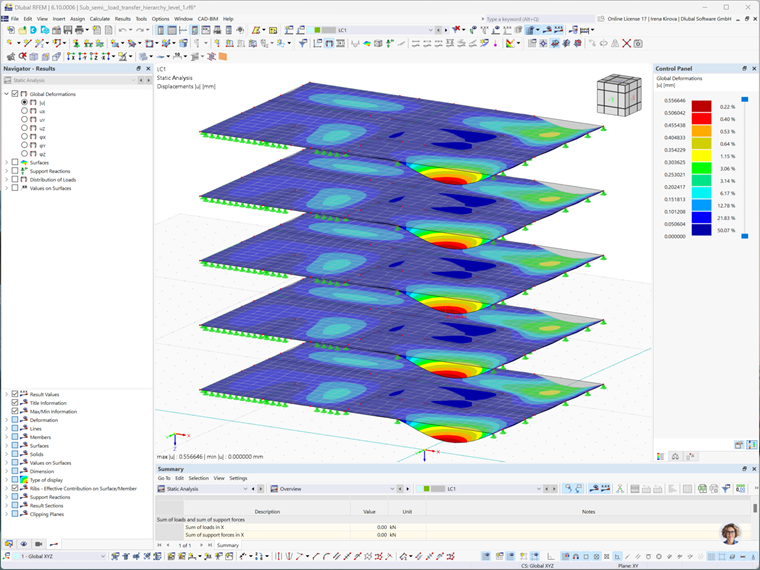
The Semi-Rigid Diaphragm story type considers the real rigidity of the slabs, reflecting the concept of a rigid diaphragm. It accounts for the flexibility of the floor in the 3D calculation, providing a more accurate representation of how the floor behaves under loads like wind or seismic forces. Unlike the Rigid Diaphragm type, the FE nodes are not rigidly coupled to the center of gravity, allowing for a more precise model.
This type is particularly useful when the stiffness and flexibility of the floor significantly influence the structural behavior. It ensures a more detailed and accurate representation of lateral forces and deformations.
Real-World Scenario:
In a mixed-use building containing both office and residential space, the floors may exhibit different levels of flexibility, especially if they are made of materials such as wood. The Semi-Rigid Diaphragm story type is particularly useful here, as it accounts for the flexibility of the floors in response to lateral forces like wind or seismic loads. This type allows for a detailed model that accounts for the flexibility of the floors, which is crucial for accurate wind load and seismic analyses.
4. Load Transfer Only Story Type
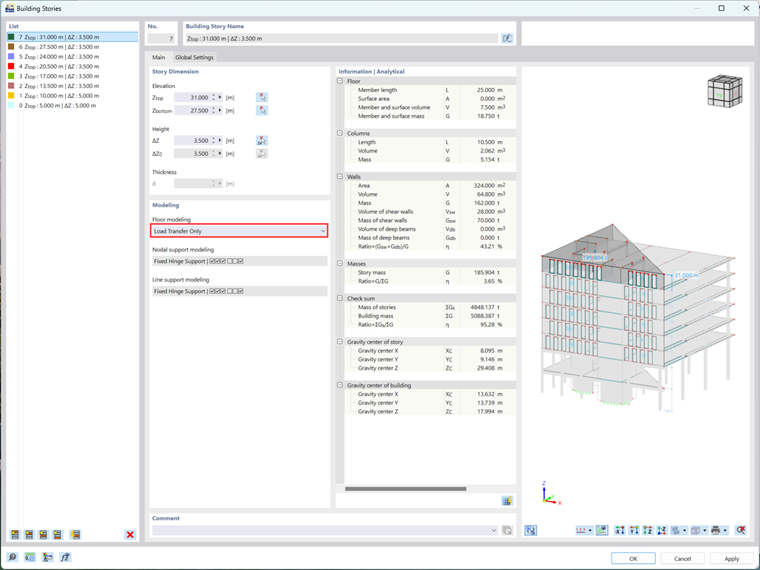
The Load Transfer Only story type assumes that the slabs do not bear loads directly, but simply transfer them to the supporting elements. This type is ideal for secondary components like bar gratings or lightweight roof panels that act as load distribution elements without contributing to the overall stiffness of the building.
In this type, the floor slab does not influence the stiffness of the building either in-plane or out-of-plane. Instead, it simply collects loads and transfers them to other elements in the 3D model, ensuring that the primary load-bearing components are not overcomplicated.
Real-World Scenario:
In the case of a stadium roof with a tensioned membrane structure, the roof itself does not resist loads directly but merely transfers the loads to the structural supports, such as the tension cables or supporting columns. The Load Transfer Only story type is suitable for modeling these secondary elements, like the membrane fabric or lightweight panels, which only act as load distribution components without contributing to the building's overall stiffness. This approach ensures that the model accurately represents the behavior of the non-structural roof elements while avoiding unnecessary complexity in the primary load-bearing components.
Flexibility in Mixing Story Types
One of the standout features of Dlubal’s Building Model add-on is the ability to mix different story types across separate stories in the model. This allows you to tailor the model to reflect different behaviors on each floor, depending on how you expect each floor to interact with the rest of the structure. For example, you might use a “Rigid Diaphragm” type for lower stories where floor flexibility is less critical, while using “Semi-Rigid Diaphragm” for upper stories that require more detailed floor behavior analysis.
Real-World Scenario:
In a high-rise building with a mix of concrete and wooden floors, the lower stories might be modeled using the Rigid Diaphragm story type due to their higher stiffness, while the upper stories with more flexible wooden floors could be modeled using the Semi-Rigid Diaphragm story type. This hybrid approach allows for an accurate representation of the building's overall behavior, ensuring both efficiency and precision in the analysis.
Conclusion
Choosing the appropriate story type in Dlubal’s Building Model add-on is essential for achieving accurate and efficient structural analysis. Whether simplifying the model with the Rigid Diaphragm type, considering floor flexibility with the Semi-Rigid Diaphragm type, or modeling secondary elements using the Load Transfer Only story type, each option is tailored for specific structural needs. Mixing story types across different floors further enhances the model, ensuring that it accurately represents real-world behavior while maintaining efficiency. By understanding the strengths of each story type, you can optimize your analysis and ensure a reliable structural model.