


Inflatable foil cushions exhibit highly nonlinear structural behavior that can only be realistically captured using appropriate numerical methods. RFEM 6 provides specialized tools for form-finding, pressure modeling, and large deformation analysis. This enables the precise simulation and reliable design of the structural behavior of pneumatic membrane structures.
1. Basics
An inflatable structure typically consists of an air-filled foil bag with internal and external stiffening elements. The shape of the pressurized foil bag depends on various factors:
- Applied pressure or the volume of air introduced into the foil cushion
- Membrane stress distribution in the foil membrane
- Local placement and design of the stiffening elements.
2. Procedure
RFEM 6 provides a significant advantage over RFEM 5 in terms of functionality. In RFEM 6, multiple shapes can be simulated simultaneously in a single model using initial conditions. This makes it easier to compare the behavior when adjusting the pressure or membrane stress distribution.
The general procedure is as follows:
- Open RFEM 6 and activate the form-finding add-on.
- Define the material properties for the surrounding foil material and the enclosed air medium.
- Model the membrane cushion geometry using membrane elements, including the stiffeners, by creating a rough approximation of the desired target geometry.
- Define a gas solid within the foil bag with a description of the atmosphere.
- Apply the form-forming loads for the form-finding process to the membrane body.
- Define the form-forming internal pressure of the foil cushion for the form-finding process using a gas pressure load.
- Apply a realistic support condition for the foil cushion body.
- Start the calculation of the load case to evaluate the desired target geometry.
- Create additional load cases, for example, snow and wind.
- Combine initial conditions with your load combinations.
3. Example
This is based on a comparison with Example 3.8 from the book [1]
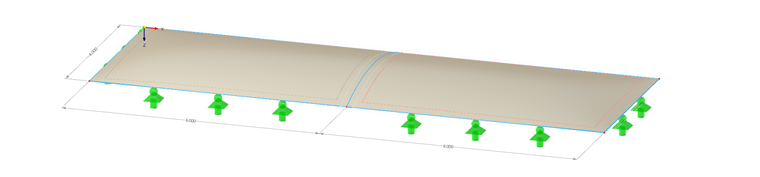
- The following foil cushion is considered:
| Span | B | 4 m |
| Length | L | 12 m |
| Material | Ex = Ey | 300 kN/m |
| Self-weight | gk | neglected |
| Internal pressure, permanent load case | pi,k | 0.3 kN/m² |
| Internal pressure, snow | pi,k | 0.6 kN/m² |
| Snow | sk | 0.52 kN/m² |
| Wind suction | ws,k | 0.78 kN/m² |
| Force | nx = ny | 1.56 kN/m (center of cushion) |
| Sag | f0 | 0.4 m (cushion center) |
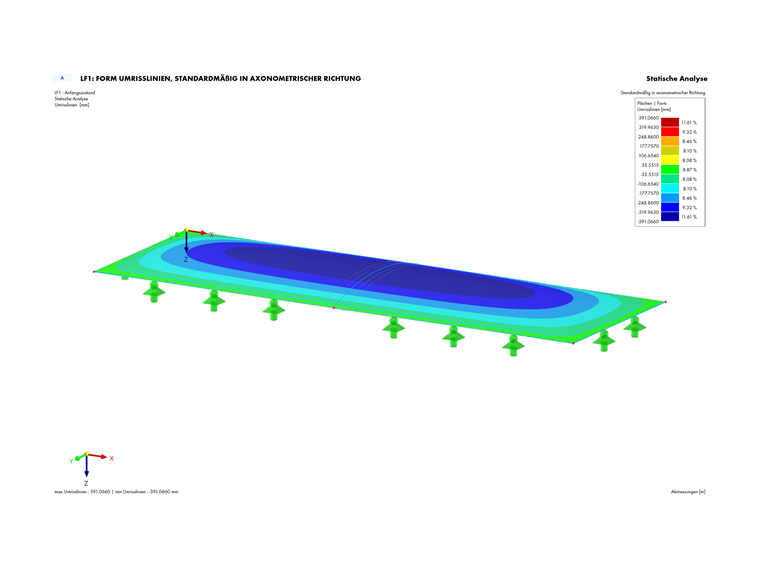
Given the force and the internal pressure, the initial shape is calculated as follows:
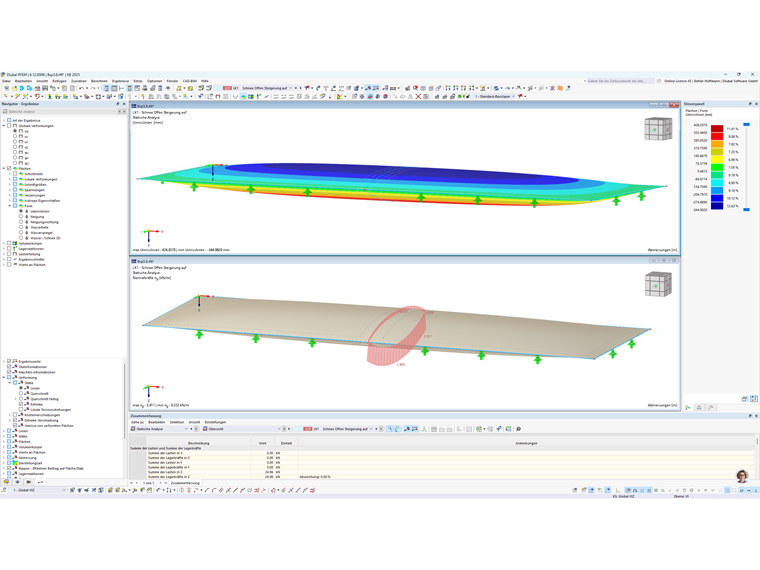
3.1 Load Combination 1: Internal Pressure and Snow, Open Solid
Here is a comparison table with the values in the literature [1].
| Results | Analytical | Numerical | RFEM 6 |
| Height ftop | 0.374 m | 0.355 m | 0.345 m |
| Force ny,top | 0.55 kN/m | 0.57 kN/m | 0.53 kN/m |
| Height fbottom | 0.434 m | 0.432 m | 0.425 m |
| Force ny,bottom | 2.99 kN/m | 2.91 kN/m | 2.91 kN/m |
The difference between the numerical solutions and the analytical solution has already been mentioned in the literature.
The numerical solution in the literature uses a simplified cable net to determine the values.
The RFEM 6 solution uses the 3D calculation model with surfaces and solids.
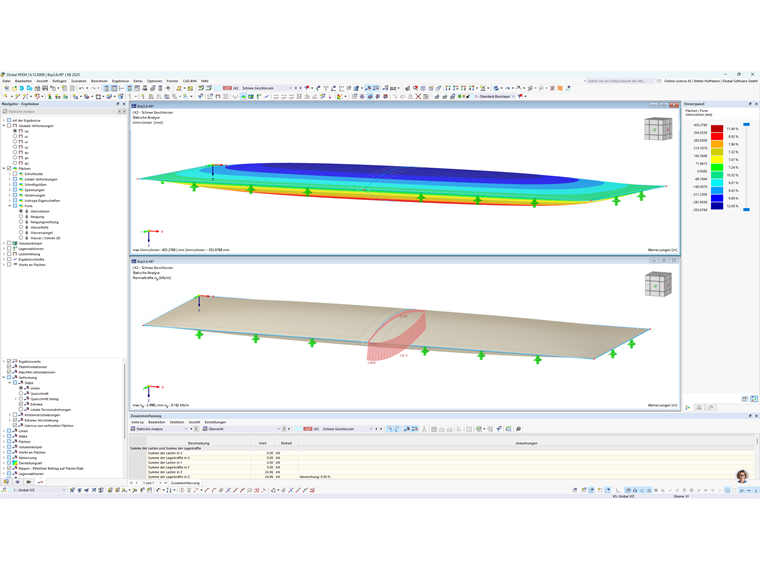
3.2 Load Combination 2: Internal Pressure and Snow, Closed Solid
Here is a comparison table with the values in the literature [1].
| Results | Analytical | Numerical | RFEM 6 |
| Internal pressure p0 | 0.3 kN/m² | 0.3 kN/m² | 0.3 kN/m² |
| Solid V0 | 2.147 m³ | 2.146 m³ | 20.10 m³ |
| Internal pressure p1 | 0.577 kN/m² | 0.579 kN/m² | 0.585 kN/m² |
| Solid V1 | 2.142 m³ | 2.135 m³ | 20.04 m³ |
| Height ftop | 0.367 m | 0.346 m | 0.352 m |
| Force ny,top | 0.32 kN/m | 0.44 kN/m | 0.40 kN/m |
| Height fbottom | 0.430 m | 0.429 m | 0.424 m |
| Force ny,bottom | 2.84 kN/m | 2.81 kN/m | 2.81 kN/m |
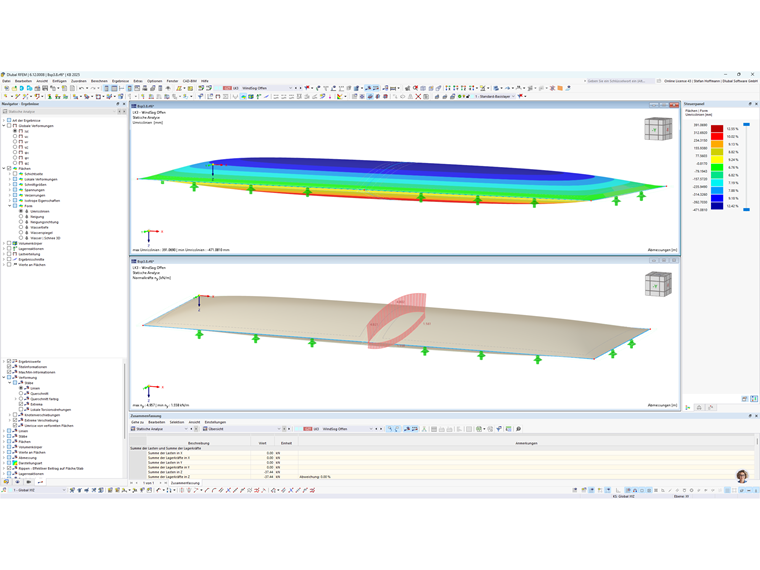
3.3 Load Combination 3: Internal Pressure and Wind Suction, Open Solid
Here is a comparison table with the values in the literature [1].
| Results | Analytical | Numerical | RFEM 6 |
| Height ftop | 0.475 m | 0.473 m | 0.469 m |
| Force ny,top | 4.80 kN/m | 4.75 kN/m | 4.80 kN/m |
| Height fbottom | 0.40 m | 0.399 m | 0.390 m |
| Force ny,bottom | 1.56 kN/m | 1.56 kN/m | 1.56 kN/m |
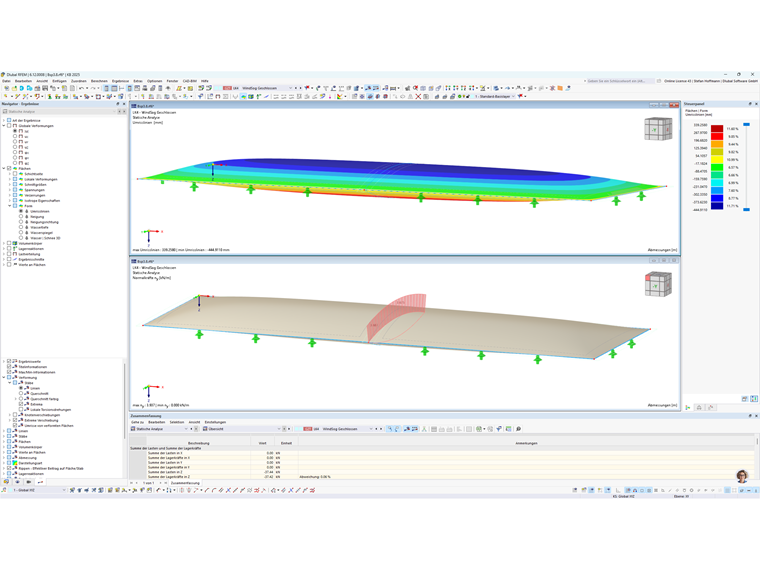
3.4 Load Combination 4: Internal Pressure and Wind Suction, Closed Solid
Here is a comparison table with the values in the literature [1].
| Results | Analytical | Numerical | RFEM 6 |
| Internal pressure p0 | 0.3 kN/m² | 0.3 kN/m² | 0.3 kN/m² |
| Solid V0 | 2.147 m³ | 2.146 m³ | 20.10 m³ |
| Internal pressure p1 | 0.02 kN/m² (negative) | 0.0 kN/m² | 0.02 kN/m² |
| Solid V1 | 2.154 m³ | 2.147 m³ | 20.16 m³ |
| Height ftop | 0.447 m | 0.448 m | 0.443 m |
| Force ny,top | 3.55 kN/m | 3.61 kN/m | 3.68 kN/m |
Evaluation
The values from our calculations appear to match those found in the literature—both analytical and numerical—with only minor deviations.
The difference in the volume is most likely due to a small error in the document, where the decimal point is off by one place.
4. Conclusion
The modeling and simulations performed show that RFEM 6 is ideally suited for the analysis of inflatable structures thanks to its powerful material models, nonlinear calculation options, and flexible boundary conditions. In particular, for foil cushions, both the structural behavior under internal pressure and the interaction between prestress, material nonlinearities, and geometric stiffness can be realistically modeled. This confirms that RFEM 6 is a reliable and practical tool for engineers who want to design, evaluate, and optimize complex pneumatic structures.
5. Outlook
The methodology presented for the calculation of foil cushions can potentially be applied to other pneumatically stabilized structures. Inflatable structures, in particular, exhibit similar fundamental physical principles: a thin-walled, flexible envelope stabilized by internal pressure and subject to highly nonlinear interactions between membrane stresses, geometric changes, and external loads.
By further developing the numerical models—for example, using advanced material laws, coupled flow-structure interactions, and more precise modeling of load cycles—even complex air-supported structures can be reliably simulated and designed. This includes both the consideration of dynamic wind loads and the analysis of pressure control concepts, leakage scenarios, and installation conditions.
This opens up a wide range of applications in which the insights gained from calculations of air-supported structures can directly contribute to the optimization, safety, and efficiency of pneumatic lightweight structures.