


When selecting a nodal support or a column joint on a reinforced concrete slab, the punching load can be derived directly from the support force or from the internal forces in the column. However, if a node at a wall corner or wall end is selected for the design check, the punching shear load cannot be determined directly from the support force or the surface internal forces in the connected walls.
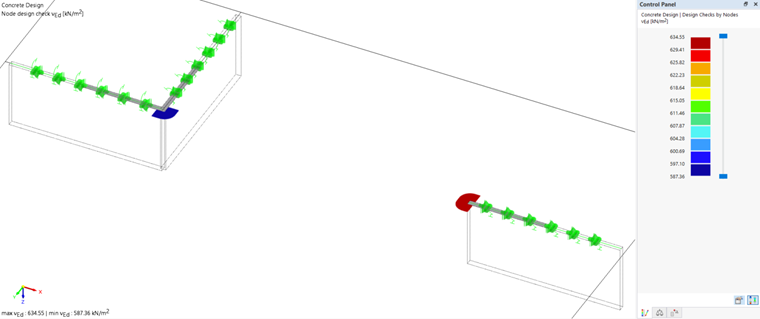
Determination of Punching Load at Wall Ends and Corners
In general, the punching shear load at wall ends and wall corners is not determined from the support forces or the surface internal forces of the connecting walls, but rather from the surface internal forces of the slab to be designed. This approach offers the advantage of largely reducing the influence of singular stress peaks in the immediate node area. At the same time, it also allows you to account for punching shear caused by pure line loads, such as those from connected wall panels.
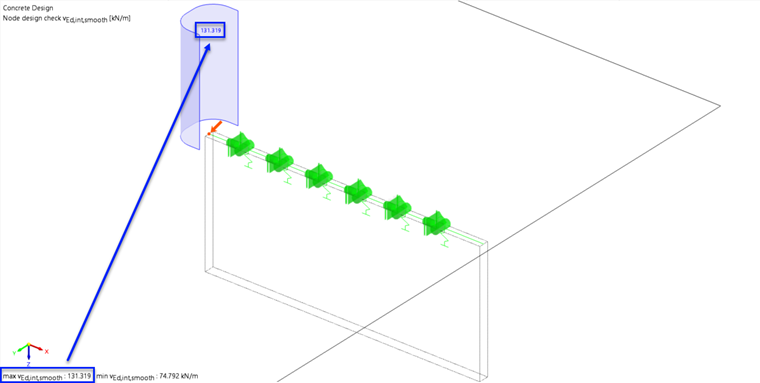
When selecting a punching point, RFEM 6 automatically creates a critical control perimeter at a distance of 2.0 d in accordance with Section 6.4.2 [1].
To determine the punching shear load, the 'Concrete Design' add-on automatically creates a cut along the control perimeter in order to evaluate the relevant surface internal forces. For the design check, the surface internal force vEd,int,smooth from RFEM is used.
By default, RFEM 6 sets the option for a “smoothed distribution of the shear force along the length of the critical perimeter” for wall ends and wall corners. In this case, the averaged distribution of the shear force over the critical perimeter is used to determine the acting shear force.
The effect of load eccentricities is then taken into account via the load-increasing factor β. RFEM 6 provides various methods for determining this factor:
- Determination via full-plastic shear distribution according to Section 6.4.3 (3) [1]
- Use of constant factors in accordance with Section 6.4.3 (6) [1]
- User-defined specification of an individual load-increasing factor
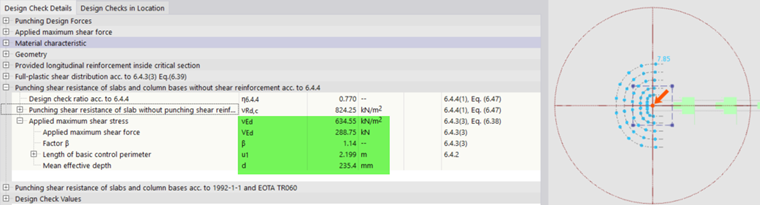
The applied shear force VEd is given by:
VEd = u1 ⋅ vEd,int,smooth
with:
- u1 = length of critical control perimeter
- vEd,int,smooth = smoothed shear force along critical perimeter
For the example shown, the result is:
VEd = 2.199 m ⋅ 131.319 kN/m ≈ 288.97 kN
Alternative Method of Verification Using vEd,int,max
Alternatively, in RFEM 6, you can select the option for an “unsmoothed shear force distribution along the critical perimeter” in the 'Concrete Design' add-on. In this case, the applied shear force VEd is determined on the basis of the maximum shear force vEd,int,max along the critical control perimeter.
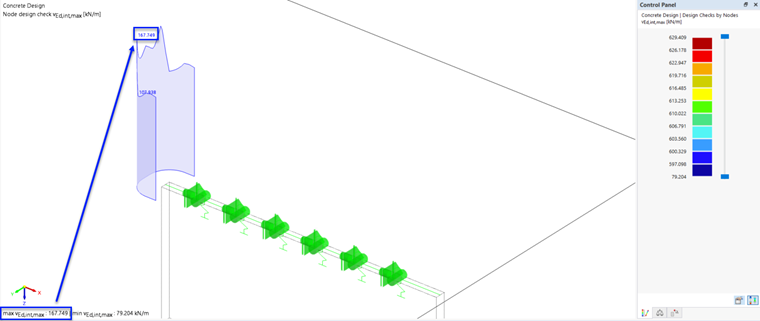
Since the maximum shear force value is already used directly in this case, no additional load-increasing factor β may be used to account for load eccentricities.