


Differential shortening between the central core and the peripheral columns is a critical design consideration when it comes to high-rise buildings of 40 and more stories. These effects can even design modifications, such as enlarging column dimensions or adding outriggers.
One effective way to mitigate column shortening is to consider the contribution of longitudinal reinforcement. This approach is not expensive, as the reinforcement is already in place. Certainly, we can add more reinforcement to further reduce column shortening.
But how is this handled in commonly used structural analysis software? First, we should understand the mechanisms of column shortening:
- Column shortening in reinforced concrete structures can be attributed to two primary components: elastic and inelastic deformations. The elastic shortening occurs immediately upon the application of load and is governed by the axial stiffness of the structural elements, which depends on both, the material properties and the cross-sectional dimensions.
- In contrast, the inelastic (or time-dependent) shortening develops gradually over time due to creep and shrinkage effects in the concrete. These phenomena lead to a progressive reduction in the effective stiffness of the columns, resulting in additional vertical deformation even under sustained loading.
Let's see how these effects are considered in common FEM software.
ETABS Approach
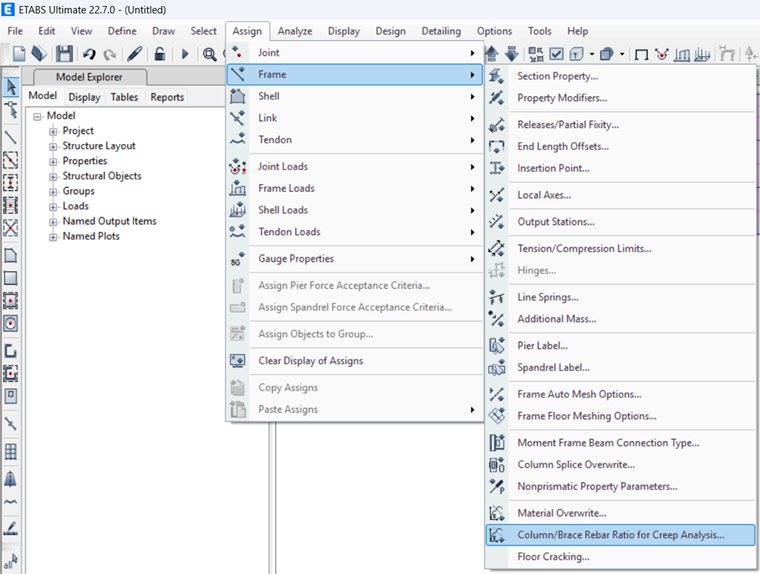
The reinforcement is not considered in the calculation of the axial stiffness of the columns, but the impact of the reinforcement on the concrete creep parameters. In other words, ETABS considers the impact of reinforcement on the inelastic part of the column shortening (see Figure below) but neglects the elastic part.
RFEM Approach
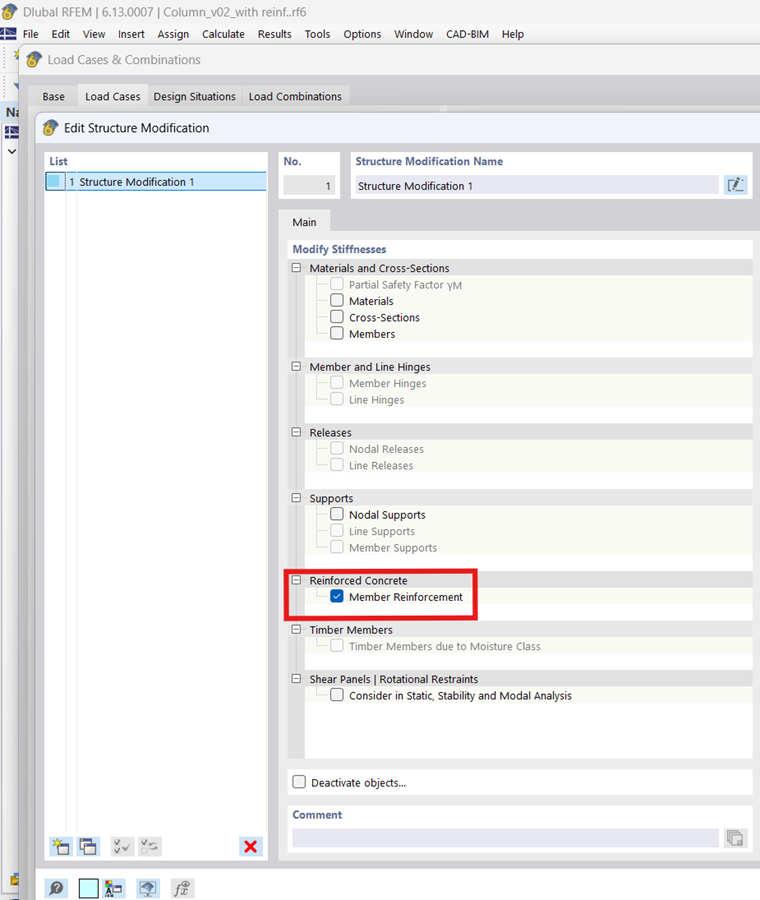
Dlubal offers a general approach by allowing users to consider reinforcement in the calculation of member stiffness (see Figure below) in RFEM 6. Columns are treated as composite sections (concrete + reinforcement) during analysis. Therefore, the impact of reinforcement on both, the elastic and inelastic components of column shortening is taken into account.
Example
To illustrate how each software deals with column shortening and to show the impact of reinforcement, a numerical example is presented.
The following parameters are considered:
- Column size: 1.0 m × 1.0 m
- Length: 10.0 m
- Concrete: C30/37
- Reinforcement: 36T32 (2.89%)
- Load: 10,000 kN
Results
1) First, an elastic analysis is done in both software to ensure that the same parameters are considered. We find exactly the same shortening in both software (3.03 mm).
2) Second, inelastic analyses are performed, taking into account the creep and shrinkage in the concrete without the reinforcement. We see that we also obtain exactly the same results (16.74 mm).
3) Last, the reinforcement is considered in the inelastic analysis. As expected, ETABS overestimates the axial deformation because it doesn't consider the reinforcement in the member stiffness as RFEM does. The difference between the results is about 56%, emphasizing the importance of considering the reinforcement in the creep estimation and in the elastic stiffness of the members.
| Type of Analysis | ETABS | RFEM |
| Elastic analysis without reinforcement | 3.03 mm | 3.03 mm |
| Inelastic analysis (creep + shrinkage) without reinforcement | 16.74 mm | 6.74 mm |
| Inelastic analysis (creep + shrinkage) with reinforcement | 14.64 mm | 9.38 mm |
Annotations
It might be possible to find an approximate method in ETABS to consider the reinforcement in the estimation of the axial stiffness of the members by changing the stiffness modifiers. Still, it's not as practical compared to RFEM, which offers a more accurate and direct approach.
It's possible to consider the axial stiffness of the reinforcement by defining an equivalent composite section in ETABS. Since shrinkage and creep are not taken into account during analysis, ETABS cannot consider the inelastic deformation then.