


In structural engineering, it's common practice to create multiple analytical models to satisfy different code requirements. One model may be dedicated to ultimate limit states (ULS) with specific stiffness assumptions; another is built for serviceability limit states (SLS) with modified stiffness. Sometimes, a third model is created to account for thermal effects, creep, cracking behavior, and other special conditions.
But what does this mean in practice?
- Engineers have to deal with multiple analytical models for the same structure, which increases the overall effort.
- Each change of the model – whether it's a section modification, load adjustment, or geometry update – requires a revision of all models.
Many users of ETABS know this workflow well. It increases the coordination workload, consumes time, and introduces the risk for inconsistencies and errors.
The smarter approach with RFEM 6
Engineers can work with a single analytical model and assign different stiffness properties for each load combination, such as for:
- Ultimate limit states (ULS)
- Serviceability limit states (SLS)
- Thermal load cases
- Other design scenarios
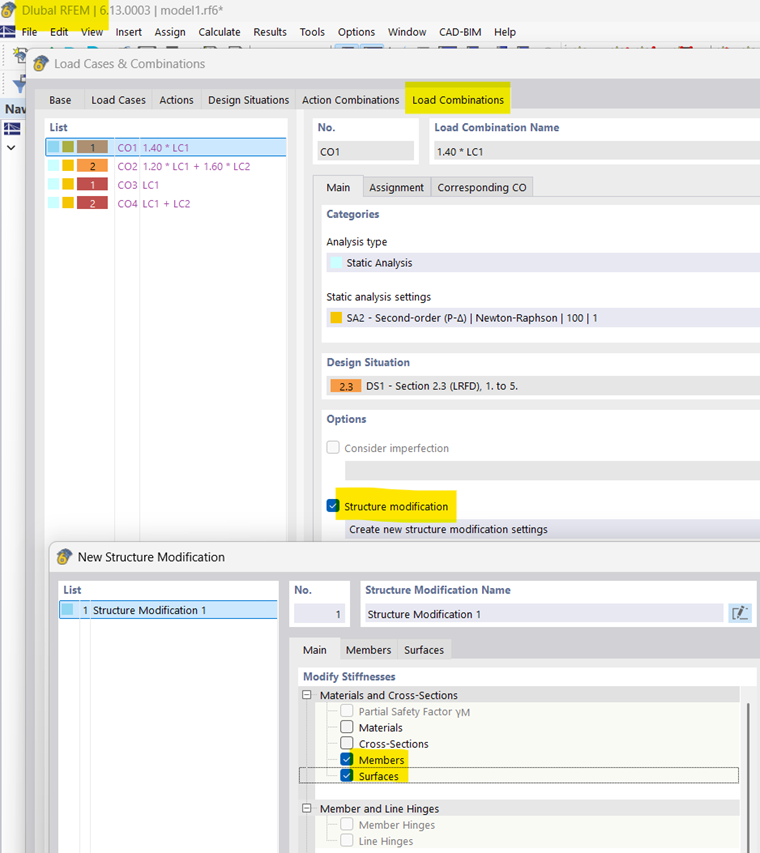
That is, one structural model satisfies all design situations, resulting in:
→ better clarity
→ fewer inconsistencies
→ reduced risk of errors
→ easier updates
Each model modification is made only once and is reflected across all design checks. In an environment where accuracy, coordination, and time management are critical, simplifying the modeling process is not just convenient – it's strategic.