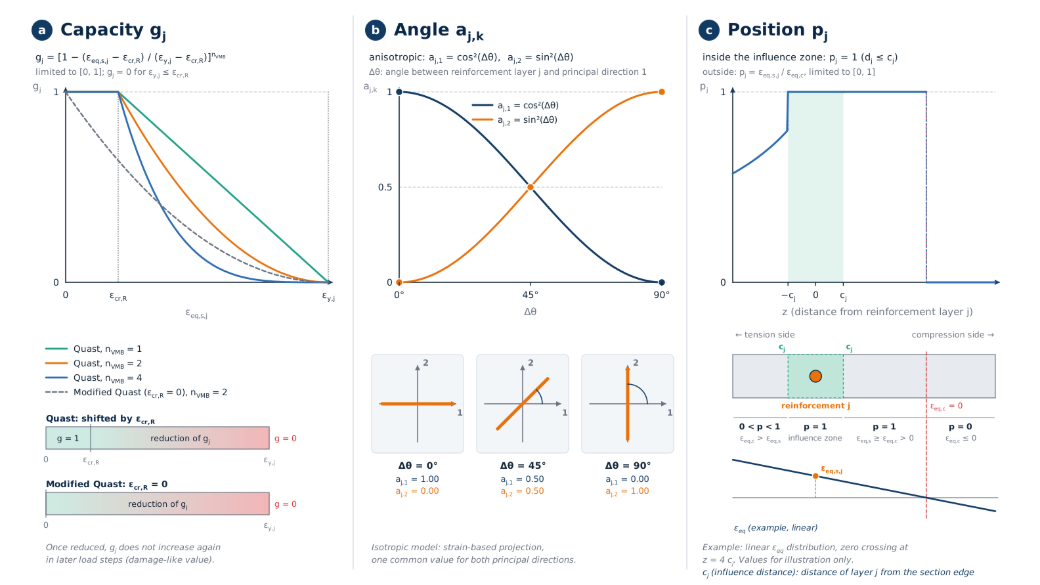
A new tensile stiffening approach is available for anisotropic damage material starting with version 6.16.0001. It accounts for the contribution of the concrete between cracks locally, at each concrete integration point, and separately in both principal strain directions. The extent to which tension stiffening takes effect depends on the direction, location, and strain of the reinforcement. This approach is enabled by default for the Quast and Modified Quast methods and is implemented only for surface elements.
The theoretical background and implementation are described in the manual:
Functionality
For each reinforcement layer, an activation factor is determined based on its remaining capacity (strain), its angle relative to the principal tensile direction, and its location relative to the analyzed concrete point. Tension stiffening is only added where the reinforcement can actually act on the concrete, and not globally across the entire cross-section.
- Quast: The target curve, weighted by the activation factor, is applied to the concrete stress.
- Quast modified: The target curve, weighted by the activation factor, is added to the concrete stress of the base material. As a result, the concrete stress can only be increased, never reduced. This variant is the default setting.
The previous, globally applied approach has been replaced and is no longer available as an additional option. Results from existing models may differ from calculations performed with older program versions. The expected changes and deviations are explained under FAQ 5869 | Deviations from Older Versions Regarding Tension Stiffening .
For isotropic damage material, the approach is applied in a modified form; the differences are described in the FAQ.