Quast
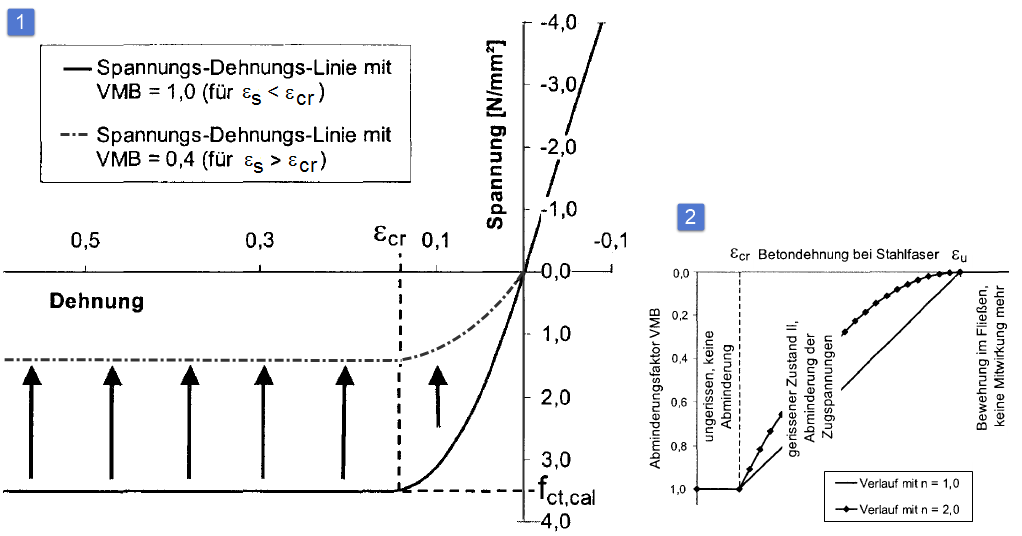
This model for determining the concrete's contribution to tension between the cracks is based on a defined stress-strain curve of the concrete in the tension area (parabola-rectangle diagram).
The basic assumptions of Quast's approach can be summarized as follows:
- Full contribution of the concrete in tension until the crack strain εcr,R or the factored concrete tensile strength fct,R is reached.
- Reduced stiffening contribution of the concrete in the tension zone according to the existing concrete strain
- No tension stiffening after the governing rebar has started to yield
In summary, this means that the factored tensile strength fct,R is not a fixed value, but refers to the existing strain in the governing steel (tension) fiber. The maximum tensile strength fct,R decreases linearly to zero from the defined crack strain εcr,R until the yield strain of the reinforcing steel in the governing steel fiber is reached (for nVMB = 1).
This is achieved using the stress-strain relation in the tension area of the concrete (parabola-rectangle diagram), shown in the image below, and by the determination of a reduction factor VMB (stiffening contribution of concrete).
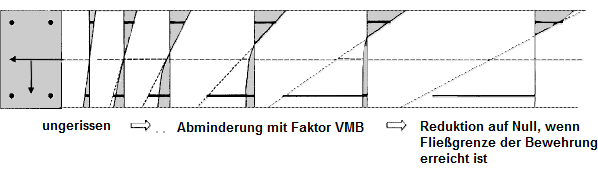
The next image shows a schematic view of stress states for increasing loading due to tension stiffening.
The stress-strain relation in the tension zone can be described with the following equations:
for ε > εcr,Rr
- The curvature of the parabola in the first section can be controlled by the exponent nPR.
- The exponent should be adjusted in such a way that the transition from the compression zone to the tension zone is preferably achieved with the same modulus of elasticity.
To determine the reduction factor VMB, the strain at the most heavily tensioned steel fiber is used. The position of the reference point is illustrated in the graphic below.

The reduction parameter VMB decreases with increasing steel strain. In the diagram for the VMB factor (see the image below), it is evident that the factor VMB is reduced to zero exactly at the point when the yielding of the reinforcement starts.
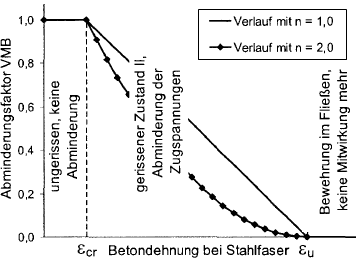
The distribution for the reduction factor VMB in state II (ε > εcr,R) can be controlled by means of the exponent nVMB.
- According to Pfeiffer [2], the values nVMB = 1 (linear) to nVMB = 2 (parabola) are experiential values for structural components subjected to bending.
- Quast [3] uses the exponent nVMB = 1 (linear) in his model, thus achieving good concordance when recalculating column tests.
- According to Pfeiffer [2], pure tension tests with acceptable conformity can be modeled with nVMB = 2.
The assumption of a parabola-rectangle diagram for the cracked concrete tension zone is to be regarded as a calculation aid. At first glance, there are major differences compared to experimentally determined stress-strain curves on the tension side of the pure concrete.
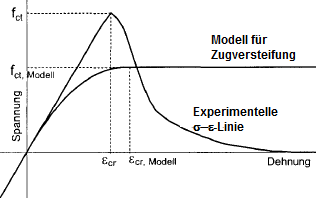
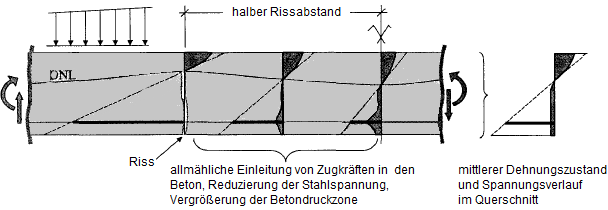
The given stresses in the reinforced concrete cross-section in bending show that the parabola-rectangle diagram is indeed better suited to describe the mean of the strains and stresses.
In a bending beam, a concrete body forms between two cracks. It acts as a sort of wall into which tension forces are gradually reintroduced by the reinforcement. This results in a very irregular distribution of stress and strain. On average, however, a strain level with a parabola-rectangle curve can be created, through which the mean curvature can be determined.
For the model by Quast, the calculation values to be applied were proposed as follows:
- For the tensile strength fct,R
- For the crack strain εcr,R
The calculational value for the tensile strength fct,R is thus smaller than specified by the Eurocode. This is due to the description of the stress-strain relation and the determination of the reduction parameter VMB, in which the assumed tension stress and the resulting tension force are only slowly reduced after exceeding the tension strain. For a strain of 2 ⋅ εcr, there is also an acting tension stress of about 0.95 ⋅ fct,R. Thus, in case of bending, the reduction of the stiffness can be predicted well. For pure tension, the above-mentioned values for fct,R are too small. According to Pfeiffer [2], the values from EC 2 should be applied for the calculation value of the tensile strength.
The values recommended by Quast [3] for fct,R = 1/20 ⋅ fcm can be obtained by applying 60% of the tensile strengths given in EC 2. When applying fct,R = 0.6 ⋅ fctm, the cross-section is predicted to crack too early. At the same time, this already takes into account a reduction in tensile strength under permanent load (about 70%) or a temporarily higher load (for example, the short-term application of the rare action combination) that leads to a damaged tension zone.
The individual calculation values for the concrete's tension zone can be described as follows:
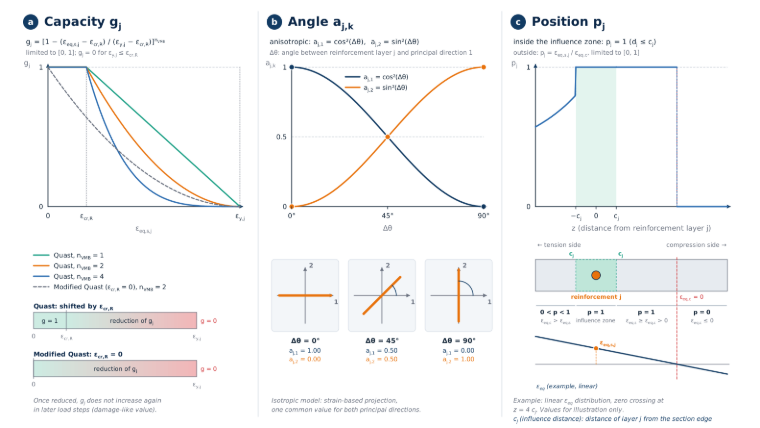
Modified Approach According to Quast
The modified approach according to Quast uses the same calculated tensile strength fct,R as the approach according to Quast (see the previous section), but uses its own, simpler target curve σ̂(ε): It increases linearly from zero up to the tensile strength fct,R (at the strain fct, R < /sub>/E, where E is the modulus of elasticity of the concrete) and remains constant thereafter. There is no parabolic component; the exponent n < /sub>sub>t < /sub>/sub> and the crack strain ε < /sub>sub>cr,R < /sub>/sub> from the Quast approach are not used. Additionally, the '''method of application''' to the concrete stress differs:
* In the '''Quast''' approach, the concrete stress in the tension zone is '''set directly to the value of the target curve''' (σc = σ̂(ε), see target curve in the “Quast” section); this can result in either an increase or a decrease compared to the stress of the unmodified base material model.
* In the '''modified approach''', the target curve is instead '''purely additively''' superimposed on the concrete stress σc,Main(ε) provided by the base material model (for example, damage model).
σ̂(ε) Target stress curve, according to Quast or modified Quast; see the respective section σc Concrete stress in the tension zone σc,Basis(ε) Concrete stress in the base material model, for example, a damage model Δσc Additive tension stiffening factor applied to the concrete stress σc Concrete stress in the tension zone σc,Basis(ε) Concrete stress of the base material model, for example, a damage model Δσc Additive tension stiffening factor for concrete stress Δαj,k Contribution of the reinforcement layer j to the activation factor of the principal direction k gj Capacity factor of the reinforcement layer j aj,k Angle factor between the reinforcement layer j and the principal direction k pj Position factor of the reinforcement layer j εs,j Strain of the reinforcement layer j εc Concrete strain z Location along the cross-section thickness (depth coordinate) Δθ Angle between the reinforcement direction and the principal tensile direction εeq,s,j Equivalent strain at the location of the reinforcement layer j εeq,c Equivalent strain in the analyzed concrete layer Δαj,k Contribution of the reinforcement layer j to the activation factor of the principal direction k p Exponent of the p-norm aggregator; the usual value is p = 8. Note: Do not confuse this with the position factor pj—same letter, different meaning. αk Activation factor of the principal direction k αk Activation factor of the principal direction k εk Principal strain in the direction k σtarget,k Target stress in the principal direction k σ̂(ε) Target voltage curve, according to Quast or modified Quast; see the respective section
Variant
Target Stress Curve Based on
Behavior
Recommendation
According to Quast
Section “Quast”
Enforcing: can both add and remove tensile stress to guide the mean response toward the target value
When calibrated to a specified mean tensile stress-strain behavior
Modified according to Quast
Section “Modified Approach According to Quast”
Purely additive (Δσk ≥ 0): adds tensile stress only if the target value exceeds the current concrete stress
Default setting (numerically more robust)