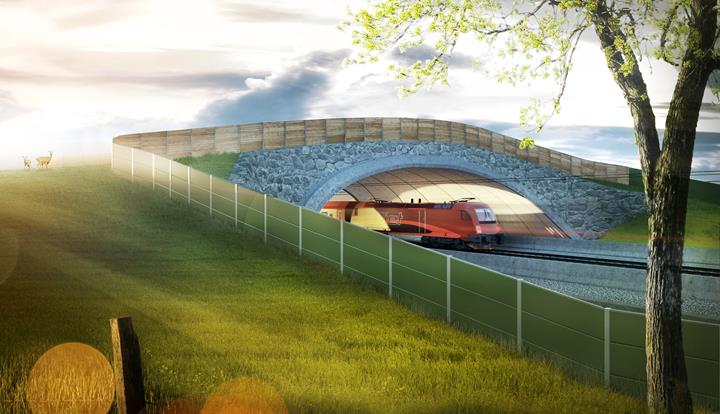
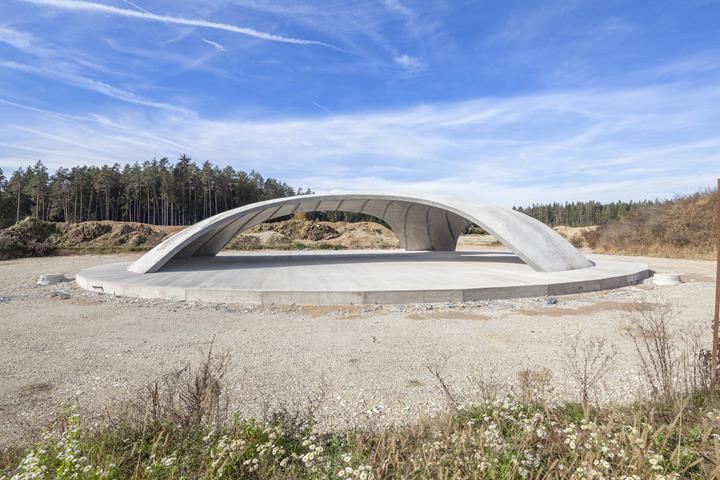
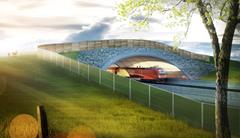
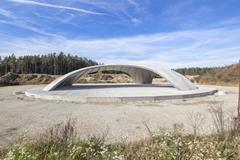
The new bridge spans the new double-track line of the Koralm Railroad in the south of Carinthia. In order to test as many design details as possible, a 1:2 scale test shell was erected in advance, which is now being used as an event canopy.
Functioning of Construction Method PFHC
First, a flat concrete slab with wedge-shaped outlets, in which wedge-shaped air cushions are mounted, is cast. On the slab's edge, unbonded tendons are placed in sheaths. Subsequent to the concrete hardening, an air cushion lying underneath is blown up, transforming the concrete slab into a double curved shell. At the end of the transformation, the tensioning cables are additionally prestressed. They are anchored as soon as all the joints are sealed with concrete or grout.
Construction of Wildlife Crossing
In the case of the wildlife bridge, the thickness of the transformed shell is ~4 inches and is supplemented ~14 inches of concrete. Fine cracks that form during the transformation process are sealed by this additional layer of concrete. The underside is free of cracks, as this is where the compression zone is located during the transformation process.
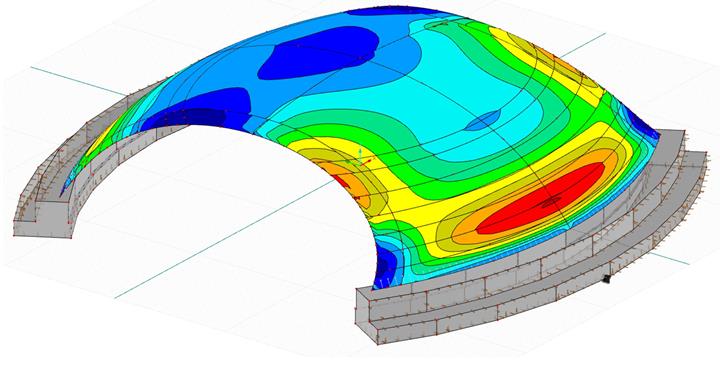
The entire shell structure of the bridge has ground plan dimensions of 120.5 ft x 127 ft and a height of 29 ft. The shape is based on the optimization of the supporting structure in accordance with the occurring loads and given boundary conditions. Due to this optimization, a state of membrane stress is reached which is favorable for the structural behavior.
The ecological balance of the wildlife crossing has been impressive. In comparison with a reinforced concrete frame originally planned as a crossing alternative, environmental pollution can be reduced by about 40%, evaluated with regard to the global warming potential (CO2 equivalents).
| Investor and Design | Austrian Federal Railways (ÖBB) www.oebb.at |
| Geometry Optimization and Structural Analysis | Technical University of Vienna Institute for Supporting Structures www.tuwien.at |