Description
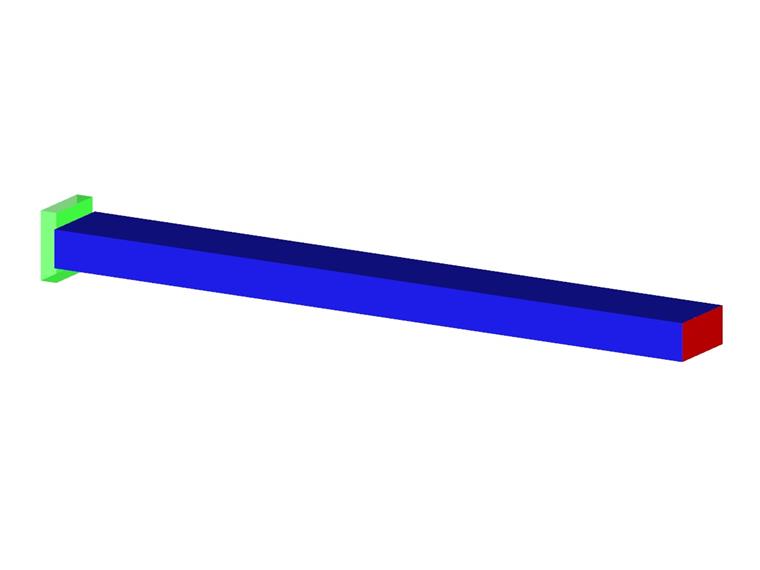
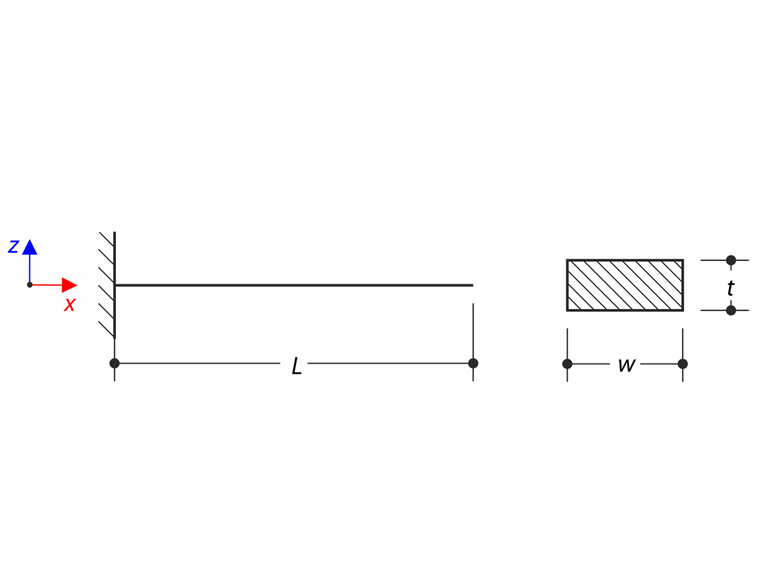
A steel cantilever with a rectangular cross-section is fully fixed on one side and free on the other side. The aim of this verification example is to determine the natural frequencies of the structure. The problem is described by the following parameters.
| Material | Steel | Modulus of Elasticity | E | 206000.000 | MPa |
| Poisson's Ratio | ν | 0.300 | - | ||
| Density | ρ | 7800.000 | kg/m3 | ||
| Geometry | Cantilever | Length | L | 90.000 | mm |
| Width | w | 10.000 | mm | ||
| Thickness | t | 5.000 | mm |
Analytical Solution
Longitudinal Oscillations
The natural longitudinal oscillation of a thin bar is described by the following differential equation
|
u |
Deflection in the longitudinal direction |
|
c |
Longitudinal wave propagation velocity |
The solution is supposed to be in the form u(x,t) = U(x) T(t). Using this form, the differential equation can be rewritten as follows:
This is the second-order differential equation with the following general solution.
The constants C1 and C2 can be obtained from the boundary conditions. The deflection on the fixed side and the stress on the free side has to be zero. The wave equation is determined using these boundary conditions.
The set of angular frequencies can then, obviously, be determined.
The first natural frequency in the longitudinal direction can be calculated.
Transversal Oscillations
The natural transversal oscillation of a thin bar is described by the following differential equation.
Note that this equation has to be solved for both transversal directions. The solution is supposed to be in the form v(x,t) = V(x) T(t). Using this form, the differential equation can be rewritten as follows:
Where λ4 is the substitution for the following expression.
The fourth-order differential equation has the following general solution>
The constants C1 to C4 can be obtained from the boundary conditions. The deflection and rotation on the fixed side, and the bending moment M and transversal force T on the free side, have to be zero. The wave equation for the transversal oscillations is determined using the boundary conditions.
This is the transcendent equation, and its solution can be found numerically. The natural frequencies can then be determined.
RFEM Settings
- Modeled in RFEM 6.11 and RFEM 5.08
- The global element size is lFE= 0.001 m
- Shear stiffness of the members is neglected
- Isotropic linear elastic material model is used
- Member entity is used
Results
| Natural Frequency | Analytical Solution | RFEM 6 | Ratio | RFEM 5 - RF-DYNAM | Ratio |
| fx1 [Hz] | 14275.253 | 14275.072 | 1.000 | 14275.072 | 1.000 |
| fy1 [Hz] | 1024.900 | 1024.778 | 1.000 | 1024.820 | 1.000 |
| fy2 [Hz] | 6422.940 | 6418.894 | 0.999 | 6417.154 | 0.999 |
| fy3 [Hz] | 17984.417 | 17960.053 | 0.999 | 17960.779 | 0.999 |
| fz1 [Hz] | 512.450 | 512.413 | 1.000 | 512.495 | 1.000 |
| fz2 [Hz] | 3211.470 | 3210.490 | 1.000 | 3211.004 | 1.000 |
| fz3 [Hz] | 8992.208 | 8986.983 | 0.999 | 8988.420 | 1.000 |