


Objective
This example is intended to validate the results of a user-defined nonlinear material law in RFEM. Here, a manually defined stress-strain diagram is compared with an independent numerical solution generated using a custom-developed Newton-Raphson solver developed in Python.
Model Description
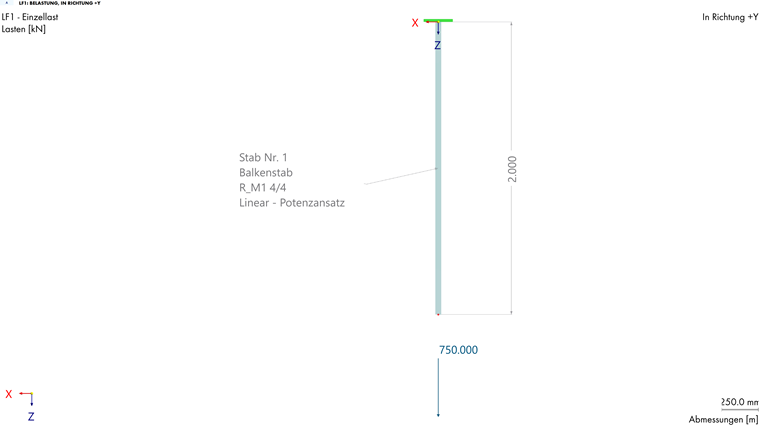
A simple tension member is used as the structural system.
| L | 2,0 | m | Length |
| a | 4 | cm | Square cross-section |
| Support | Node 1 | Fixed (restrained) | |
| Support | Node 2 | Free | |
| Fz | 750 | kN | Load at Node 2 |
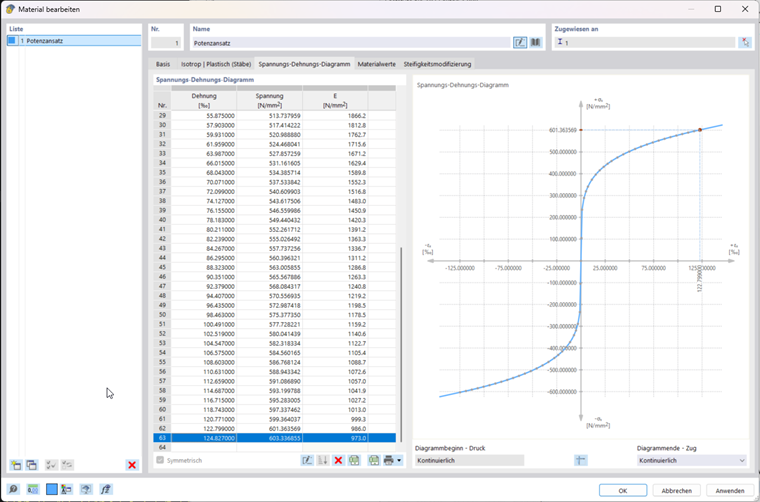
A power law is used as the material law for the modeling of S235 steel. The analytical description of the curve is:
$$
\sigma(\epsilon) =
\begin{cases}
E_0 \cdot \epsilon & \text{for } 0 \le \epsilon \le 1{,}119 \cdot 10^{-3} \\
f_y \cdot \sqrt[m]{\dfrac{E_0 \cdot \epsilon}{f_y}} & \text{for } \epsilon \ge 1{,}119 \cdot 10^{-3}
\end{cases}
$$
where
$$
\begin{aligned}
m &= 5 \\
E_0 &= 210\,000 \text{ kN/cm}^2 \\
f_y &= 23{,}5 \text{ kN/cm}^2
\end{aligned}
$$
To implement this law in RFEM, the function was evaluated at 63 nodes. In the nonlinear area, a step size of Δε = 0.002028 was selected to achieve a high level of accuracy in the diagram. After the last node, the function is extrapolated linearly using the last calculated tangent modulus.
The calculation in RFEM is performed nonlinearly using the linear static analysis with the following settings for the Newton-Raphson solver:
- Number of load increments: 10
- Maximum number of iterations: 100
Verification
For verification purposes, a Python script (see Python code for Verification Example 9964, a non-linear 1D FEA verification example using the Newton-Raphson method. ) was developed that implements the Newton-Raphson method to solve the nonlinear equilibrium condition. The calculation is based on the defined material function and serves to independently verify the computational results from RFEM.
Result Comparison
The following table compares the displacements u of Node 2 for the 10 load increments:
| Load P [kN] | uRFEM6 [mm] | uScript [mm] | Abs. Dev. [mm] | Rel. Dev. [%] |
|---|---|---|---|---|
| 75.00 | 0.4464 | 0.4460 | 0.0004 | 0.09% |
| 150.00 | 0.8929 | 0.8930 | 0.0001 | 0.01% |
| 225.00 | 1.3393 | 1.3390 | 0.0003 | 0.02% |
| 300.00 | 1.7857 | 1.7860 | 0.0003 | 0.02% |
| 375.00 | 2.2321 | 2.2320 | 0.0001 | 0.00% |
| 450.00 | 5.7128 | 5.4950 | 0.2178 | 3.81% |
| 524.99 | 12.0050 | 11.8780 | 0.1270 | 1.06% |
| 599.99 | 23.1933 | 23.1580 | 0.0353 | 0.15% |
| 674.99 | 41.7599 | 41.7310 | 0.0289 | 0.07% |
| 749.98 | 70.6726 | 70.6720 | 0.0006 | 0.00% |
Summary
The results of the RFEM analysis are virtually identical to those of the independent reference calculation.
| Max. absolute deviation | 0.2178 mm |
| Max. relative deviation | 3.81% |
| Correlation coefficient R2 | 0.999987 |
| Relative deviation (final load increment) | 0.00% |
Numerical verification confirms excellent agreement between the RFEM calculation and the reference solution. The maximum relative deviation of 3.81% occurs locally in the transition region to plastic strain and is attributable to the discretization of the continuous power-law model into discrete nodal points. In the final load increment, the difference between the two models is negligible at less than 0.01%. With a coefficient of determination of R2 ≈ 1.0, the correctness of the material model implemented in RFEM 6 is designed.