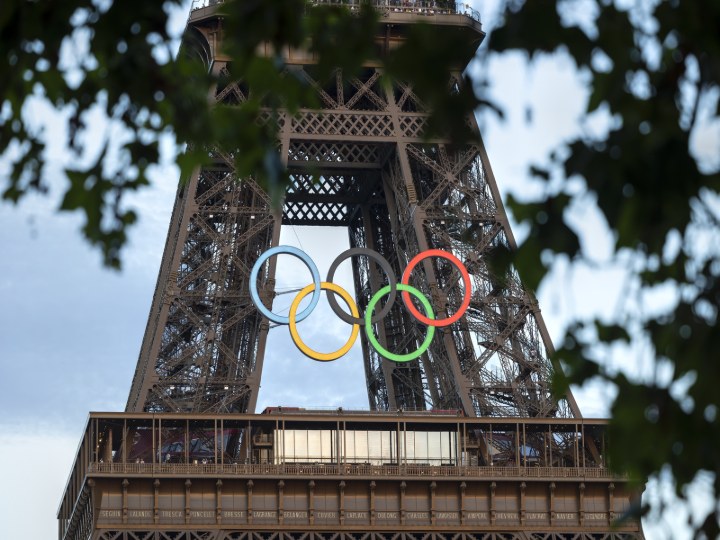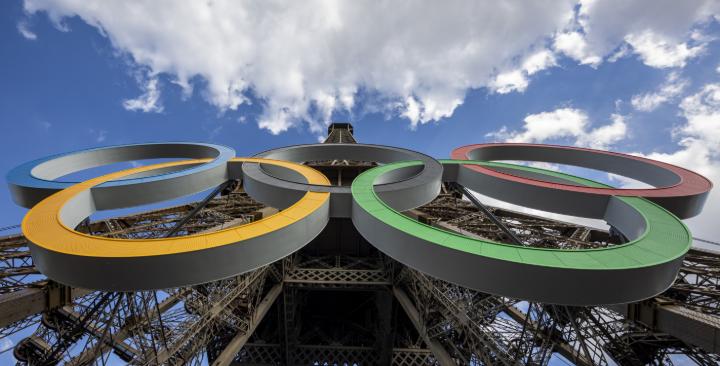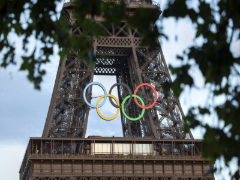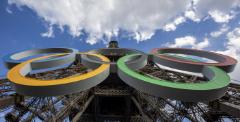
Manufactured in France, XCarb recycled steel from ArcelorMittal was used in the production. The rings were fabricated in the VIRY workshops.
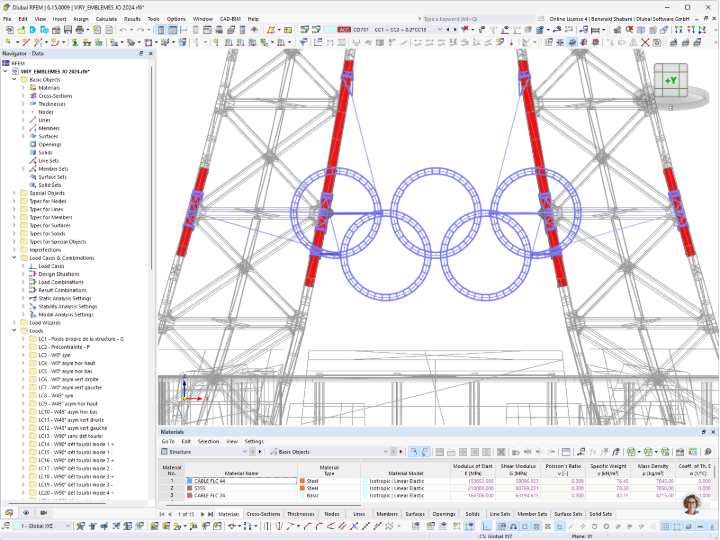
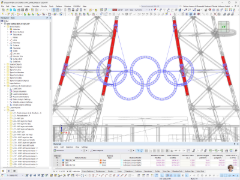
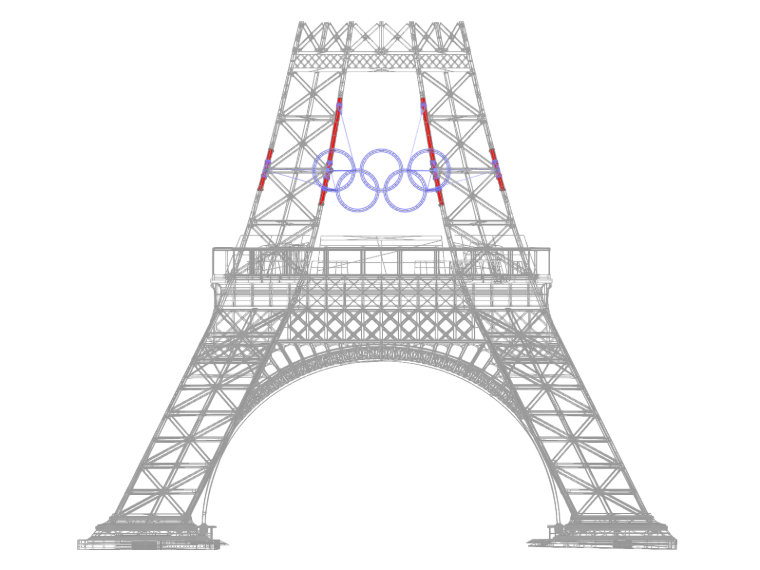
The support structure of the rings consists of two hangers and four diagonal tension members. Eight additional cables were used for stabilization. A particular challenge of the project was to securely attach the steel structure—weighing approximately 30 metric tons (33 US tons)—to the Eiffel Tower without altering its existing steel structure through welding or drilling. The friction clamps used transfer forces exclusively via contact and friction. This allowed for the preservation of the Eiffel Tower’s historic supporting structure.
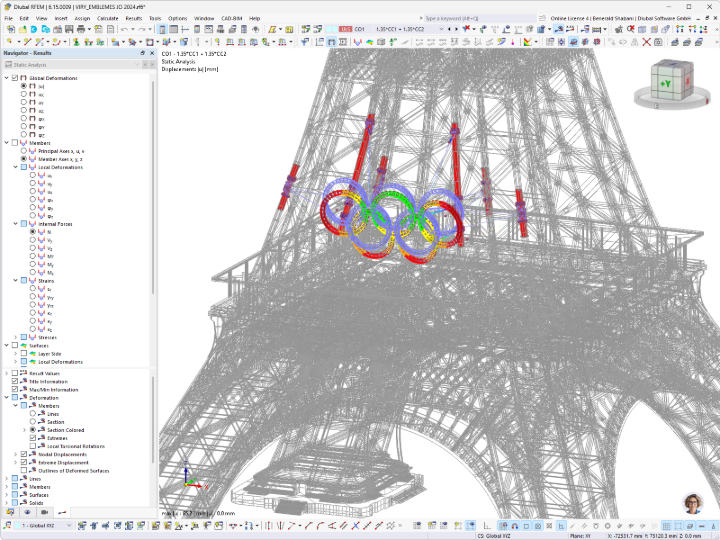
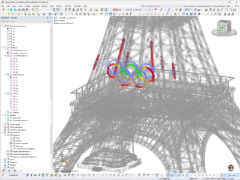
Following a 3D scan of the Eiffel Tower’s struts, the connection areas were modeled in RFEM 6 by Dlubal Software. The contact points between the friction clamps and the existing structure were modeled using appropriately aligned nonlinear supports. Cable elements were also used for the design and stability analysis.
For the cross-sections specifically tailored to the geometry of the Olympic rings, individual cross-section shapes were generated in RSECTION.
The support reactions and force values determined from the structural model were then forwarded to the Centre Technique des Industries Mécaniques (CETIM). There, a mechanical analysis of the Eiffel Tower’s existing steel structure was conducted in the area of the connection points.
The project shows how a temporary yet extraordinary steel structure can be safely attached to a historic building. By combining 3D scanning, detailed modeling and design in RFEM 6, nonlinear support conditions, and individual cross-sections, the load capacity and stability of the Olympic rings were reliably designed while taking into account the existing structure.
| Location | Av. Gustave Eiffel, 75007 Paris, France |
| Contractor | ArcelorMittal France |
| Client's Representatives | JM ROUECHE Conseil |
| Lead Designer | T/E/S/S atelier d’ingénierie and INGELUX |
| Structural Design | VIRY FAYAT GROUP and T/E/S/S atelier d’ingénierie |
| Steel Manufacturer | VIRY FAYAT GROUP |