The topic of civil engineers and engineers in the construction industry in general has been requested by you repeatedly: Understandable, as it is very exciting! That's why we are hosting today's guest for the second time, and we are very excited about it. You can read the first interview with Moritz Menge in our blog.
Blog | Bridge Construction Begins in the MindMoritz is a civil engineer in bridge construction and is passionate about his job. He would also like to pass on this enthusiasm to other colleagues in the industry. Therefore, he wrote a book, which we talked about in our last interview. Now, a second edition has been published and we are excited already: Tell us something about it!
Passion in the Second Edition
His twenty years as a civil engineer predestine him to build bridges in engineering. His main point is that although planning and construction themselves are becoming increasingly digital, they still involve people working together. People make mistakes, and these cause tension and misunderstandings. At the same time, the construction industry's environmental footprint is devastating for the climate, and thus for our planet.
- “We build great structures together with other professionals. Due to their qualifications and approach, these colleagues often have a different mindset than we engineers are used to."
So we can assume a general communication problem between the individuals involved in the construction. Engineers in particular are asked to take a leading role and to gather all these different people, who bring different knowledge, into an ultimately successful project team.

Young engineers are often more far-sighted, particularly with regard to the climate friendliness of the construction industry and working together as a team. However, they often lack the experience to implement their plans and ideas. Moritz would like to help here.
His book sold quite well, so the publishing house proposed a second edition of the non-fiction book: This is understandable, as non-fiction books for engineers are a rarity. It may be of particular interest to fans of our podcast that this time, an audio book will also be included.
Civil Engineers with Great Responsibility
When we ask Moritz what responsibilities a civil engineer has on a project, he takes a deep breath. Because there are some. Above all, an engineer is responsible for his/her own work, of course. He/she must be able to guarantee the quality of his/her own work:
- "What do I do with what I have learned? How do I use this?"
However, he/she is not only responsible for his/her own job and the construction project. He/she must also pay attention to society as a whole. Large construction projects are usually paid for by the public sector; that is, tax money. Of course, nothing should be wasted here in order to end up with a building that truly serves a community purpose.

Furthermore, there is the much-discussed influence of the construction industry on our environment and the climate, of course. The CO2 footprint of construction is a major problem worldwide. However, this is often forgotten or ignored: There is also a big lever to move in the opposite direction.
Bridge Construction Begins in the Mind
Now, we discuss some interesting chapters of his book. Exciting topics, which we have already encountered in our podcast, are addressed: And rightly so, because talking about it is essential for our industry.
Engineers as Managers
In the construction industry, we have the peculiarity that executives, including managers or managing directors, are usually engineers themselves. This has many advantages. For example, they can go ahead with their own knowledge in direct contact with the customer and set the course for a successful project without having to seek advice from outside. Furthermore, an engineering manager knows the tasks of his or her engineering colleagues much better.
- “A passionate engineer can also lead his or her company or department passionately from within."
However, a manager has to be trained first. They master their own technical expertise without any problems, but some soft skills are often missing for the successful management of employees.

Engineers and Error Management
Mistakes happen; this is normal. In engineering, however, serious mistakes can have dire consequences. This is often a matter of safety of life and health, as well as the financial aspect. Moritz explains to us how engineers can deal with mistakes:
- Creation of quality loops
- Openly addressing mistakes without mutual blame
- Recognizing the sources of error and limiting the possible consequences
- Learning from mistakes and developing further
Structural Engineering Is Incompatible with Stress
Moritz heard this phrase from a client and adopted it himself. A good level of planning quality is always the most important thing, especially when it comes to safety. Time pressure and stress are counterproductive, of course. If a team is in danger of becoming hectic, action should be taken to set realistic goals.
Engineers and Lawyers in Construction and Planning Process
Lawyers are very important for the planning and construction of building projects. Engineers, client representatives, and lawyers often only sit at the same table when it comes to assigning blame to one another.
Here, Moritz recommends that lawyers should be involved in the planning processes as early as possible. In this way, the preventive knowledge of a lawyer can help to avoid potential problems later.
Mediator in Construction
In his role as a mediator, Moritz wants to help ensure that conflicts are avoided or moved towards a solution at an early stage. As an impartial supporter, he proactively helps all disputants to work out the process for a solution structure together.
Above all, it is important to him that everyone takes a step back and looks at the big picture in order to communicate successfully with each other. This is the only way to find a common solution, which is to create a win-win situation.
Future of Construction
He thinks that dealing with climate change and digitization are the important topics today. He also touches on them in his book. As is the issue of the shortage of skilled workers.
Since the construction industry often appears, and still is, rather conservative, it attracts fewer young people than other industries. This is where structures need to be created to further promote enthusiasm for a career in the construction industry.
![BLOG 000098 | Listen to the full interview here: [https://www.dlubal.com/de/bildung/infotainment/podcast/000019 019 Is BIM the future?] feat. Ma](/en/webimage/038369/3456863/architecture-g178c47e66_1920.jpg?mw=760&hash=9d7292f33054636440ad680426b02c37f3f951ea)
His wish for the future would be for more attention, space, and time to be given to the planning of construction projects. Changing or modifying something at a later date takes not only time, but also energy and money. Pressure on costs, personnel, and deadlines not only makes planning less effective, but it can also lead to unnecessary problems later on during construction.
- “If we put more energy into careful design, our construction projects could be better in many ways."
Working out solutions requires diverse approaches. After all, a construction site is most efficient when the planning has been done properly and well thought out beforehand. Moritz sees the planning of a building as a kind of work preparation for the implementation on the construction site. The more attention and consideration are given in advance, the less extra work there is for those who have to implement this planning in the end.
Moritz, what is your favorite building?
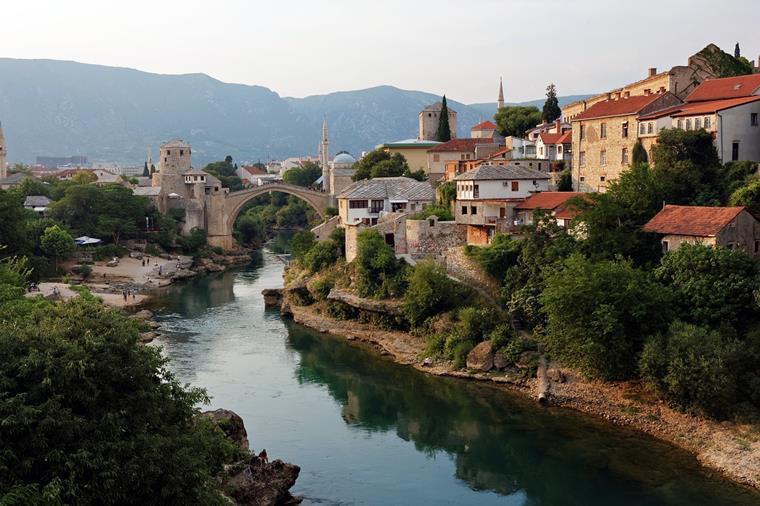
The answer is still the same. His favorite building is the bridge in Mostar, the world-famous Stari Most. It leads over the Neretva River and connects the Christian and Muslim districts of Mostar.
When he saw it in 1986, the original was still standing; it was later destroyed, then rebuilt. In 2006, he had the opportunity to look at the faithful replica again. Bridges connect people, and this one is a monument against war. A truly impressive structure. Thank you for being with us, Moritz!