


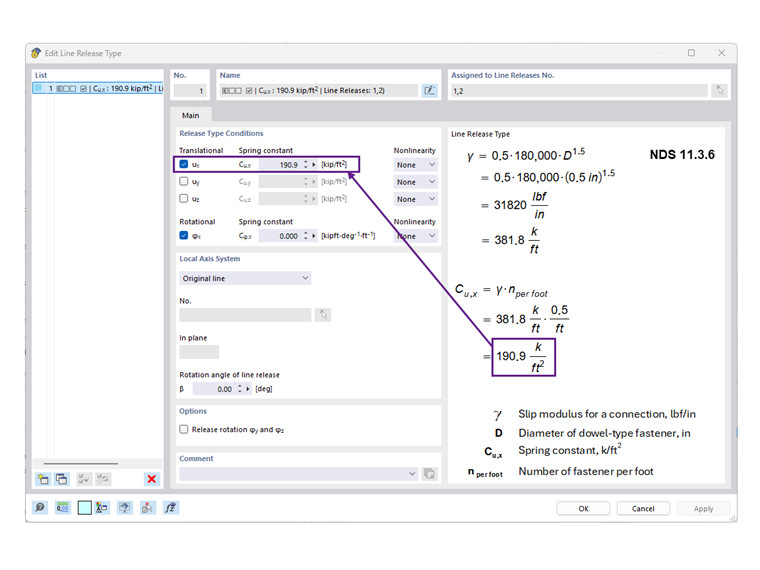
To represent the stiffness of the overall structure accurately, the shear coupling between the CLT panel floor and the downstand beam can be modeled using a line release. This allows for the definition of a spring constant, eliminating the need for an alternative system with coupling members. The spring constant is derived from the slip modulus of the fastener, which can be determined according to ANSI/AWC NDS [1]. It should be noted that defining a spring constant to represent this stiffness is a recommended practice, though not explicitly specified by the standard.
In this example, hexagonal wood screws with a diameter of 0.5 in are used at a spacing of 24.0 in.
To comply with NDS requirements, the slip modulus, γ must be multiplied by a factor of 0.5 according to Chapter 11.3.6 since the value given in the standard is based on two shear planes. For dowel-type fasteners in wood-to-wood connections, the slip modulus and the spring constant are calculated as follows:
The figure below illustrates the schematic distribution of bending and shear stress for "rigid", "semi-rigid", and "flexible" couplings.
.png?mw=760&hash=c88f3514b006260a73e08b756778d026e656891d)

