Answer:
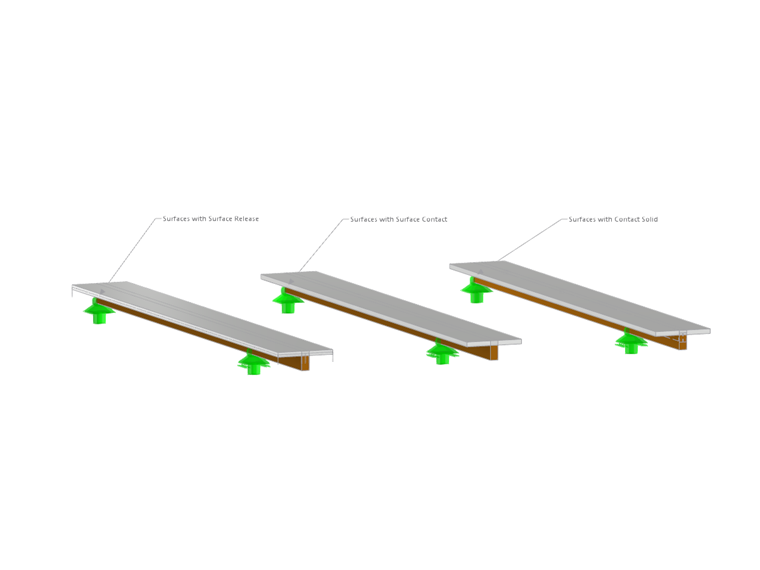
The special feature of a timber-concrete composite floor is that the concrete is flexibly connected to the timber by means of fasteners (for example, bolts or birdsmouth joints). This flexibility must be taken into account in the global structure in order to model the stiffness and stress distribution correctly. RFEM provides various coupling options for this purpose:
- Contact solid: You can account for the flexibility using the contact solid defined between the concrete and timber surfaces. This has the advantage that you can evaluate the shear forces or shear stresses directly for the design of the fasteners. More information about the contact solid can be found here:
- Surface contact: You can also use a surface contact to flexibly connect surfaces in the same way as with contact solids. The advantage of a surface contact is the simple definition of the contact condition. More information about the surface contact can be found here:
- Surface release: Using surface release, you model surfaces not geometrically separated as with the other two options, but in the same plane. The surface eccentricity ensures that the stiffnesses are modeled correctly. With surface release, you can define different stiffnesses in the x and y directions. More information about the surface release can be found here:
You can download an example model with all variants by clicking on the image below.