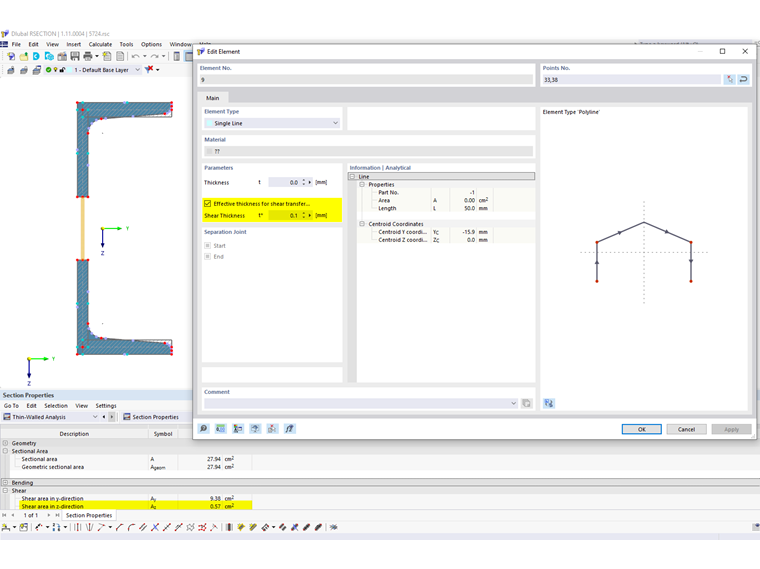
A possible cause for the very small shear area calculated in RSECTION 1 could be the definition of the effective element thickness for shear transfer t*.
The shear area is calculated according to the following formulas:
|
Iz |
Second moment of area in relation to the axis z or y |
|
Sz |
First moment of area in relation to the axis z |
|
t* |
Effective element thickness for the shear transfer |
|
A* |
Surface area based on the effective shear thickness t* |
|
Iy |
Second moment of area in relation to the axis y |
|
Sy |
First moment of area related to the axis y |
|
t* |
Effective element thickness for the shear transfer |
|
A* |
Surface area based on the effective shear thickness t* |
As can be seen from the formulas, the effective element thickness t* has a significant influence on the result. If t* is defined too small, the calculated shear area will be very small.
In the cross-section from Image 1, an effective thickness t* = 0.1 mm was assumed for the opening. As a result, the calculated shear area Az is very small.
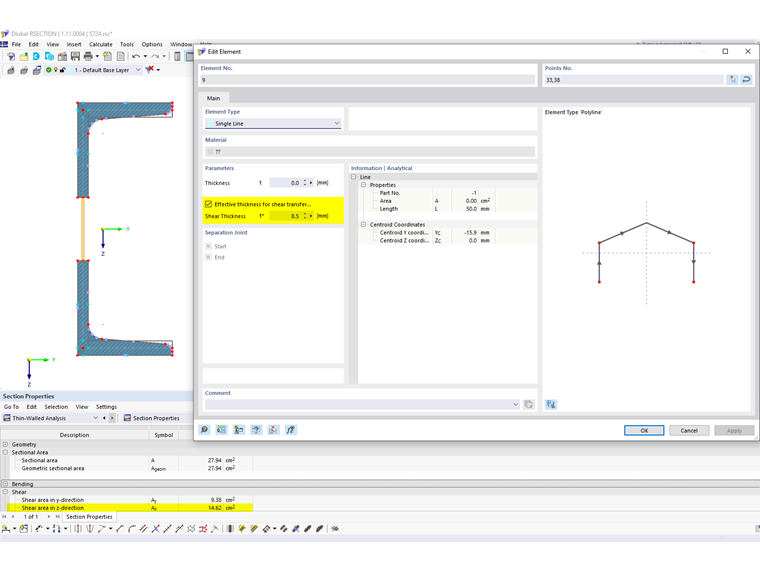
In Image 2, the effective shear area was increased to 8.5 mm, resulting in a significantly larger shear area.