In the ever-evolving solar industry, the design and installation of photovoltaic systems must account for a variety of solar module types. Among these, glass solar panels have gained popularity due to their aesthetic appeal and durability. However, designing solar panels, especially glass panels, requires specialized considerations. Like other solar panel designs, glass panels need tailored assessments to evaluate their load-bearing capacity accurately.
Engineers must account for the unique material properties of glass, such as its brittleness and flexibility, as well as the distinctive load scenarios that may arise. These scenarios often include snow on solar panels, where uneven snow accumulation can create asymmetrical loading, or additional forces resulting from maintenance activities. These factors, along with the inherent characteristics of solar panel glass, require careful evaluation to ensure the structural integrity and long-term performance of the solar panel system under varying conditions.
Dlubal’s Solution
Dlubal’s software offers robust solutions for addressing these unique challenges in solar panel design. With the Glass Design add-on for RFEM 6, engineers can perform comprehensive load analysis, simulating multiple load scenarios within a single platform. The software allows engineers to design solar modules with precision, while considering the specific material properties of glass and unique loading conditions like snow accumulation or forces from maintenance activities.
This integrated approach streamlines the solar panel roof design process by addressing the unique requirements of glass solar panels, assessing the system’s utilization, and optimizing its performance.
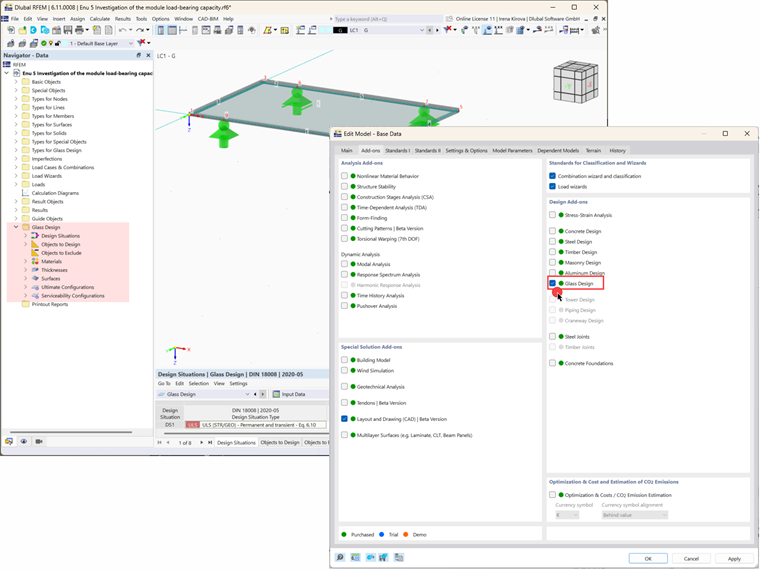
Example: Investigating the Load-Bearing Capacity of a Glass Solar Panel Using RFEM 6 and the Glass Design Add-on
1. Modeling the Solar Panel
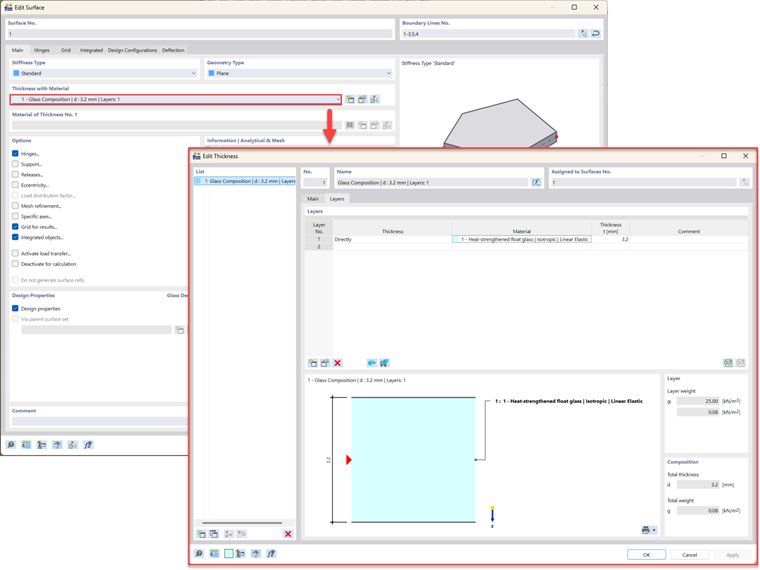
Let’s consider an example where we assess the utilization of a glass solar panel using RFEM 6 and the Glass Design add-on. In this example, we define the glass panel as a surface with a "Glass composition" thickness type of 3.5mm (Image 2). The panel consists of a layer of heat-strengthened float glass. The panel is hinged to the boundary members, which are defined as aluminum rails in RFEM 6 (Image 3).
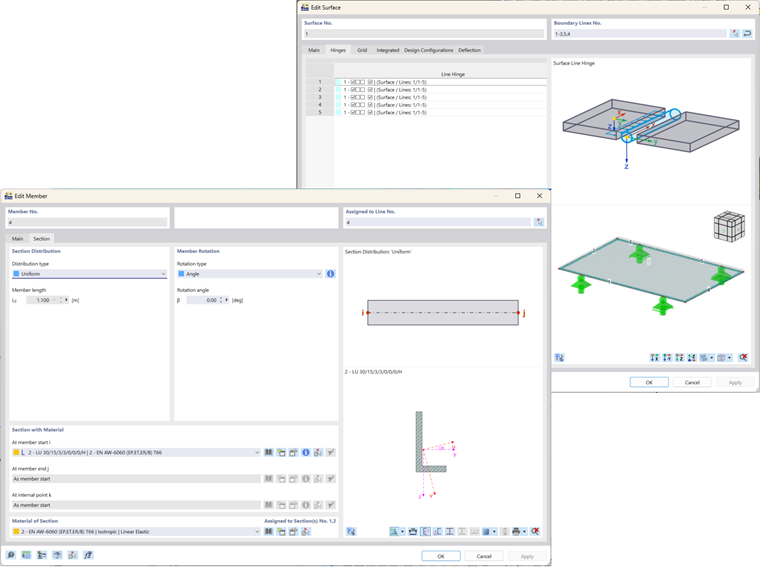
One key advantage of using RFEM 6 is that there’s no need to model the secondary (support) structure in detail. Engineers can instead simulate the supports using the software’s available features, saving both time and effort while maintaining the accuracy of the design. For this example, nodal supports are used, and the rails are connected to them.
2. Applying Loads and Simulating Special Load Scenarios
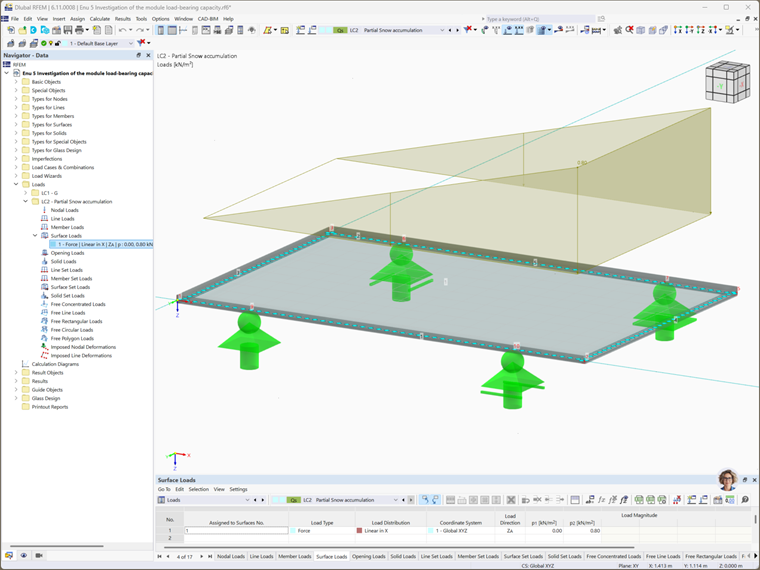
In this step, we apply a partial snow load accumulation to the glass solar panel, representing a common scenario that engineers face when designing photovoltaic systems in snowy regions (Image 4). Uneven snow accumulation can create additional forces on the panel, which must be considered to avoid damage or failure over time. This is particularly important when designing solar panels for home installations or solar panel roof designs that are exposed to extreme weather conditions.
3. Analysis and Utilization
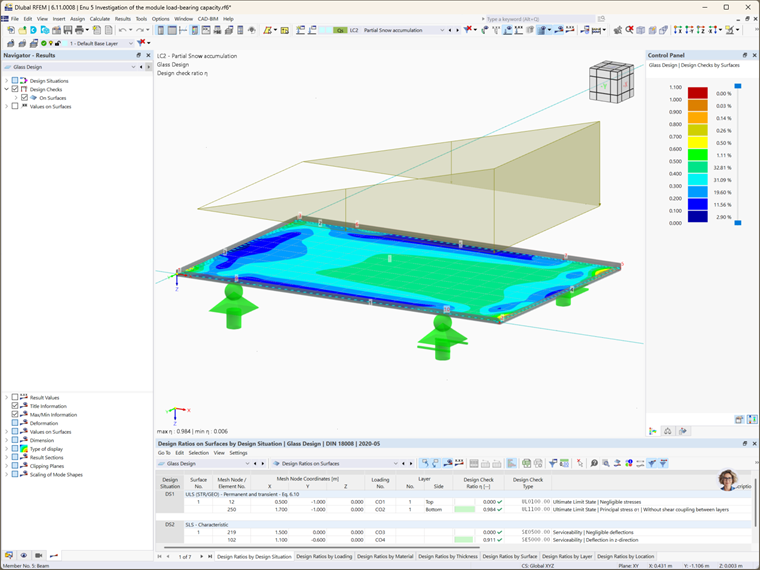
After defining the glass panel and applying the load, we run the analysis to determine the utilization of the solar panel. This analysis provides essential data, such as whether the panel’s design is adequate for the applied loads and conditions. By obtaining the design check ratios (Image 5), we can assess if the panel can handle the assigned load and the level of utilization, allowing engineers to optimize the system further if needed.
Conclusion
While this example is relatively simple, it clearly demonstrates the power of RFEM 6 and the Glass Design add-on in simulating complex solar panel designs and load scenarios for glass solar panels. The integrated approach of Dlubal’s software ensures that all aspects of the design process—ranging from material properties to special load scenarios—are addressed effectively, ultimately optimizing the safety and performance of the photovoltaic system.
By offering advanced capabilities for both design and load analysis, RFEM 6 enables engineers to tackle the challenges of unique solar panel designs, ensuring that solar panel systems perform efficiently and safely in a wide range of conditions.