Fire Design
Fire resistance design is regulated in DIN EN 1993 Part 1-2. Section 4.2 presents “Simple design methods” which form the basis of the design in RFEM 6 and RSTAB 9.
In this case, the actions are compared with the load-bearing capacities at the component level. The fire actions resulting from temperature rise are determined on the basis of temperature curves (nominal fire curves). The actions are determined under reduced partial safety factors in the accidental design situation. The resistances are taken into account by reducing the material properties based on the increased temperature.
Critical Component Temperature Θa,cr
In addition to the design method mentioned above, EN 1993-1-2, Section 4.2.4, describes the design method at the temperature level based on the critical component temperature. This becomes interesting when reactive fire protection materials are applied to the steel and their layer thicknesses need to be determined.
The critical component temperature represents the maximum temperature that may be reached so that the analyzed member or member set can still withstand the actions. The lowest critical component temperature by structural component is governing.
The equation for determining Θa,cr is:
The parameter for determining the critical component temperature is the design ratio μ0, which represents the ratio of the actions under fire exposure Efi,d and the resistances at the start (t = 0) of the fire Rfi,d,0. The critical component temperature is therefore independent of the fire resistance design, which determines the resistance as a function of the duration of the fire or temperature curves, and so on.
The function graph of Θa,cr has the following distribution:
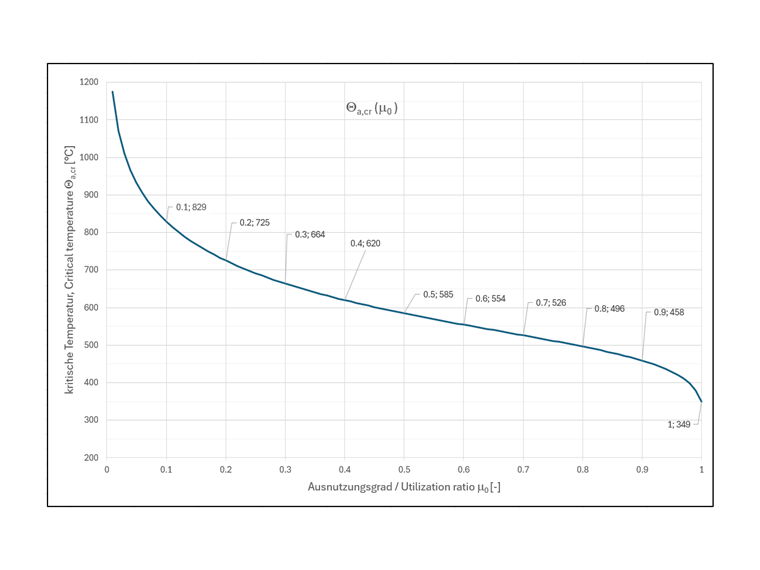
The design ratios μ0 may be determined using elastic or plastic design methods.
Application Limits, Boundary Conditions
The following limitations apply to the calculation of the critical component temperature in RFEM 6:
- Not applicable if deformation criteria are governing,
- Not applicable if it is necessary to consider stability effects,
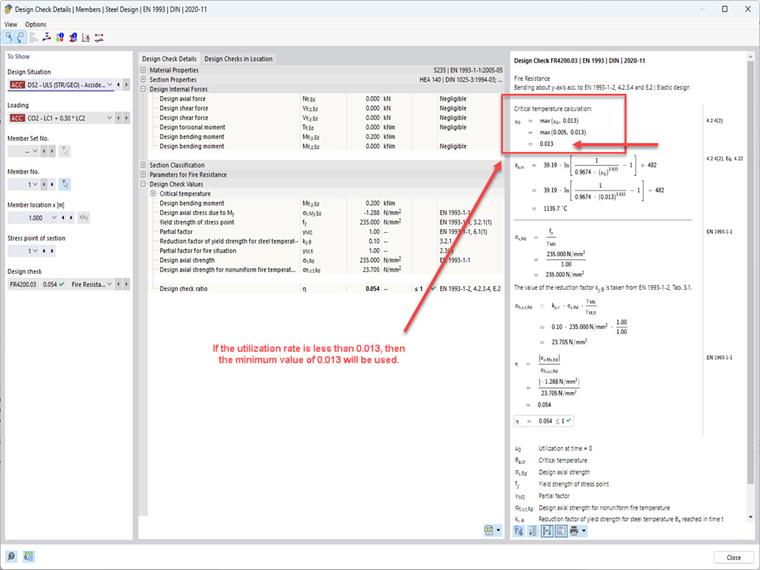
- Design ratios μ0 < 0.013 should not be used.
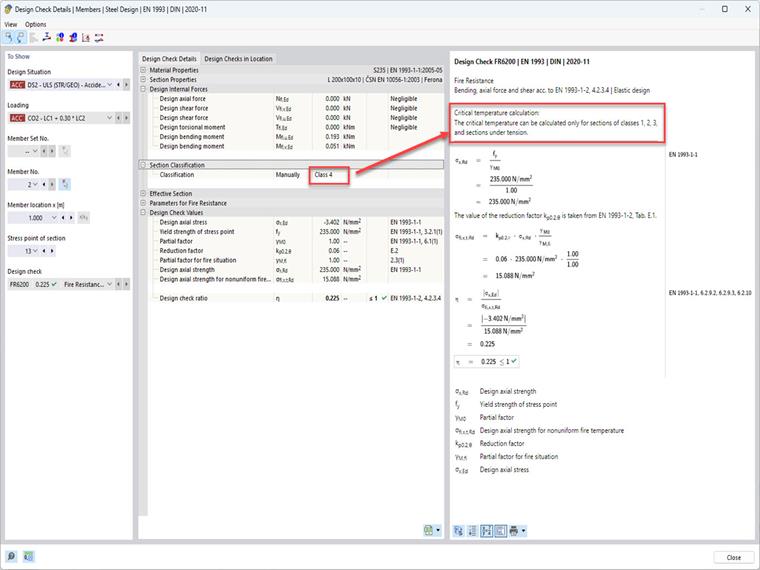
- There are components with cross-section class 1, 2, or 3, or components subjected to tension.
- The component is heated evenly across the entire cross-section.
Calculation Example
The calculation of the critical component temperature for shear and axial stress verification is shown using the example of a single-span beam:
| Material | Steel S235 |
| Span | L = 2 m |
| Permanent load | g = 3 kN/m |
| Live load | p = 5 kN/m |
| Design situation | EN 1990; ULS - Exceptional - ψ2,1 |
| Partial safety factors | ψ2,1 = 0.3 |
| Design format | elastic/elastic |
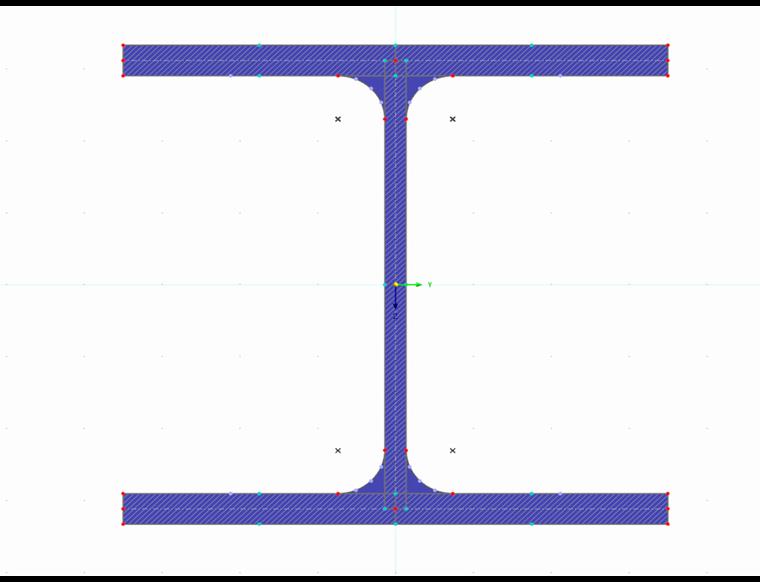
| Cross-section | HEA 140 - DIN 1025-3 |
| Max. static moment | max. Sy = 86.77 cm3 (determined using RSECTION 1) |
| Moment of inertia | Iy = 1033.34 cm4 (determined using RSECTION 1) |
| Section modulus | Wy = 155.4 cm3 |
| Web thickness | tw = 0.55 cm |
Shear stress design:
Axial stress design:
The minimum critical component temperature is governing:
Application Example in RFEM 6
In order to perform a fire resistance design in RFEM 6, it is necessary to assign an ultimate configuration to the members to be designed in the Steel Design add-on in addition to the fire resistance configuration.
The load combinations in the design situation for the fire resistance design are determined using the main design situation ψ2.1 according to EN 1990 | 2010-04.
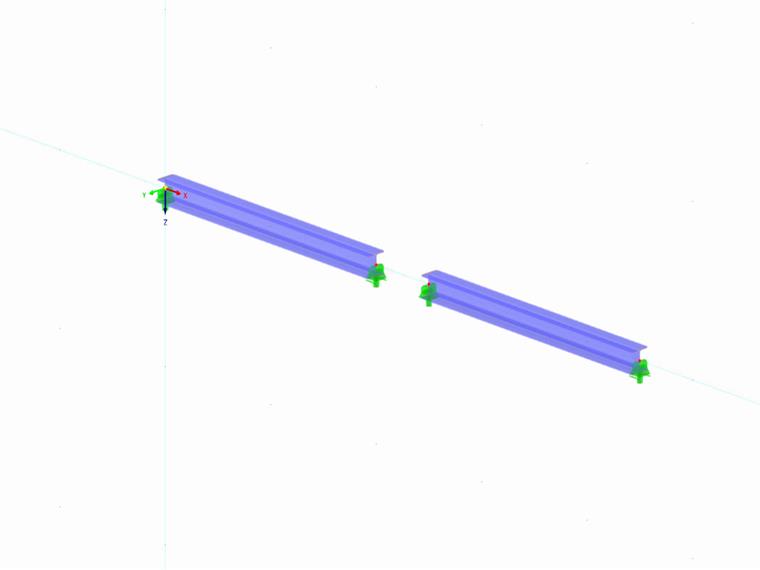
In the attached example model, a fire resistance configuration is assigned to members No. 1 and 2. In the main dialog box under the design parameters, the calculation of the critical component temperature is selected.
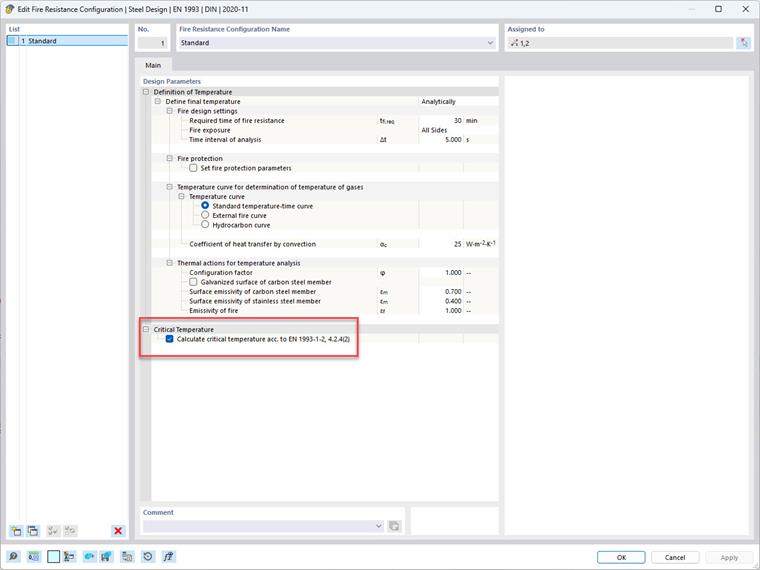
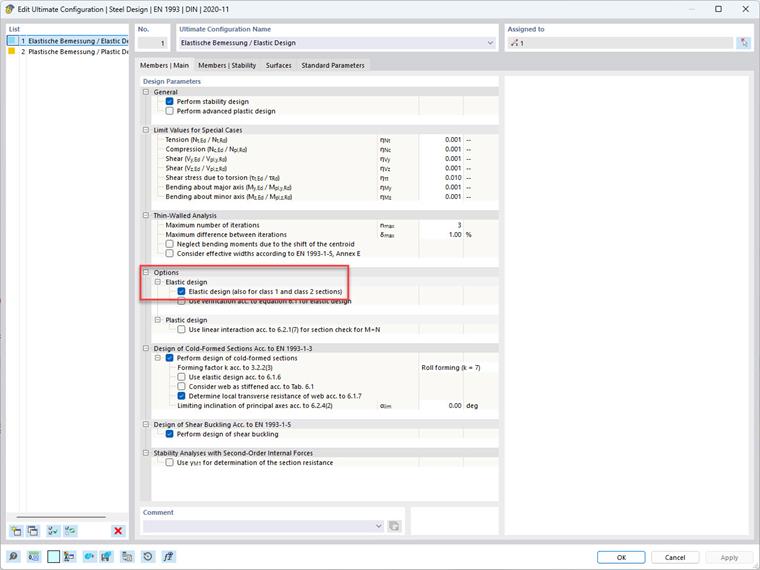
The decision as to whether the cross-section checks in the fire resistance design are elastic or plastic is made in the ultimate configuration: "Main|Members" tab – Options – Elastic design (also for cross-sections of Class 1 and 2). If this option is selected, the design is elastic; otherwise, if possible, it is plastic.
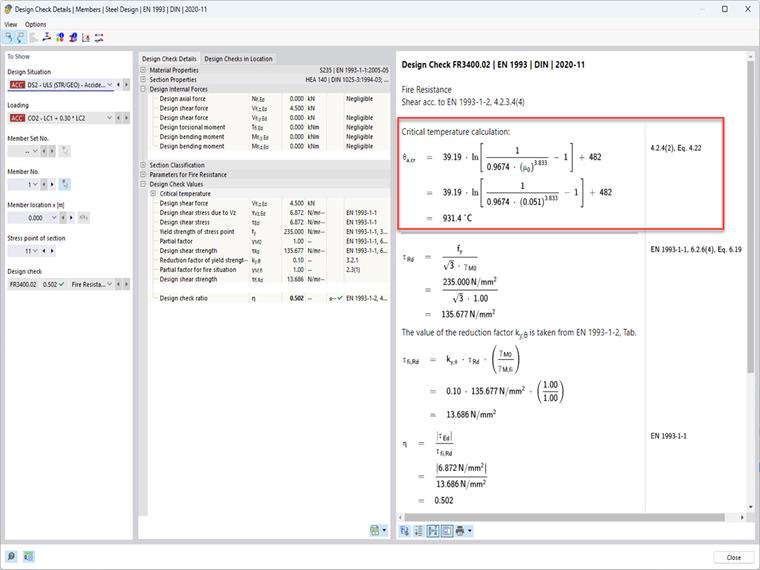
After the steel design calculation has been performed, the design check details show the results for the fire resistance design as well as the calculation of the critical component temperature.
Checking Limits of Application in RFEM 6
RFEM 6 automatically checks the application limits regarding the restriction to cross-section classes 1 to 3 and the restriction to the minimum design ratio μ0,min = 0.013. If these limits are exceeded, corresponding messages are displayed.
To download the models used, refer to "Models for Download" at the bottom of the website or click on the following images.