🌬️ Introduction
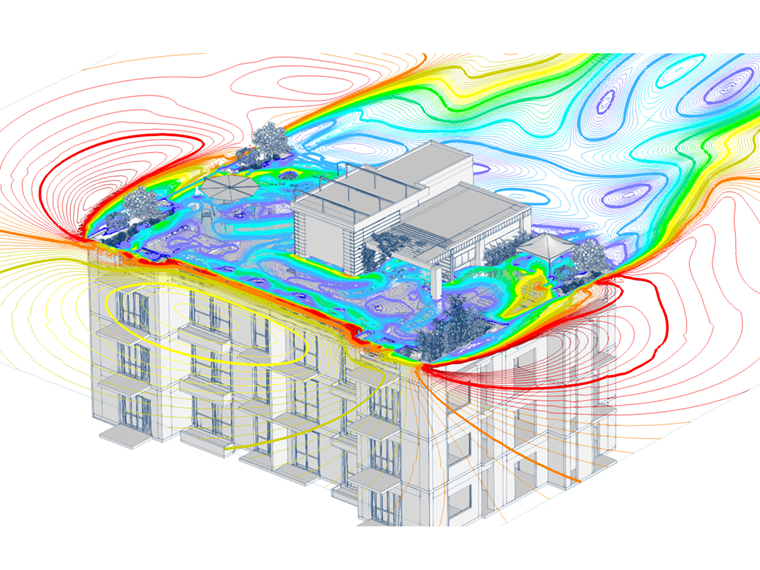
With the growing trend toward sustainable and multifunctional building design, rooftops have become active spaces that host a wide variety of installations from HVAC systems and solar panels to green roofs, antennas, and even lightweight recreational structures. While these elements enhance a building’s functionality and aesthetics, they also introduce new aerodynamic challenges. Understanding and accurately simulating wind behavior around rooftop equipment is crucial for preventing structural failures, optimizing performance, and ensuring safety and comfort.
⚙️ Why is the rooftop equipment highly sensitive to wind effects?
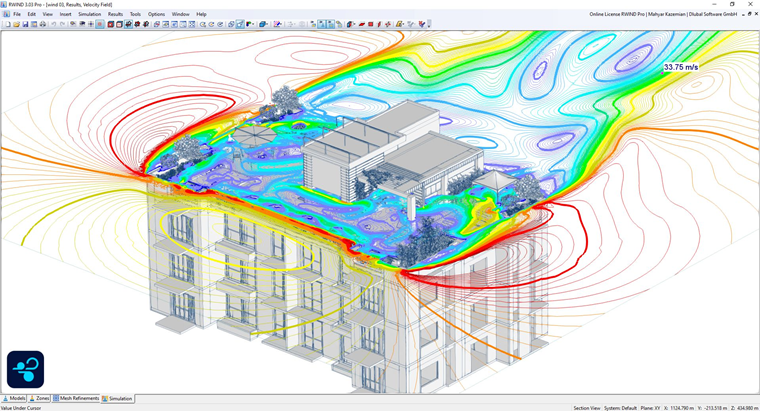
Rooftop structures are typically installed in zones of high wind exposure, where local flow acceleration, turbulence, and vortex formation can significantly amplify wind pressure. Unlike main building components designed according to standardized wind load codes, rooftop systems often have complex geometries, irregular arrangements, and varying stiffness levels.
Common aerodynamic issues include:
- Uplift and overturning forces acting on lightweight elements (for example, solar panels, HVAC units).
- Vortex shedding and dynamic oscillations on antenna masts or slender supports.
- Flow separation zones causing pressure fluctuations around parapets and mechanical units.
- Wind-induced noise or vibration affecting user comfort and equipment performance.
📌Note: The implementation of aeroelastic instability and Vortex-Induced Vibration (VIV) analysis in RWIND is planned as a key future enhancement. This development aims to extend the software’s capabilities toward comprehensive dynamic wind–structure interaction studies, enabling more accurate prediction and assessment of wind-induced responses on flexible and slender structures.
🧭 Limitations of Code-Based Approaches
Building codes such as EN 1991-1-4 (Eurocode 1), ASCE 7-22, or WTG-Merkblatt M3 provide general guidelines for wind loads on building envelopes. However, their applicability to small-scale, irregular rooftop components is limited. Standardized pressure coefficients often fail to capture accurately the complex local flow interactions between:
- Multiple rooftop units
- Varying roof slopes or parapet heights
- Surrounding urban terrain or nearby buildings
This is where CFD-based wind simulation becomes an indispensable engineering tool.
💻 Benefits of CFD Wind Simulation
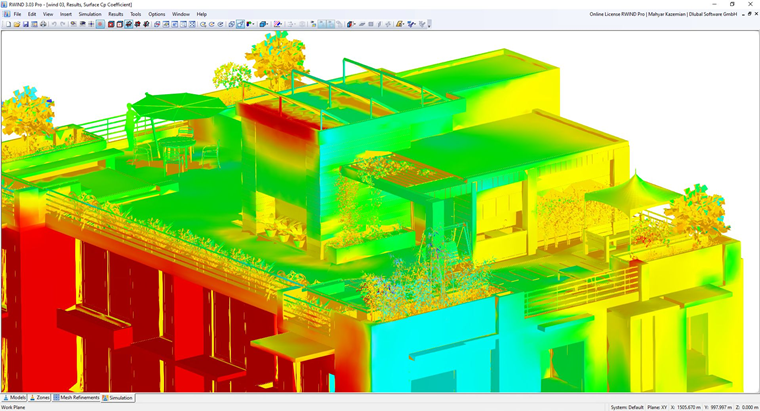
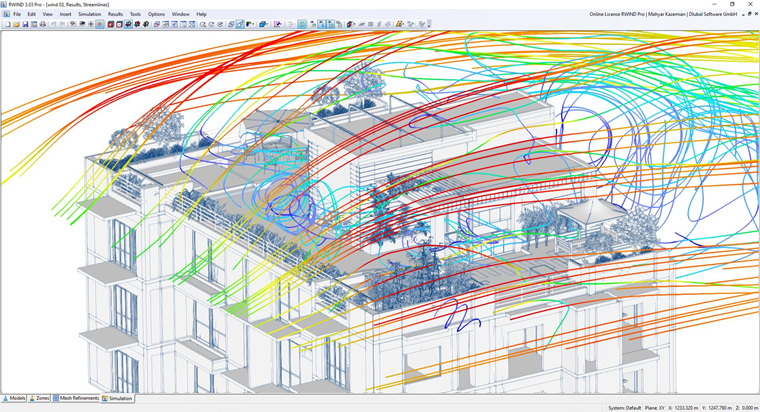
Modern Computational Fluid Dynamics (CFD) methods, such as those implemented in RWIND, offer advanced insight into rooftop wind phenomena by solving the Navier–Stokes equations in three dimensions. With LES (Large Eddy Simulation), DDES (Delayed Detached Eddy Simulation) and RANS (Reynolds-Averaged Navier–Stokes) turbulence models, engineers can visualize and quantify critical flow characteristics, such as:
- Pressure distribution on all surfaces (for accurate load transfer to structural models like RFEM 6).
- Flow streamlines showing recirculation zones or stagnation points.
- Lift, drag, and moment coefficients for structural anchorage design.
- Transient wind behavior (gusts, vortex shedding) under realistic inlet conditions.
Such analyses allow precise optimization of anchoring systems, shielding effects, and safety factors, reducing material costs while increasing reliability.
🏗️ Practical Applications
1. HVAC Systems:
Wind can create uplift or suction forces under and around large mechanical units. CFD helps determine optimal locations, enclosure shapes, or deflector panels to minimize turbulence and noise.
2. Solar Panel Arrays:
Tilted photovoltaic modules can act as aerodynamic surfaces. Simulation identifies the most critical wind directions and evaluates ballast requirements or frame stability.
3. Communication Antennas:
For slender antenna masts or satellite dishes, dynamic wind actions can intensify structural response. Time-dependent CFD results support detailed analysis.
4. Roof Gardens and Lightweight Structures:
Canopies, pergolas, or green roofs require wind comfort and load verification for both structural elements and users. CFD provides a basis for optimizing windbreak walls or vegetation layouts.
🧩 Integration with Structural Analysis
Using the RWIND and RFEM interface, calculated surface pressures from CFD can be automatically transferred as load cases to the structural model. This enables:
- Direct combination with other load types (dead, snow, thermal)
- Structural design according to Eurocode or ASCE standards
- Iterative design optimization, especially for complex assemblies or retrofitted systems
🔍 Case Study: Impact of Installation Height on Wind Loads of Rooftop Membrane Structures
This case study investigates how installation height critically influences wind loads acting on a membrane structure used as rooftop equipment. The same membrane geometry was analyzed at two locations: near ground level and on the roof of a tall building. Despite identical geometry and boundary conditions, the rooftop installation experienced approximately 33% higher resultant wind force compared to the ground-level case.
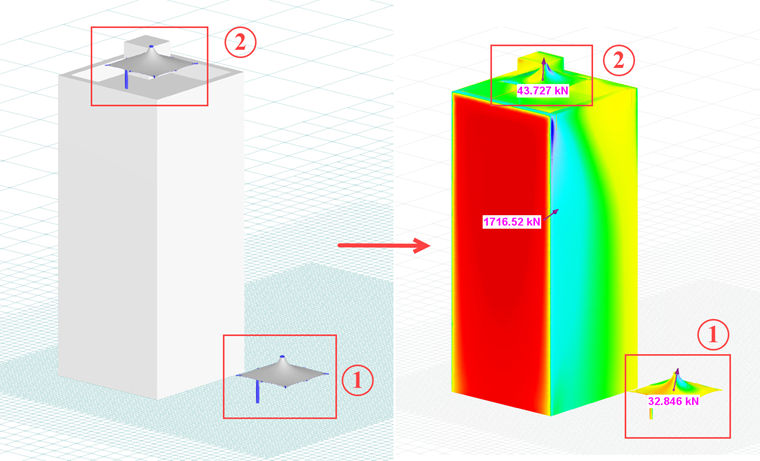
The increase is mainly driven by higher wind velocities at elevated heights due to the atmospheric boundary layer, combined with local flow acceleration, separation, and strong suction effects at roof edges. Rooftop exposure also introduces higher turbulence intensity and peak pressure fluctuations, which are particularly critical for lightweight and flexible membrane systems.
The results highlight that membrane structures designed on the basis of ground-level assumptions may be significantly underdesigned when installed on rooftops. Accurate CFD-based wind simulation that includes building geometry, height-dependent wind profiles, and roof-edge effects is, therefore, essential to ensure structural safety and the serviceability of rooftop membrane equipment.
✅ Conclusion
Accurate wind simulation is not merely an academic exercise, it is a practical necessity in modern building design. As rooftop utilization continues to expand, CFD-based wind analysis provides engineers, architects, and building owners with the tools needed to ensure:
- Structural safety
- Operational reliability
- Long-term performance of rooftop installations under real wind conditions
By integrating simulation results into the design workflow early, engineers can make informed decisions that balance aesthetics, functionality, and safety, creating rooftops that perform as beautifully as they look.