


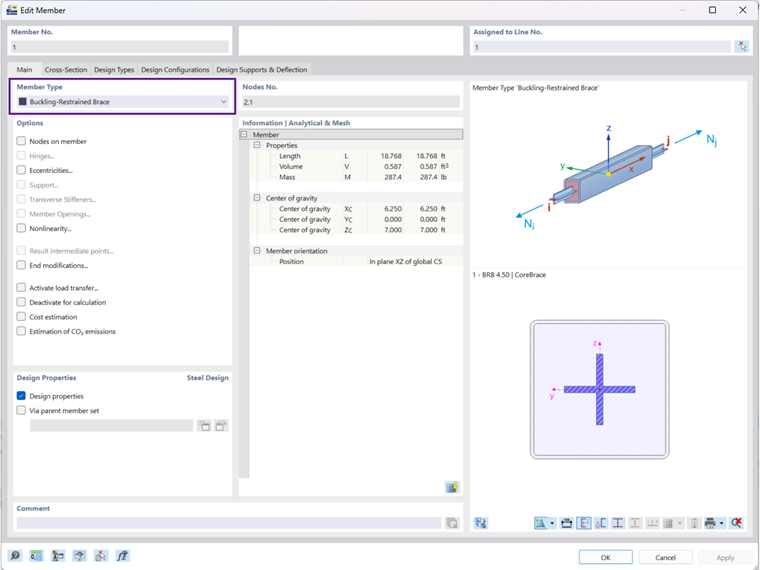
The cross-section library includes both Standardized and Composite BRB sections (Image 2). In most applications, the standardized sections are sufficient.
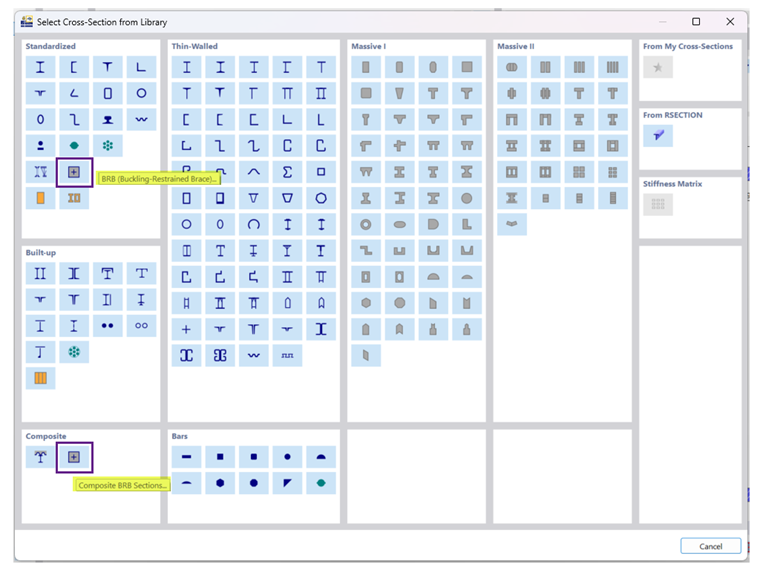
For standardized sections, CoreBrace products are available. To access them, set the region to "--" or "All" and select Buckling-Restrained Brace as the material type (Image 3).
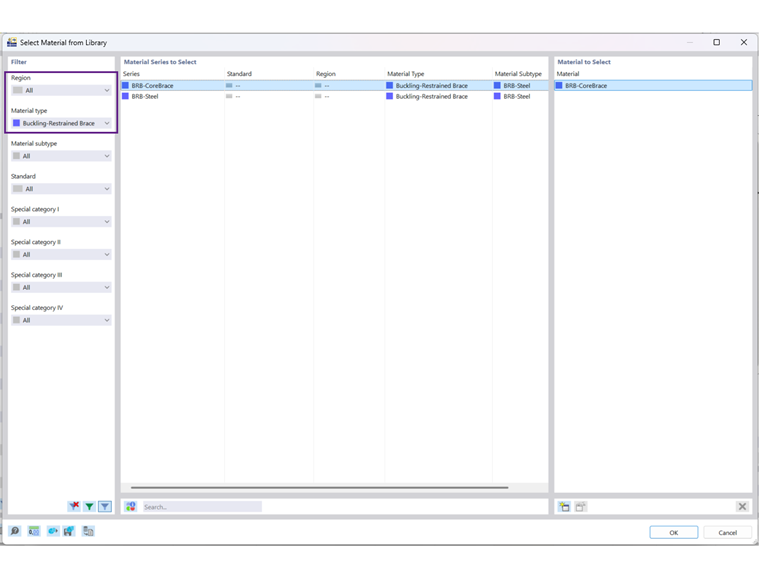
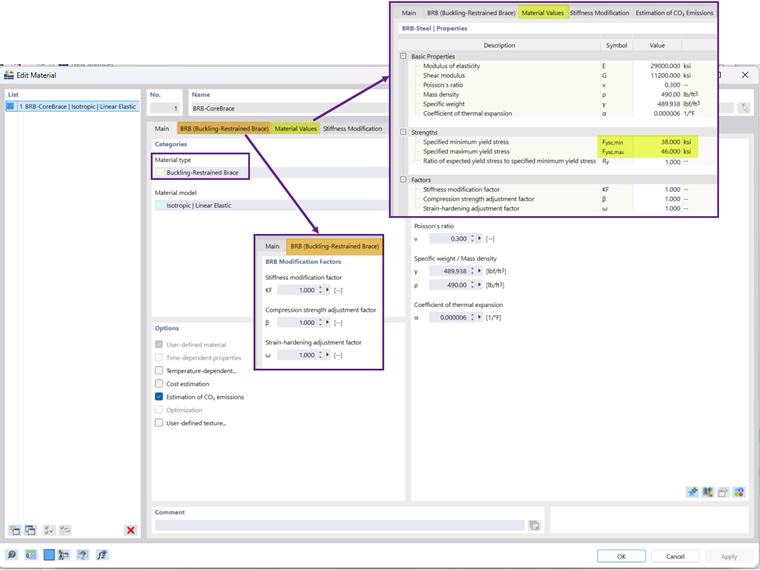
After selecting BRB as the material type, the following modification factors can be defined (Image 4):
- 1) Stiffness Modification Factor, KF
This factor accounts for the increased axial stiffness of the BRB in accordance with AISC Seismic Design Manual Section 5.5 [2]. It depends on the brace strength, frame geometry, and connection details (bolted, welded, or pinned). Typical values range from 1.20 to 2.00 in increments of 0.05.
- 2) Compression Strength Adjustment Factor, β
This factor accounts for the compression force exceeding the tension force due to BRB behavior, as described in AISC 341, Section F4.2b [1]. The value depends primarily on the expected strain demand in the steel core and the connection details.
- 3) Strain-Hardening Adjustment Factor, ω
This factor accounts for the increase in brace strength after yielding due to strain hardening, as described in AISC 341, Section F4.2b [1]. Similar to β, it depends on the expected strain demand in the steel core and the connection details.
These adjustment factors are typically provided by the BRB manufacturer. For preliminary design, they may be estimated using design aids published by the manufacturer. In a future release, RFEM will be able to automatically calculate these initial values for preliminary design.
The minimum and maximum yield stresses of the steel core can be specified in the Material Values tab.
Buckling-Restrained Braced Frame (BRBF) Design in the Steel Design Add-On
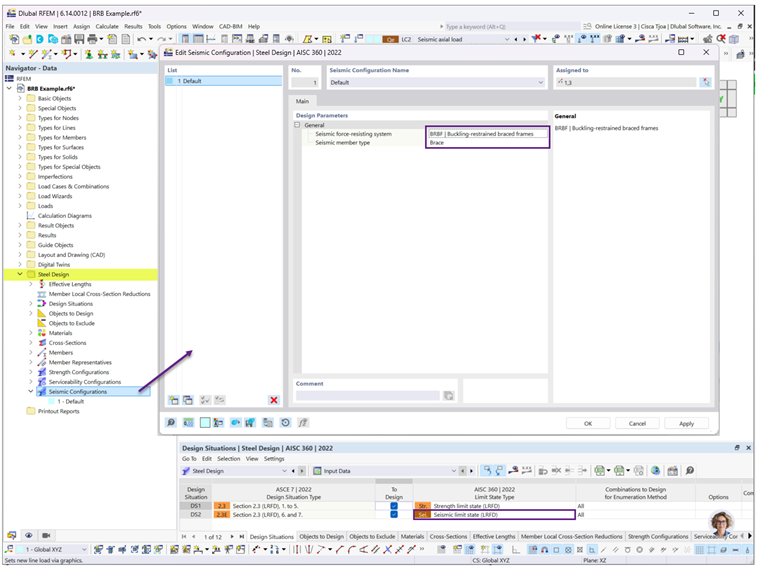
In the Steel Design add-on, a new Seismic Configuration can be defined by selecting the appropriate SFRS Frame Type and Member Type (Image 5). Currently, only BRB braces can be designed within the BRBF system. BRBF beams and columns will be added in a future release.
AISC 341 seismic design checks are performed only when Seismic Limit State is selected as the limit state type (Image 5).
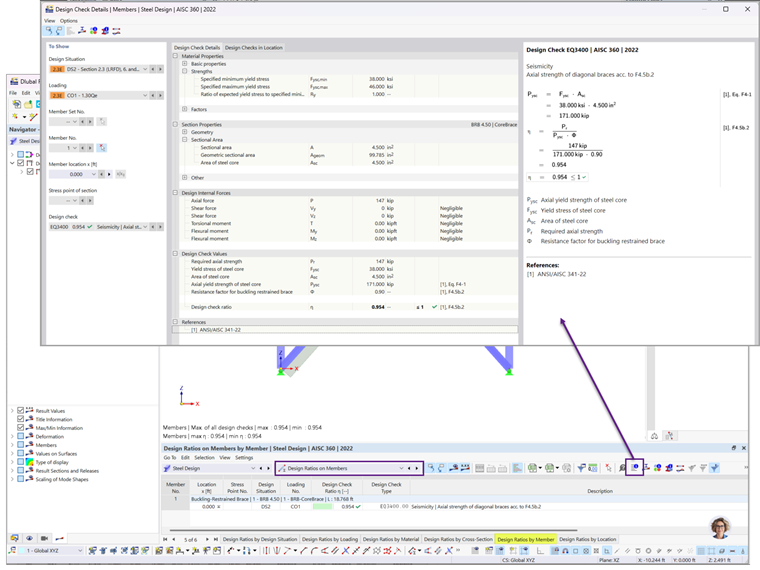
The design axial strength of the steel core is reported in the Steel Design results table (Image 6).
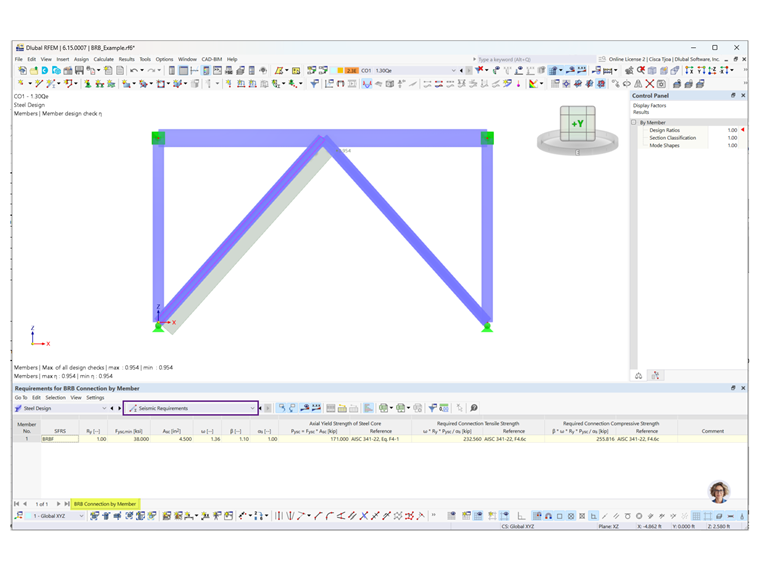
In addition, the BRB Connection by Member tab in the Seismic Requirements table provides the required strength used to design the brace connections and adjoining members (Image 7).
 Knowledge Base