Arched Structures Made of Pipe Sections
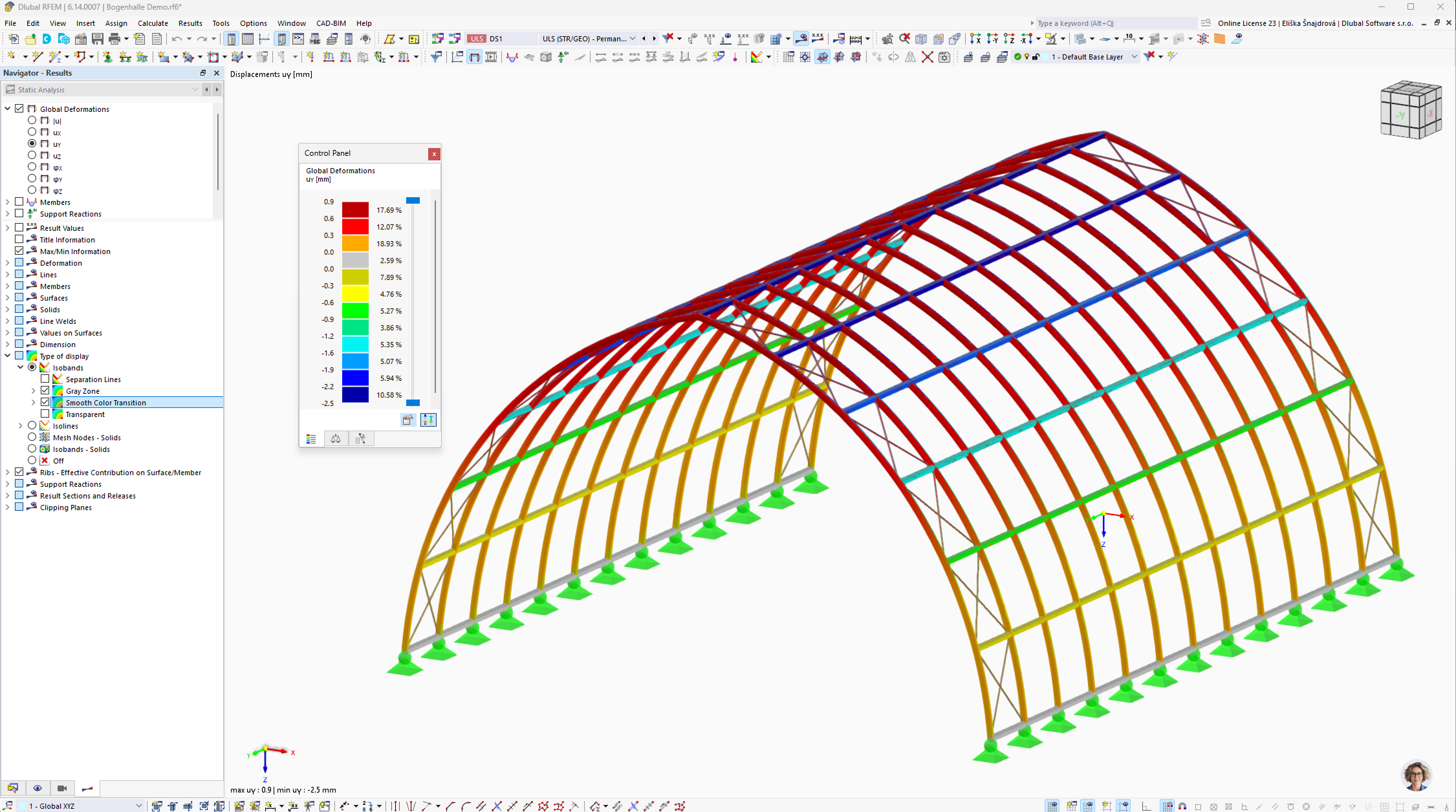
Arched structures made of pipe sections present unique structural challenges compared to conventional hall structures using rolled sections. The curved geometry requires a precise determination of critical loads as well as a careful evaluation of structure stability, particularly buckling behavior under wind and snow loads. For Statik Breinbauer, which regularly works for a client specializing in this construction method, developing a reliable and repeatable engineering workflow was crucial—one capable of handling second-order analysis, complex connection geometries, and various load cases.
Steel Design with RFEM 6
Statik Breinbauer uses RFEM 6 as its primary tool for the complete structural design of arched hall projects. Using the Structure Stability add-on, the team determines critical loads and derives imperfections directly from the calculated buckling modes, which are then incorporated into the subsequent design. The Steel Design add-on handles stability analyses according to standards, while the Steel Joints add-on allows for a detailed FEM-based evaluation of connections involving individual structural components. A CAD-to-RFEM workflow via DXF import as a background layer further accelerates model creation—from geometry import to a fully verified structural model with minimal effort.
Advantages of Using Dlubal Software
- Precise stability analysis for curved structures — The Structure Stability add-on allows for the reliable determination of critical loads and the derivation of imperfections from buckling modes — indispensable for the design of arched halls.
- Faster modeling through DXF import — Importing CAD geometry as a background layer in RFEM significantly reduces modeling effort and minimizes input errors for recurring project types.
- Complete joint design in a single environment — The Steel Joints add-on allows for the individual assembly of structural components for complex tubular joints — a capability often missing in other programs.
- Seamless documentation for review engineers — The transfer of calculation documentation and the RFEM model file ensures a smooth design process without the need for follow-up questions regarding FEM-based joint design.