


You could use the 'Insert' menu again to define the cross-sections of the platform. Alternatively, double-click the Cross-Sections item in the navigator (see the Navigator - Data image).
Circular Cross-Section
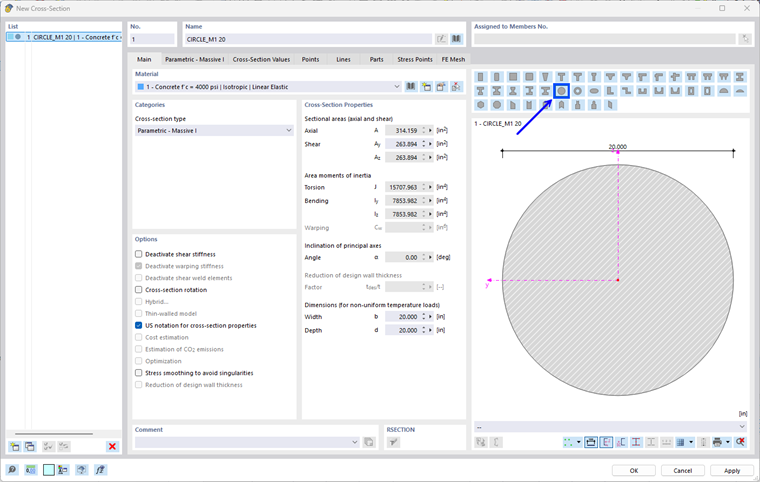
The 'New Cross-Section' dialog box appears. To define the concrete column, click the
 button above the rectangular cross-section image. A circular cross-section is shown subsequently.
Check whether the f'c = 4000 psi material is set. Then select the Parametric - Massive I tab (1). Enter 12.000 in to define the diameter (2).
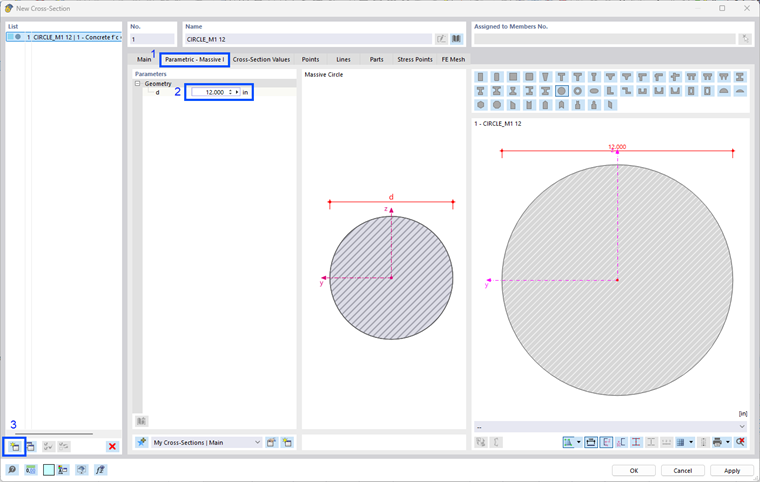
To continue defining cross-sections, click the
 button in the bottom-left corner of the dialog box (3).
W Cross-Section
Cross-section no. 2 is created. To allocate the W 8x31 cross-section, click the
 button in the 'Name' area. The cross-section library is opened.
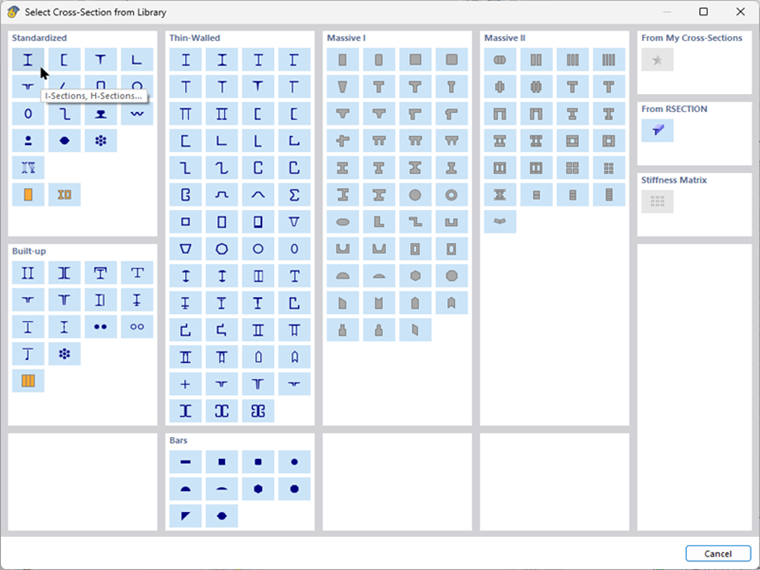
Click the
 button in the 'Standardized' area. In the next dialog box, use the filter options to select the cross-section.
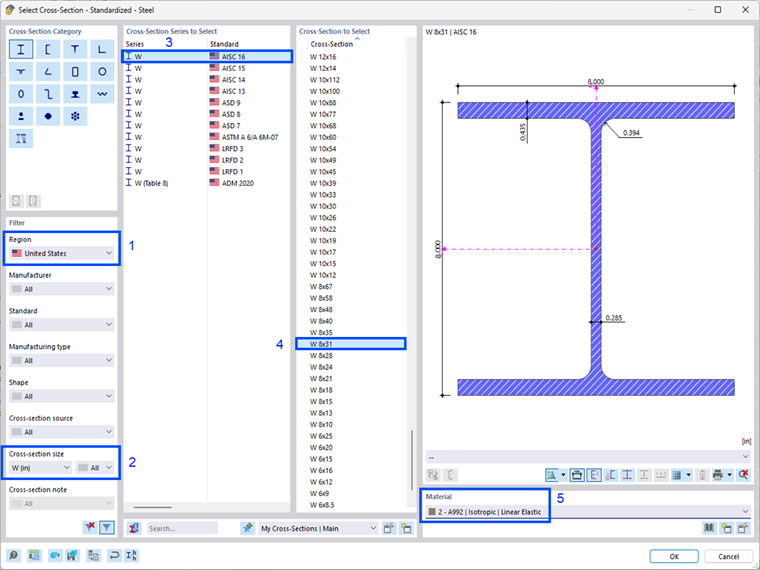
In the 'Filter' area, select the United States region (1) and the W (in) size (2) from the lists.
Select AISC 16 standard (3). Then select the W 8x31 cross-section in the right column (4).
If the A992 steel material has not been set automatically, select it from the list (5). Click OK to return to the 'New Cross-Section' dialog box.
W Cross-Section
You could define the W 8x18 cross-section in the same way. To apply a different method, however, click OK and close the 'New Cross-Section' dialog box.
You can find all objects in the table underneath the workspace. The 'Materials' table contains the two materials and their properties, for example, whereas the 'Cross-Sections' table displays the two cross-sections.

To define the W 8x18 cross-section, select the 'Cross-Section Name' cell of line 3. Enter W 8x18 (note the space between "W" and "8") to activate a list of corresponding cross-sections while typing. Select the AISC 16 cross-section.
Make sure that A992 is set in the 'Material' column so that the proper material is allocated.
The essential cross-sections of the model have been defined now. It would be possible to create the downstand beam of the slab, too, but this is shown at a later step.