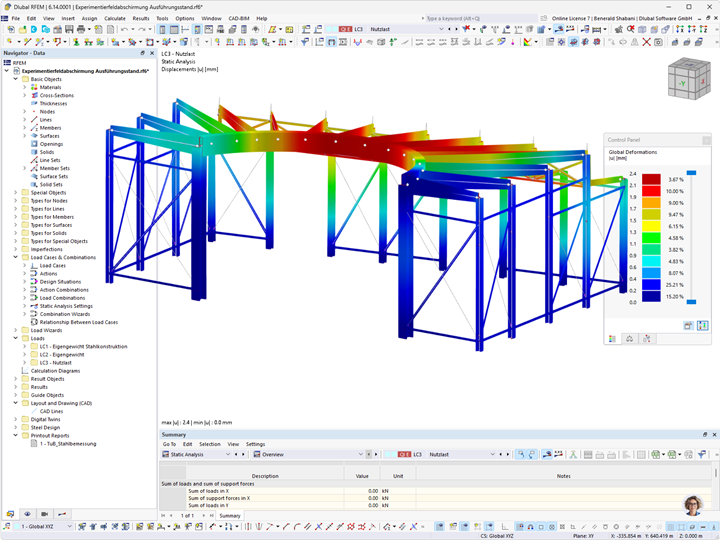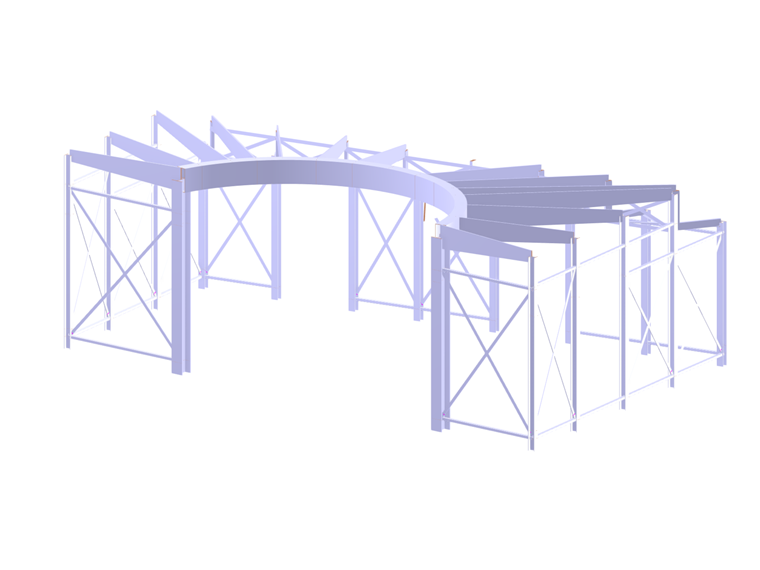
The Dlubal customer TuB Tragwerk GmbH was responsible for the structural design of the radiation shielding enclosure. The TuB engineers used RFEM for 3D modeling, calculation, and steel design.
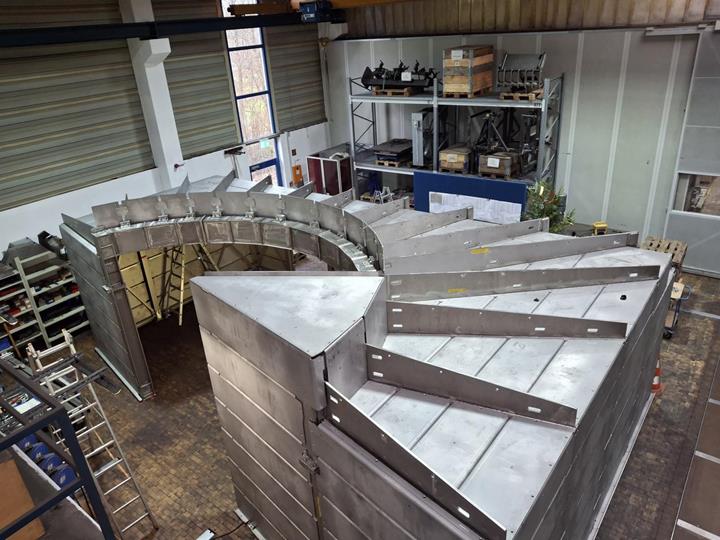
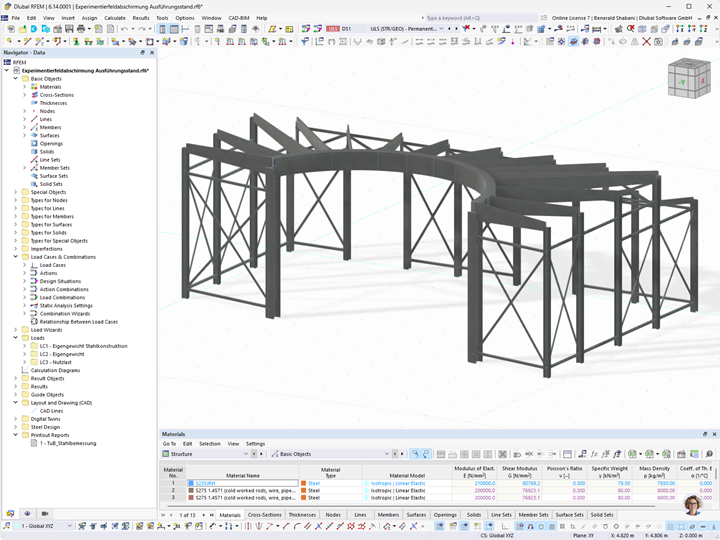
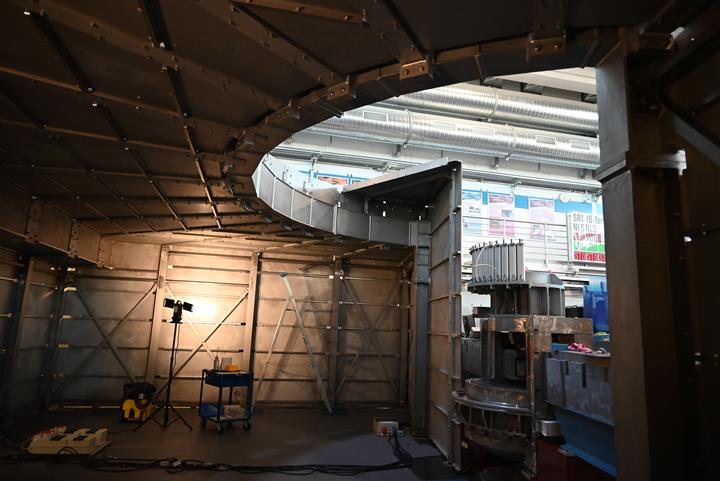
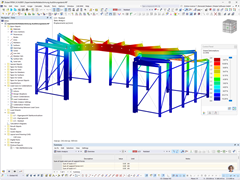
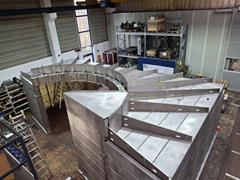
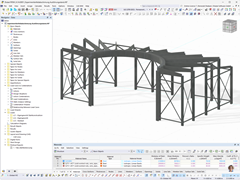
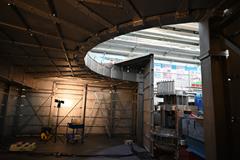
The enclosure spans a trapezoidal floor plan measuring approximately 10.0 m × 6.5 m (32.8 ft × 21.3 ft) without any columns. On the diagonal side, the ceiling structure features a semicircular opening to allow materials to be brought into the experimental room. A ring girder is arranged on two columns along this edge of the ceiling. Radially arranged ceiling girders extend from this ring girder with a cross-section depth that decreases toward the outside. Each ceiling girder is supported in the plane of the walls on a hinged column.
An electrical conduit runs along the adjacent hall wall. Here, the ceiling structure is designed with a height offset.
The ring beam is designed as a box girder. The floor loads are transferred to the two columns via bending and torsion. The floor beams, which are rigidly connected, ensure the stabilization of the ring beam. At the ends of the ring beam, the load-bearing columns are also rigidly connected, which minimizes floor deflections.
The structure is braced by bracing members arranged between the columns in the plane of the exterior walls.
Since the experimental setup requires non-magnetic materials, all steel components were fabricated from 1.4571 stainless steel of grade S275. To ensure radiation protection, the structure was coated with lead sheathing with a thickness of 50–70 mm (1.97–2.76 in). These were mounted on stainless steel plates with a thickness of 10 mm (0.39 in), which are attached to the substructure in the wall and ceiling areas.
| Location | Technical University of Munich |
| Investor | Heinz Maier-Leibnitz Research Neutron Source (FRM II) Technical University of Munich www.frm2.tum.de |
| Steel Construction | Peter Feckl Maschinenbau GmbH |
| Structural Design | TuB Tragwerk GmbH |