


|
Author
|
Michaela Rotterová
|
|
University
|
CTU | Faculty of Civil Engineering, Czech Republic
|
Abstract
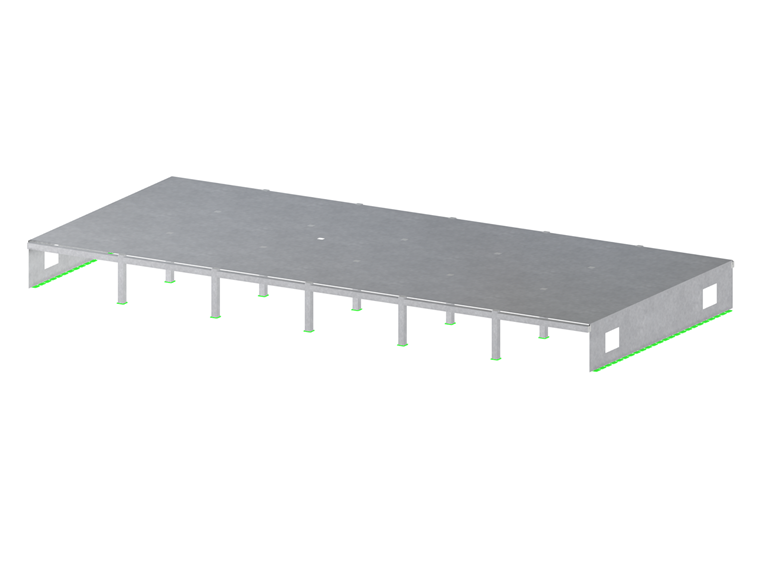
This Bachelor’s thesis addresses the punching shear design and analysis of locally supported reinforced concrete slabs. The main objective of the thesis is to compare various methods and tools for punching shear design and shear reinforcement design, followed by an illustrative analysis of the influence of slab thickness and column dimensions on the punching shear behavior. Calculations are performed on a specified reinforced concrete structure.
For this structure, a comparison is made between manual calculations according to the 1st and 2nd generations of the Eurocode (ČSN EN 1992-1-1) and the results from the engineering software programs RFEM 6, SCIA Engineer 25, and FIN EC 2026. The comparison of manual calculations according to the 1st and 2nd generations of the Eurocode (ČSN EN 1992-1-1) shows that, although the resulting number of shear members and stirrups is identical, the results obtained by manual calculation according to the 2nd generation exhibit a higher degree of utilization. This difference is a consequence of the differing theoretical approaches of the two standards. Calculations using engineering software were performed only according to the first generation of the Eurocode, as the second generation has not yet been implemented in the software. A comparison of the results from manual calculations (according to the first generation of the Eurocode) and those from engineering software shows that a more economical design can be achieved using engineering software.
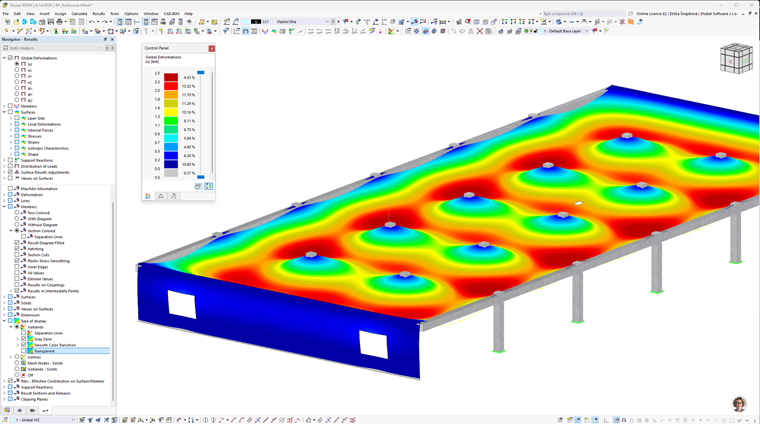
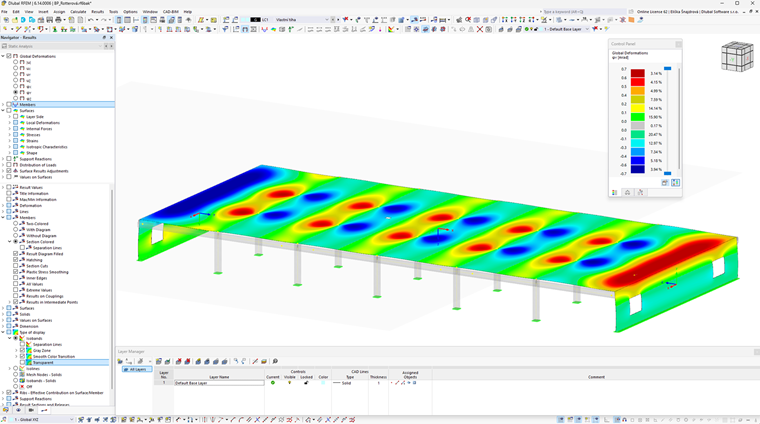
In the next section of this work, an illustrative analysis was performed to examine the influence of slab thickness and column dimensions on the punching shear capacity of elements without shear reinforcement. The results show that increasing the slab thickness—for example, by adding caps—has a more significant effect on the load-bearing capacity than increasing the column dimensions.
The overall evaluation indicates that engineering software results in savings in shear reinforcement compared to the manual method. The illustrative analysis shows that adjusting the slab thickness is a more effective solution for increasing the punching shear resistance than increasing the column perimeter.
This bachelor’s thesis is included in the Dlubal Talent CTU 2026 competition.