


Charles Ellis: Forgotten Hero of the Golden Gate
A red steel giant, spanning the entrance to San Francisco Bay with record dimensions. The name behind this incomparable feat of engineering seemed to have been known for a long time. But historians have proven that the true technical genius behind the Golden Gate Bridge was none other than Charles Ellis.
We take a closer look at the story of this engineer and immerse ourselves in a world of passion for structural engineering, rivalries, a masterful structure, and the fog of oblivion over San Francisco Bay. Who was Charles Ellis? And why would the Golden Gate Bridge never have been possible without him? Stay tuned!

Cheers for the Golden Gate Bridge – But Not for Charles Ellis
The Golden Gate Bridge opened in 1937. A masterpiece of engineering. After more than four years of construction, the gigantic steel bridge finally towered over the entrance to San Francisco Bay. The masterminds behind the bridge were celebrated with an exuberant celebration.
Cheers, fame, and thunderous applause for chief engineer Joseph Strauss. But one important man was missing: Charles Ellis. Decades later, his name is still virtually unknown. Engineer Charles Ellis never stood in the spotlight. He wasn't even invited to the opening. Yet without Charles Ellis, the Golden Gate Bridge would probably never have been built.
Charles Ellis: Building Impossible Bridge
In the early 20th century, there were calls for a very special bridge. It was to connect San Francisco and the Marin Peninsula: a crucial trade hub. Both by water and by land. For a long time, it was considered impossible to build. The winds were too strong, the span too large. For the time, it was almost unthinkable.
Chief engineer Joseph Strauss presented his first designs in 1921. A hybrid bridge consisting of a suspension bridge and truss girders. The engineers among you are probably already shaking your heads. It couldn't have worked. In fact, Strauss had little experience with extremely large spans.
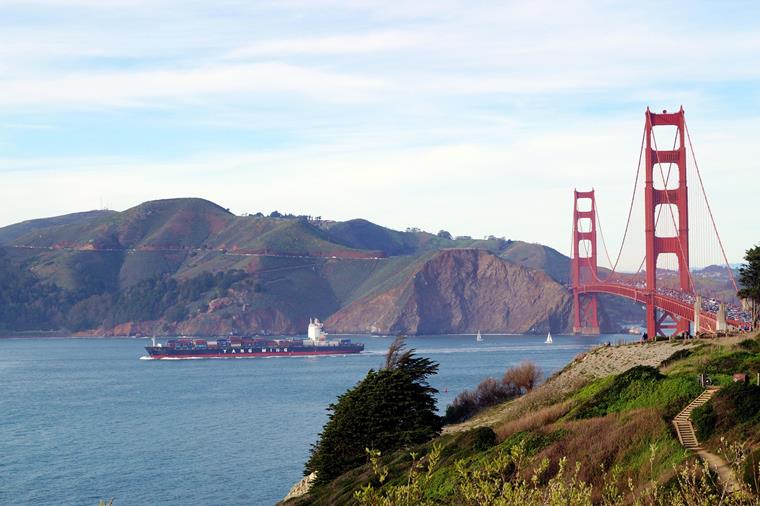
His designs were too difficult, too inefficient, and didn't look particularly good either. However, this is hardly surprising, as a span of over 1,280 meters was greater than anything that had ever been built before. At this point, those responsible decided to bring in a real expert for such cases: Charles Ellis.
Role of Charles Ellis in Building the Golden Gate Bridge
Why was Charles Ellis so important to the project? Quite simply, he was the best in his field. Hardly anyone was better suited for the job than him. Charles Ellis was a professor of structural engineering at the University of Illinois, and his main areas of expertise were:
- Elasticity theory
- Suspension bridge calculations
- Complex load models
In other words, exactly what the Golden Gate Bridge project urgently needed. His task was to translate Joseph Strauss's ideas into a calculable reality. It was necessary to determine all the important data, from the main cable diameter and tower heights to the wind force behavior.
Breakthrough for Charles Ellis: Deflection Theory
At that time, the deflection theory had already been around for several decades, but its practical application was relatively new. The principle is simple. Previously, bridges were built with as much stiffness as possible to prevent deflection. Nevertheless, there were many accidents in which such suspension bridges collapsed.
A very striking example of this was the Broughton Suspension Bridge near Manchester, which we briefly report on in this article: Millennium Bridge: Why Bridges Sway . It collapsed due to the well-known problem of natural vibrations. Older bridges were built to be extremely rigid in order to minimize deflection. But according to the deflection theory, this was exactly the wrong approach.
Since 1888, the theory gradually spread. The key point: a certain amount of flexibility in the structure is safer and more efficient. The deflection of the bridge deck and the deformation of the associated suspension cable work together.
This suddenly made it possible to use lighter and slender supporting structures. The stiffness of the suspension cable also contributes to the supporting capacity. Finally, suspension bridges remained stable even under deformation, for example due to vibrations and wind forces.
Ellis used this theory for his calculations. He determined how much the bridge could elastically deform under traffic load without the structure failing. In contrast to Strauss's designs, this allowed for a lower weight, lower material costs, and the desired gigantic span. Without these calculations, the bridge would either have been too expensive or would not have been approved for safety reasons.
Charles Ellis' Calculations for the Golden Gate Bridge
Let's get to the heart of the matter. What exactly did Charles Ellis calculate for the Golden Gate Bridge? The short answer: everything. For anyone interested in the details, here is a brief overview.
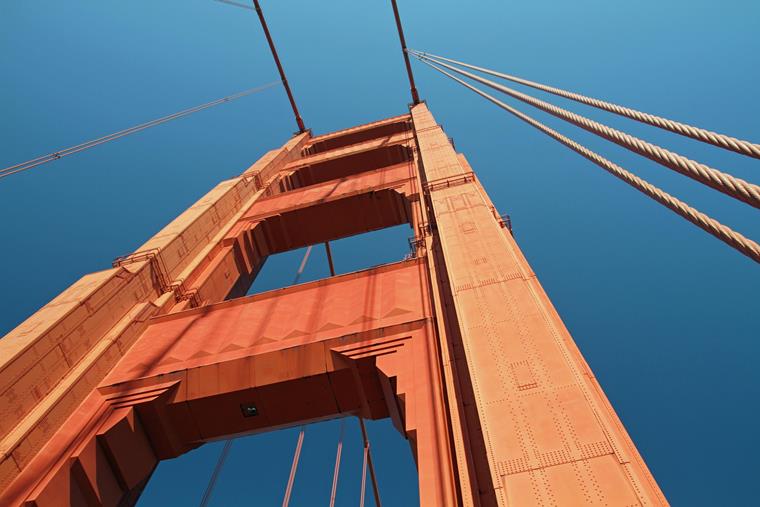
Charles Ellis determined the necessary diameter of the suspension cables to be approximately 92 cm, the maximum tensile forces to be approximately 90,000 tons per cable, and the total load. The towers were also under his calculational supervision. With a height of 227 m above sea level, these were already something special. Many key factors were important here:
- Cross-section dimensions
- Buckling stability
- Self-weight
- Cable forces
- Wind loads
And speaking of loads: the Golden Gate Bridge has a truss stiffener with a height of approx. 7.6 m. As tiny as it may seem in comparison to the bridge, its role is supporting. Literally. Because this girder has the task of preventing dangerous vibrations.
Ellis calculated its stiffness, the stresses under traffic loads and ensured sufficient wind stability. Wind was one of the greatest risks of the entire Golden Gate project. Charles Ellis knew this and therefore devoted himself to the subject in detail.
After all, the Golden Gate Bridge is still known today for extreme winds and constantly changing extreme weather. Keep in mind that back then there were no wind tunnel tests, no computers. Charles Ellis had to theoretically model all wind loads.
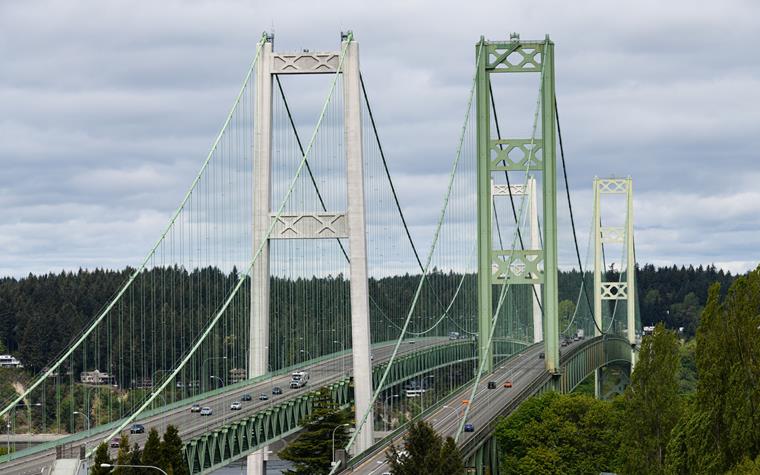
Whether lateral loads or torsional forces: he performed all calculations with pen, paper, and slide rule. Many of you can probably imagine how time-consuming this was. But the effort was worth it! By way of comparison, just three years after the Golden Gate Bridge opened, the Tacoma Narrows Bridge collapsed due to strong winds. We report on this in this article: Millennium Bridge: Why Bridges Sway . Charles Ellis' bridge, on the other hand, has remained stable to this day.
Charles Alton Ellis: It's All Matter of Form
The final design of the Golden Gate Bridge can also be traced back to Charles A. Ellis. For example, based on his calculations, he specified the sag of the cables to be approximately 152 m. This was a very crucial value for the bridge. Why was it so important?
If the cables are too tight, too much force has direct action on them. This could cause them to break under the load at some point. And what if the cables are too loose? Then the bridge is too flexible, moves too much, and could give way at some point. Charles Ellis optimized this value, so that the length of the cables was exactly right.
Scope of Charles Ellis's Work
The engineers among you will surely already have guessed. Calculating such a complex bridge in its entirety – and by hand – was no mean feat. Charles Ellis produced over 10,000 pages of calculations, all using nothing but paper, pencil, and slide rule.
To achieve this, he worked two years without a break. Day and night, seven days a week, and often to the point of complete exhaustion. He became the central technical mind behind the entire bridge project. His documents formed the basis for the construction of the Golden Gate Bridge: an incredibly impressive achievement. This was certainly recognized accordingly. Right?
Charles Ellis: Dismissal from the Project
Having such a technically gifted mind on the team: Chief Engineer Strauss must have been particularly proud of that. In fact, the opposite could hardly be more true. For Strauss, everything took too long and was therefore too expensive. And that was despite Charles Ellis already working day and night. The scope and complexity of Ellis's calculations were too much for his boss.
The two argued and Ellis was dismissed in 1931, two years before the construction began. The official reason: Strauss accused him of wasting time. And that despite the fact that Charles Ellis' calculations were already complete. So it's possible that envy was a major factor here. This impression was intensified by the fact that Strauss deleted Ellis’ name from all the records.
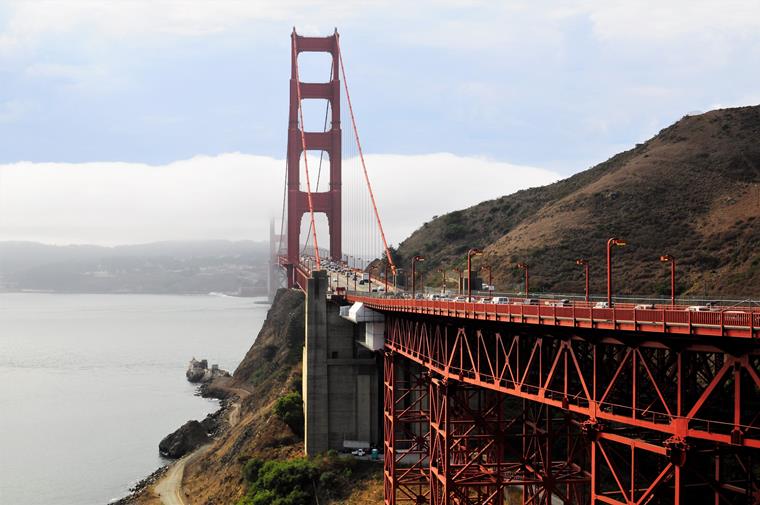
What happened then with Charles Ellis' calculations?
The irony of it all: the structural engineers on site continued to use all of Charles Ellis' documents. Ultimately, the final bridge essentially corresponded to the calculations made by the structural engineering professor. What's more, they were incorporated into every single structural component.
For example, Charles Ellis had determined the required amount of wire that was then used on site to spin the cables. Incidentally, the cables came from the Roebling company, which was backed by John A. Roebling, another interesting person we have already mentioned here: John A. Roebling: Tragic Story Behind Brooklyn Bridge
Ellis had also calculated everything in advance for the different construction stages. These included, for example, the load conditions while the bridge was halfway finished. Asymmetrical loads that could have catastrophic consequences with the slightest deviations.
Even the behavior of the Golden Gate Bridge under traffic load was based on his models. Charles Ellis calculated the maximum deflection under full traffic load to be approximately 3 m, which should not compromise the stability of the bridge. To this day, his predictions show that they are astonishingly accurate in terms of the actual behavior of the Golden Gate Bridge.
Charles Alton Ellis: Forgotten Genius
Not only was his name removed from all project files, Ellis was not even invited to the opening of the Golden Gate Bridge in 1937. His name was also not included on the original commemorative plaque. No one mentioned him in this context anymore.
Charles Ellis returned to the university and later opened his own consulting office. Throughout his life, he never received recognition for his achievements. When he died in 1949, his obituary mentioned that he was the true designer of the Golden Gate Bridge, but this was not official.
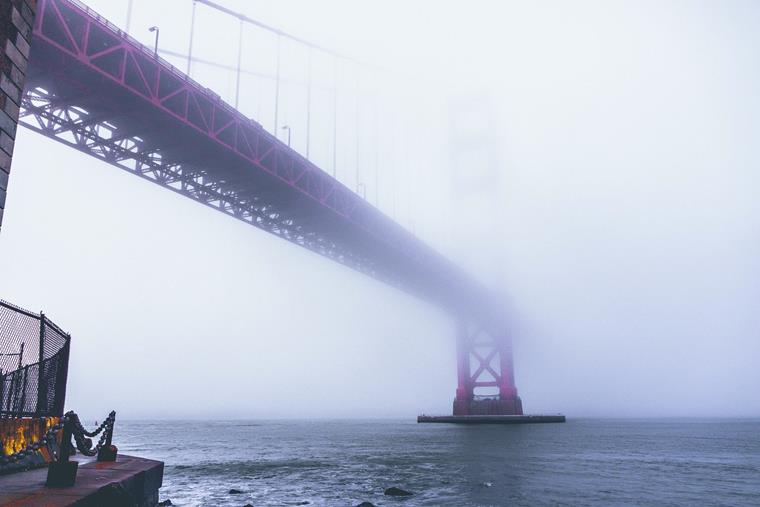
It took decades for anything to happen. In 2007, on the 70th anniversary of the opening, the Golden Gate Bridge District officially acknowledged in a report that Ellis had played the major role in the design. Since then, it has been known that Strauss acted as project manager and political driving force, while Charles Ellis took the place of the central theoretical engineer. This has also been stated on a plaque on the south tower of the bridge since 2012.
Conclusion: Charles Alton Ellis and the Golden Gate Bridge
Strauss had managed to downplay the contribution of many of his important colleagues, not just Ellis, to the Golden Gate project. He presented himself as the sole mastermind and creator of the bridge. But as many of you surely know, the visibility of engineers in structural projects is always difficult anyway.
The public sees the towers, the massive cables, and the roadway, but not the calculations behind them. Perhaps they know the name of the architect who is celebrated for his work. The people behind the scenes, who transform designs into real structures, usually remain invisible.
There are designers whose involvement in major projects is openly acknowledged, such as: Engineering Legend Gustave Eiffel . Then there are the more silent heroes of the construction industry, such as: Fritz Leonhardt – Engineer Who Makes Concrete Float . And, of course, there are those like Joseph Monier: How Gardener Invented Reinforced Concrete , who have had a huge impact on our construction industry with their inventions, mostly by accident.
Charles Ellis was definitely something special in the history of important personalities in construction. He did not own a computer at the time, yet he solved complex nonlinear problems and some of the greatest challenges in bridge construction at the time. Everything was done in theory, and in the end, it all worked out.
The Golden Gate Bridge still stands today and shows its bright red-orange color even in the thickest fog. Whether earthquakes, storms, or storm surges: so far, it has survived everything almost unscathed. And that is mainly thanks to the precise calculations of one man: Charles Alton Ellis.