When did Fritz Leonhardt live? The 20th century was marked by social change and major innovations in the construction industry. Many well-known buildings in Germany were constructed during this period. These included the first large motorway bridges, television towers, and concrete structures that still seem to hover above the ground today.
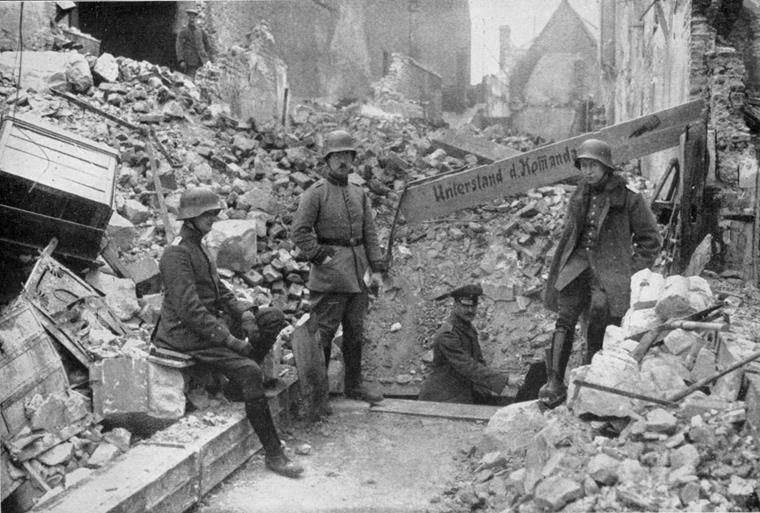
At the same time, this period was overshadowed by wars. The First World War, followed by the second one. Even in the middle of the century, it was not over yet. Almost until the last decade, the Cold War divided not only Germany but the whole of Europe with a wall.
For the construction industry, all signs pointed to structure. Structuring what had been destroyed in the wars. As quickly as possible and as cheaply as possible. This required clever, creative minds and driving forces for innovation: new methods and new building materials. One of the people who achieved great things during this period was Fritz Leonhardt.
Who was Fritz Leonhardt?
Fritz Leonhardt was born in Stuttgart in 1909 and died in his hometown in 1999. The World War I shaped his childhood, which he spent with his mother and brother in the countryside with his grandmother.
His father was an architect and sparked his interest in architecture already at an early age. As a child, he spent much of his vacation time in his uncle's carpentry workshop, where he gained his first experience in craftsmanship.
After graduating from high school, he studied structural engineering at the Technical University of Stuttgart and graduated at the top of his class. Like many of his colleagues, he initially struggled to find a job. The Weimar Republic was still reeling from the World War I and was not very stable.
In 1932, he was given the opportunity to structure a study program abroad. More specifically, in the USA. Fritz Leonhardt took advantage of this opportunity, traveling not only to North America but also to Mexico, where he became particularly interested in bridge construction.
During this time, Leonhardt built up a broad network of contacts throughout the construction industry. For example, he gained insight into the drawing for the Golden Gate Bridge, which was under construction at the time. At the end of 1933, he returned to Germany with all this experience under his belt.
At first, he considered staying in the US, as his prospects of finding a job in his homeland were still not particularly good. In the meantime, however, the NSDAP had seized power and numerous jobs were suddenly created in the field of infrastructure development.
Fritz Leonhardt joined the SA, the Sturmabteilung, which had played a major role in the NSDAP's rise to power. Throughout his life, Leonhardt never glossed over his proximity to the Nazi regime, which had ultimately been necessary to secure a secure job.
As a result, he was offered a position as a bridge engineer at the Reichsautobahn-Gesellschaft (Reich Motorway Company) from 1934 to 1938. Here, he worked on the large Sulzbachtal Bridge near Denkendorf, the Danube Bridge in Leipheim, and the Rohrbachtal Bridge in Stuttgart.
In 1938, he received his doctorate with a thesis on “The simplified calculation of double-sided girder grillages.” He was also entrusted with the project management and construction of the Rhine bridge in Cologne-Rodenkirchen. This is a suspension bridge on the Reichsautobahn that crosses the Rhine. His experience in the US proved more than useful here. After his first successful commissions, he founded his engineering office Ingenieurbüro Leonhardt, Andrä und Partner in 1939. It still exists today under this name.
Special Features of Fritz Leonhardt's Structures
In the following, we will take a closer look at some of his most famous and interesting buildings by Fritz Leonhardt. We will focus in particular on the special features for that time. How did Fritz Leonhardt work and what distinguished him from other engineers and architects of his time?
The name Fritz Leonhardt may not be as well known to the general public as those of the great architects. This is mainly because engineers are usually the silent heroes of the construction industry.
Fritz Leonhardt combined the best qualities of both professions: creativity in form and design, but also the talent to successfully implement buildings using innovative methods. What's more, he described himself as a master builder, an old term from a time when both professions were still combined in one person. This connection shows itself particularly in his works.
“An engineer should be more than just a calculator – he must be an artist.” – Fritz Leonhardt
He set new standards in German construction, particularly in the field of cable-stayed and monocable bridges. But he is probably best known as the creator of the first television tower. The prototype for concrete pins that do not appear too bulky despite the massive reinforced concrete.
In addition to aesthetics, he attached great importance to the efficient use of building materials. Economy was particularly important in the post-war period, both in private households and in the construction industry. At the same time, however, a certain elegance was not neglected. Fritz Leonhardt repeatedly emphasized that both technical understanding and aesthetic sensibility are necessary for good architecture.
Fritz Leonhardt: Milestones and Masterpieces
Now that we have become familiar with the special features of Fritz Leonhardt's buildings, let's take a step further. We will take a closer look at his most famous structures. What stories lie behind them? And how have they had a lasting impact on the construction industry?
Stuttgart TV Tower (1954–56)
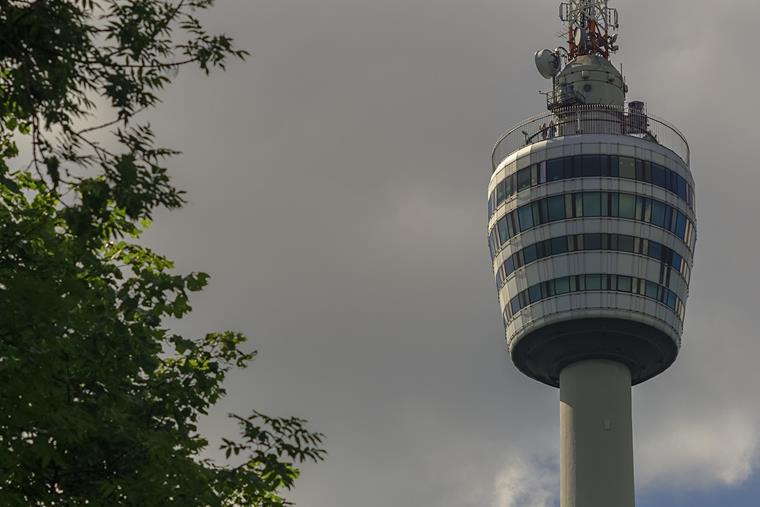
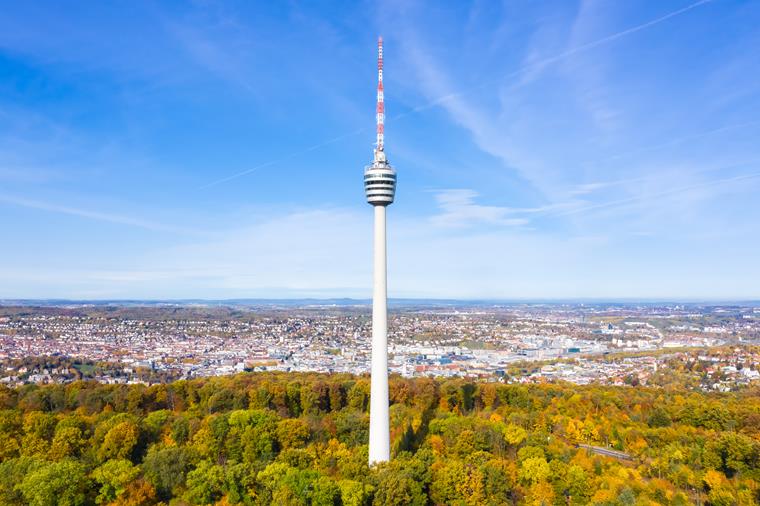
The first structure we associate with the name Fritz Leonhardt is definitely the Stuttgart TV Tower. Did you know that it was the first reinforced concrete TV tower in the world? The concrete needle, as the people of Stuttgart affectionately call it, became a prototype for numerous television towers around the world after its completion.
In 1953, the latest leisure activity had also become socially acceptable in Germany: television. The only problem was that very few people could receive television signals. In the Stuttgart area, you could only try to pick up the Südwestfunk (SWF) station Weinbiet, 100 km away, with special antennas. But that was incredibly complicated. Even watching the coronation of Elizabeth II on June 2, 1953, was a gamble.

The SWR broadcaster proposed a transmission mast on Stuttgart's Frauenkopf hill. This location would be high enough to cover the valley. A simple steel tower about 200 m high was planned. Fritz Leonhardt heard about these plans and approached the station's management with his concerns.
For aesthetic and technical reasons, he proposed an alternative: a slender, conical reinforced concrete tower with a tower ball, which would house the broadcasting equipment and a restaurant open to the public. A restaurant at this height was intended to generate additional income alongside a viewing platform.
After some back and forth, construction began on January 10, 1954. Once the foundations were in place, work began on the tower column. The reinforced concrete shaft was raised using a slipform method. Such a high formwork would simply not have been possible. This was followed by the tower ball at a height of about 150 m, which was assembled in several stages so that on February 5, 1956, after less than two years of construction, the tower was completed.
Today, such a construction project in Germany would probably be a medium-scale disaster. After all, we still have Berlin Airport and Stuttgart 21 in mind. Are we simply no longer capable of building large-scale projects today? We recommend our blog post on this topic Large-Scale Construction Projects in Germany . Sounds interesting? Then take a look! But now back to the Stuttgart TV Tower.
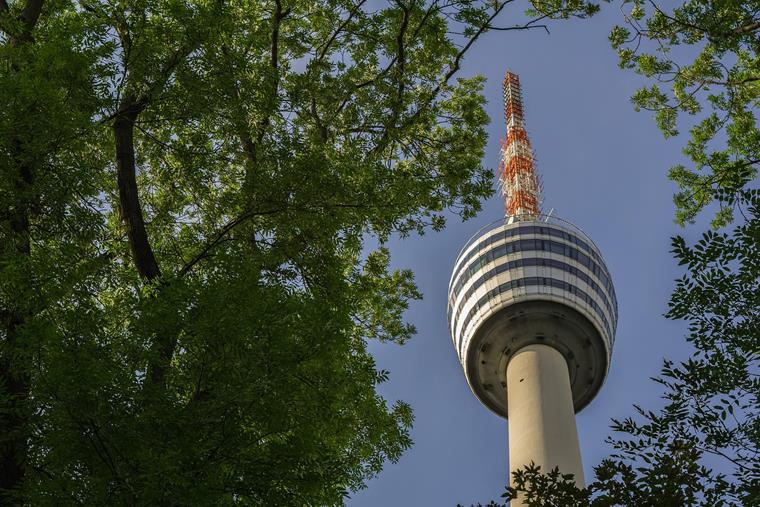
With a height of 217 m and a weight of around 3,000 t, the gigantic concrete needle stands on a foundation approximately 8 m deep. And Leonhardt's vision paid off. The tower was not just a simple broadcasting station. It became an architectural sensation. Whether it's the TV tower in Berlin, Johannesburg, or the CN Tower in Toronto, the Stuttgart TV Tower is the spiritual forefather of reinforced concrete TV towers worldwide.
The tower received an architecture award already in 1956 and was listed as a historic monument in 1986. In 2013, the Stuttgart TV Tower was modernized and reopened to visitors in 2016. Currently, the 70th anniversary celebration is coming up. To mark this occasion, further modernization measures are in the pipeline. Approximately €1.5 million has been allocated for the repair of fine cracks in the shaft of the reinforced concrete tower so that the landmark of the city can be preserved for years to come.
Bridge Architecture: Fritz Leonhardt as Master of Bridges
Fritz Leonhardt was almost better known for his bridges than for his television tower. These bridges featured enormous spans, economical use of materials, and an aesthetic appearance. Bridges made of steel and concrete that seemed to hover.
This earned him a reputation as a true master bridge builder. Let's take a closer look at some of his most famous bridges. What is so special about them and how have they influenced bridge construction today?
Europe's Longest Suspension Bridge: Cologne Rodenkirchen Bridge
The Cologne Rodenkirchen Bridge, also known as the Rodenkirchen Bridge, was his first commission in which he managed the construction independently. This was also his first opportunity to make a name for himself in his special field.
The 567-meter-long suspension bridge spans the Rhine and, with a main span of 378 meters, was the longest suspension bridge in Europe when it was completed. Fritz Leonhardt also set new standards for bridge construction in Germany.
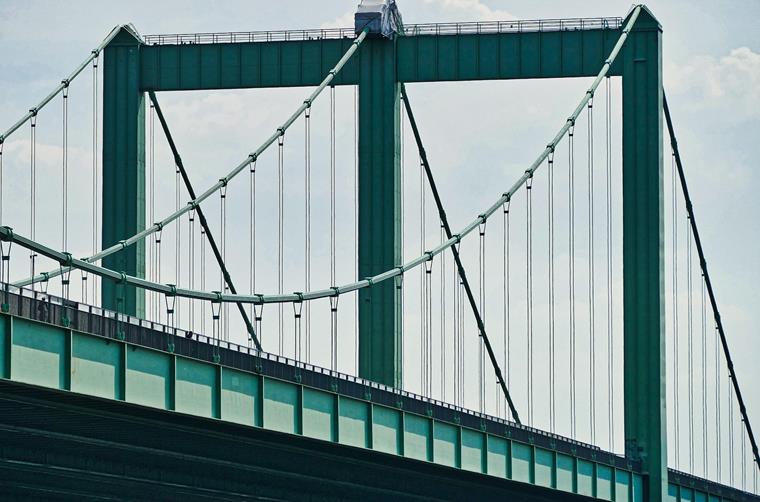
Until then, bridges had tended to be bulky, massive structures. Heavy steel for suspension bridges and solid stone for arch bridges were the standard in Germany before the start of World War II. Fritz Leonhardt took a different approach. He used his knowledge from the USA, to show Europe how efficient and aesthetic lightweight bridges could be.
The deck structure of the Rodenkirchen Bridge appeared very slender, as did the 19 cm thick deck. The steel box girder with secondary beams significantly reduced its self-weight. This was the only way to achieve such a span. The clean lines of the suspension cables and the slender towers looked unusually aesthetic, especially next to the other bridges of their time.
The bridge combined international influences with German engineering. This made it an inspiration for bridge construction throughout Europe. It connects both parts of Cologne's motorway ring road and, at 13.9 million Reichsmarks, was the most expensive structure on the Reichsautobahn, which was actually completed before the end of the war. The monumental gates at the bridgehead are particularly striking.
Over time, the bridge was extended to accommodate the increasing traffic load. From 1990 to 1994, the four lanes were expanded to six. But that was not the first major construction project, as the bridge, which had only been completed in 1940, collapsed on January 28, 1945, two weeks after being hit by bombs. The reconstruction took place, which Fritz Leonhardt regretted very much, according to his own statements, without his involvement, but close to the original.
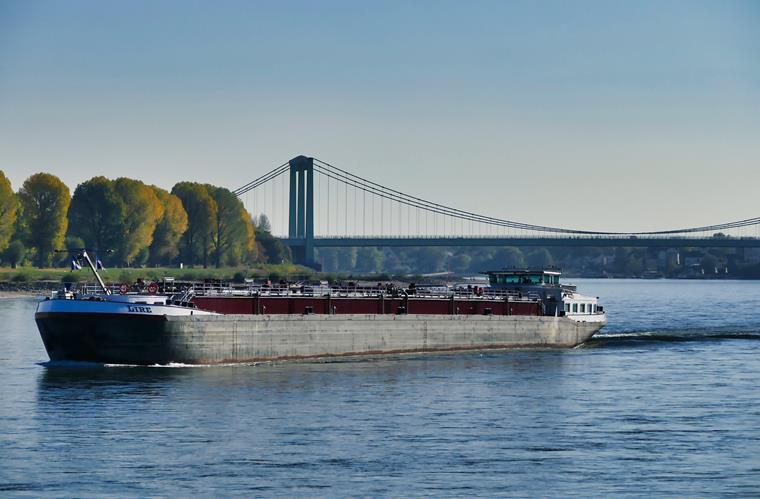
Germany's First Major Cable-Stayed Bridge: Theodor Heuss Bridge in Düsseldorf
In order to relieve traffic in Düsseldorf city center, the city commissioned the construction of a bridge over the Rhine in 1952. Fritz Leonhardt worked on this project alongside architect Friedrich Tamm, incorporating his ideas into calculations.
During the three years of construction, there was an incident. In March 1956, a section of the bridge detached during assembly and fell into the Rhine. Nevertheless, work was completed by the end of 1957 and the bridge was inaugurated on December 19.
The cable-stayed bridge itself has a length of 476 m. On one side, it is connected to the 462-meter-long approach bridge over the high-water level. The span of the main opening directly over the Rhine measures 260 m, while the two side openings extend over 108 m. This made the Theodor Heuss Bridge the first large cable-stayed bridge in Germany.
The Nordbrücke, as it is still commonly known today, was given its final name on January 31, 1964. It was named after the German Federal President and Düsseldorf honorary citizen Theodor Heuss, who died in 1963.
Like most bridges of that time, traffic has become a major burden in recent decades. In 2002, around 100,000 vehicles crossed the Theodor Heuss Bridge every day. However, the location eased quite quickly with the opening of the airport bridge.
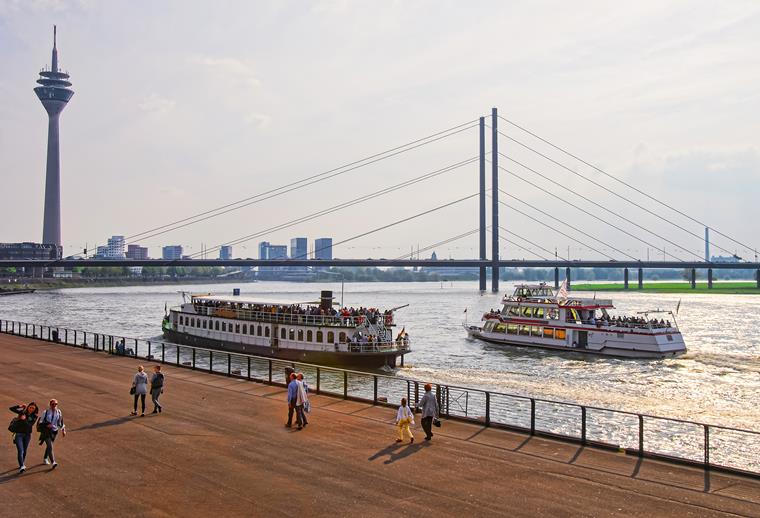
Since November 24, 2016, the Theodor Heuss Bridge has been a listed building. About three years later, the increasing traffic load became noticeable and the bridge suffered the same fate as many other old infrastructure projects.
It was closed due to insufficient load capacity for vehicles with an allowable gross vehicle weight of over 30 tons. This is the case for many bridges in Germany. Would you like to know why? Then take a closer look at this blog post: Dilapidated Bridges in Germany .
Fritz Leonhardt and Rise of Prestressed Concrete
The first attempts to work with prestressed concrete were already made at the beginning of the 20th century. But back then, there was still enough steel available. After the end of World War II, the situation was very different. This was also evident in Germany. Many bridges had been destroyed and steel was in short supply. The damaged bridges had to be rebuilt quickly and cost-effectively.
Fritz Leonhardt was not the only one to recognize that prestressed concrete was ideal for this project. What did the switch to prestressed concrete mean in comparison to conventional steel or reinforced concrete?
- High prestress of the concrete
- High prestressing force through shortening due to creep and shrinkage
- Smaller cross-section dimensions
- Reduction in self-weight
- Greater spans possible
After Fritz Leonhardt read an article by a French colleague on prestressed concrete, he also devoted himself to this topic. Under his direction, the Elz Bridge in Bleibach was built in 1948 as the first German prestressed concrete bridge in the Black Forest. But that was not all.
Together with his colleague Willi Baur, he developed the Baur-Leonhardt concentrated prestressing method in 1949. They used it for the first time on the Elz Bridge in Emmendingen. Four years later, in 1953, Fritz Leonhardt published his treatise on Prestressed Concrete in Practice. This became very important in non-French-speaking countries and is still considered relevant to construction practice today.
Leonhardt and his colleague Willi Baur also created the cycle sliding method during the construction of a bridge over the Río Caroní in Venezuela. It was used for the first time in Germany in 1967 on the Taubertal Bridge.
_geschnitten.jpg?mw=760&hash=2a5dd2c19b465049545538686dd92739e517a81e)
Fritz Leonhardt: Involvement in Large Projects
It wasn't just his own projects that caused a worldwide sensation. Fritz Leonhardt worked on numerous large-scale projects – and with great success. One example we would like to tell you more about is the structure of the Olympic Stadium in Munich.
Munich Olympic Stadium
One of the most famous buildings of the last century is the Olympic Stadium in Munich. Construction took only three years and resulted in an enormous technical achievement of the engineering skills of the time.
The architectural office Behnisch & Partner transferred the design of the building, while Frei Otto and the Leonhardt + Andrä office dedicated themselves to the gigantic tent roof structure. With an incredible 74,800 m² of surface, this superstructure is undoubtedly impressive.
The tent roof consists of a prestressed cable net structure, supported by twelve pylons. This net of steel cables supports a skin made of glass, so to speak. The acrylic glass has the property of being translucent. It allows light to pass through but does not appear transparent. This prevents strong shadows from being cast onto the stadium floor, which could interfere with events.
The cable net is not only stretchable, but was also prefabricated with the highest precision, held in place by ground anchors. In addition, the roof of the Olympic Stadium was the first large-scale use of CAD software. Many of the techniques used here were developed specifically for the construction of the Olympic Stadium. All these new insights paved the way for new, modern approaches in engineering.
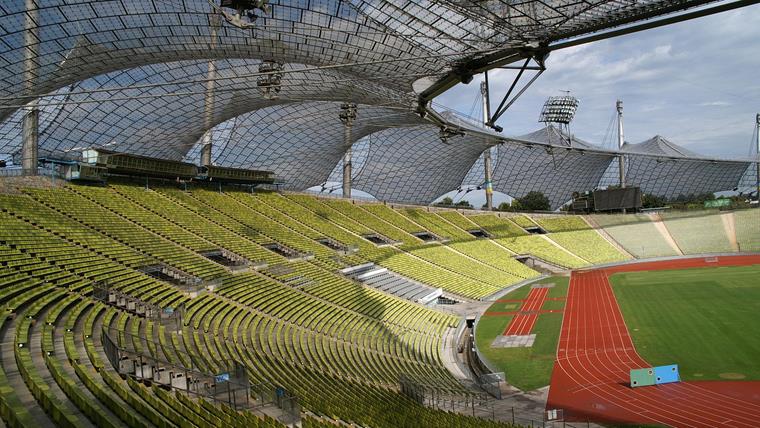
Originally, the stadium was only drawn for the Olympic Games, but it remained in place afterwards. The impressive structure itself certainly played its part. Until 2005, the Olympic Stadium in Munich was the home stadium of FC Bayern Munich, then the team moved to the Allianz Arena.
After two extensive renovations, the stadium is now mainly used for events such as open-air concerts. In 2023, the ‘’'listed'‘’ building was designated a historic landmark of civil engineering in Germany.
Engineer Fritz Leonhardt
Fritz Leonhardt was not idle outside of his architectural work either – quite the contrary. For example, he was Professor of Concrete Structures at the Technical University of Stuttgart from 1957 to 1974. From 1967 to 1969, he even served as rector there. From 1966 to 1968, he was a member of the board of the VDI (Association of German Engineers) and, in 1961, he founded the RIB Software company together with Volker Hahn (Züblin) and Friedrich Wilhelm Bornscheuer. Together, they developed software solutions for the construction industry.
Fritz Leonhardt also played a key role in designing type towers, which were indispensable for the microwave radio network. In his research and teaching, he was particularly interested in lightweight structures, especially in the field of building and bridge construction. Whenever he worked on outstanding projects, the global demand for his engineering office's work grew. After the Theodor Heuss Bridge, his team drew up plans for other cable-stayed bridges around the world.
Fritz Leonhardt passed away on December 30, 1999. His grave is located in the Waldfriedhof cemetery in Stuttgart. And his office? It still exists today. But what he really left behind for the construction industry was his attitude toward the compatibility of the roles of engineer and designer.

Conclusion on Fritz Leonhardt as Engineer
So what can we take away from our modern construction methods? After all, Leonhardt has been dead for over a quarter of a century. The answer is as simple as it is complex: a whole lot! Because Leonhardt had a lasting impact on construction in Germany.
Leonhardt's buildings show us that aesthetics and functionality are by no means mutually exclusive. Another personality in the construction industry also attempted to combine these two aspects—architect and engineer—in himself. You can find the blog post on this topic here: Between Elegance and Escapade: Santiago Calatrava .
In Fritz Leonhardt's case, however, this synergy worked perfectly, and more than successfully. He knew that engineers don't just shape infrastructure, but entire cultural landscapes. Many of his buildings are still standing today and have long since earned a place in the hearts of everyone interested in architecture and engineering.
After all, sustainability begins with a good structure. If a structural project is drawn properly from the outset, it will stand the test of time. And nothing is more sustainable than a building that is still standing even after decades. Fritz Leonhardt's structures remain etched in our memories. Not only that, they have already inspired thousands of other engineers – and will continue to do so in the future.