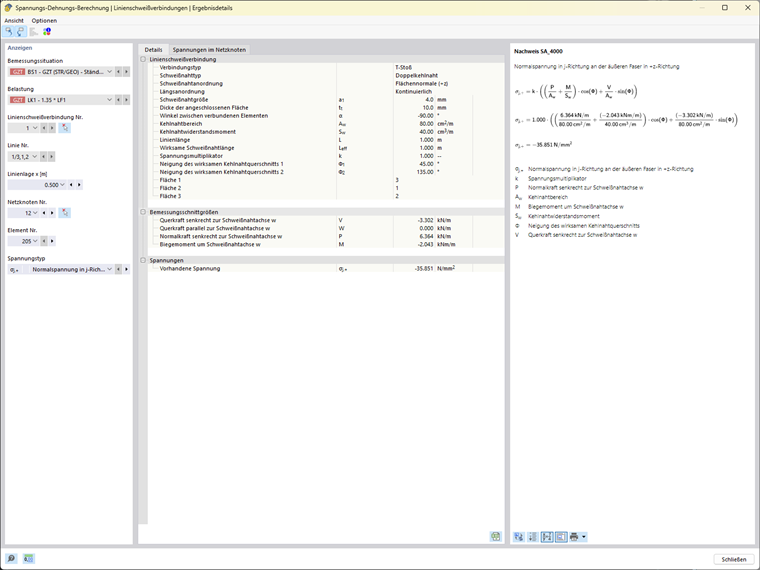
A goal of the Stress-Strain Analysis add-on is to provide a standard-independent calculation of stresses and strains. Using the add-on, you can also design the stresses in defined line welded joints. To achieve standard independence, standard-independent designations were deliberately selected. However, to ensure that the results are comparable with known designations, such as σ⊥ or σ=, it is useful to be able to interpret the calculation formulas used in the design.
The following is an example of the design of a double fillet weld:
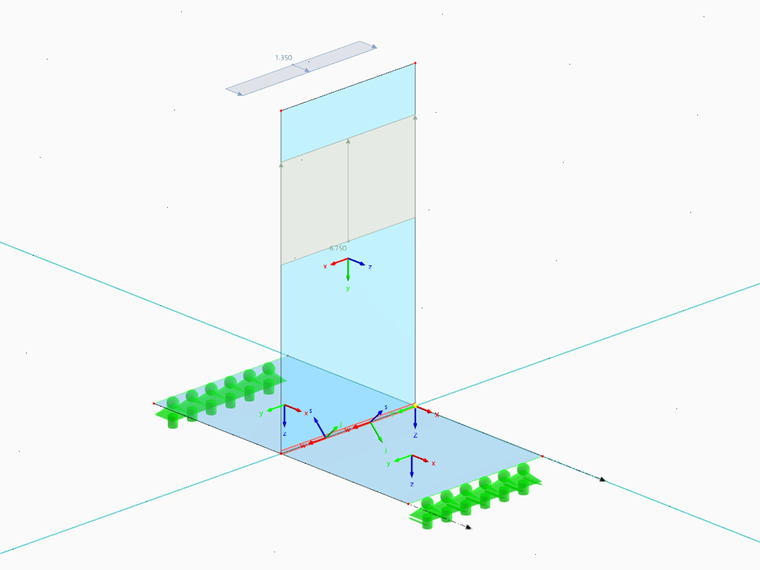
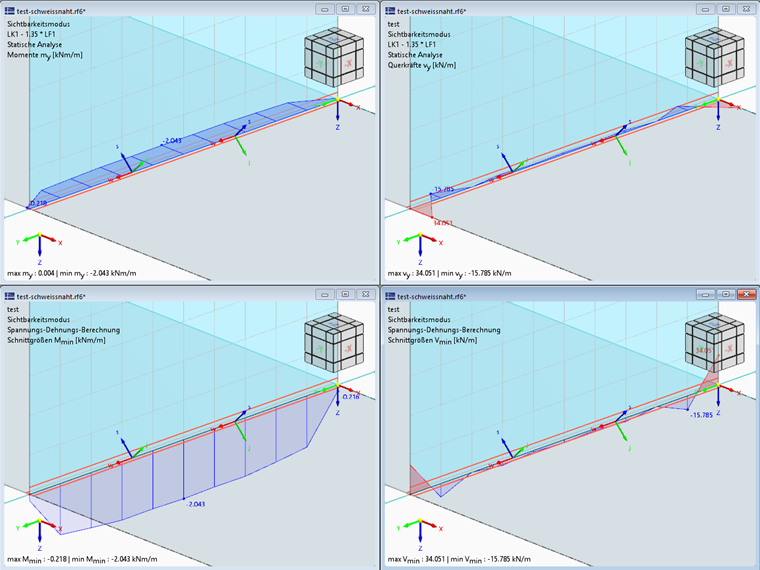
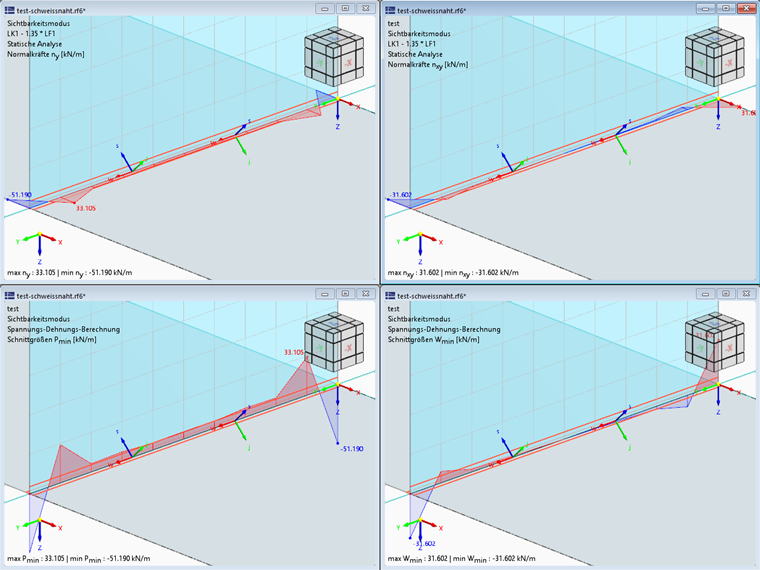
In addition to the global coordinates, the local axes of the surfaces and the line welds (w, j, s) are also shown. In order to see the section forces, a section has also been inserted which only intersects the vertical Surface 3. The following two images show the section forces my, vy, ny and nxy in the section and the corresponding forces in the weld M, V, P and W:
In the window for calculating the weld stress at a point, in this case the governing point, these forces reappear and it is necessary to transform them to the respective position. The angle φ around the w axis is used for the transformation. The basis for the rotation is the z-axis of the first selected surface, since the s-axis of the weld is parallel to it.
The stress σj,+(φ=45°) then corresponds to the stress σ⊥: