


📝 Introduction
The WALE model, short for Wall-Adapting Local Eddy-Viscosity, is a subgrid-scale turbulence model used within the Large Eddy Simulation (LES) framework for transient CFD. Unlike steady-state RANS approaches, which average turbulence effects, LES directly resolves the large, energy-carrying eddies and models only the smaller scales, allowing for a much more detailed and realistic representation of unsteady flow structures. The WALE model has been developed to overcome limitations of classic Smagorinsky-type LES models, particularly in near-wall regions. It calculates the eddy viscosity using both the strain rate and the rotation rate of the flow. By accounting for rotation effects, the model naturally reduces the eddy viscosity to zero near solid walls, without requiring additional damping functions. This prevents excessive damping of turbulence close to surfaces and allows for a more accurate prediction of laminar-to-turbulent transition as well as energy dissipation.
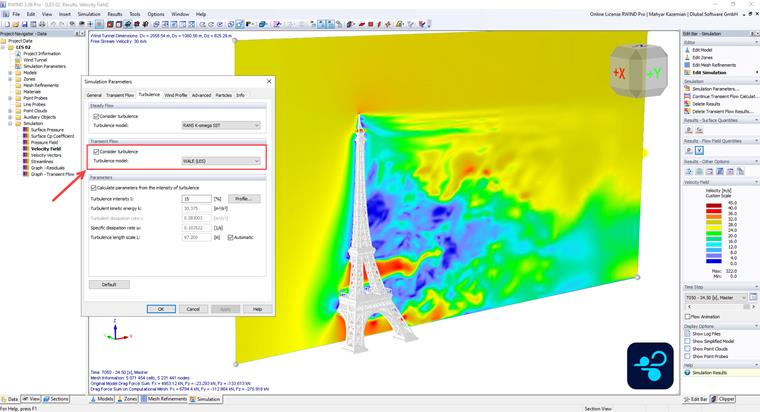
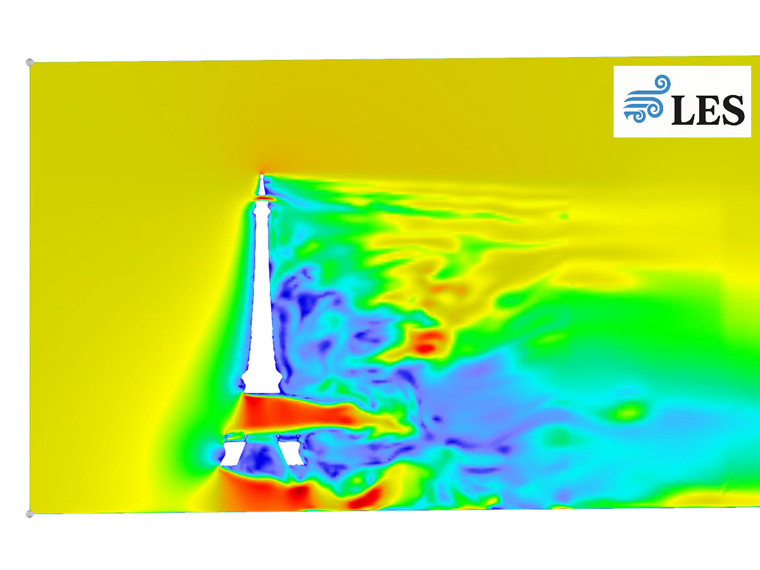
In wind engineering applications, this makes WALE (LES) especially powerful for capturing vortex shedding (Image 1), wake dynamics, and other unsteady phenomena behind tall structures or in complex flow fields. It is particularly well suited for studying vortex-induced vibrations, aeroelastic instabilities, and pedestrian wind comfort, where transient flow fluctuations are decisive. Compared to steady RANS models like k-ω SST, which deliver smoother and averaged flow fields, the WALE LES approach provides a much richer picture of turbulent structures and their time-dependent evolution. However, this accuracy comes at the cost of higher computational demands, as WALE requires finer meshes, especially near walls, and smaller time steps to remain numerically stable and physically reliable.
2. LES vs. RANS: A Brief Overview
- RANS (steady-state): Solves averaged Navier–Stokes equations; turbulence effects are modeled entirely. Provides smooth fields but lacks transient detail.
- LES (transient): Directly resolves large, energy-carrying eddies; only subgrid scales are modeled. Provides detailed turbulence structures but requires higher computational resources.
Within LES, the choice of a subgrid-scale (SGS) model is crucial. The Smagorinsky model has been a classical choice but suffers from limitations near walls due to excessive eddy viscosity. The WALE model addresses these weaknesses.
3. The WALE Model: Fundamentals
WALE stands for Wall-Adapting Local Eddy-Viscosity. It was specifically developed to overcome the deficiencies of Smagorinsky-type models in near-wall regions.
- Eddy Viscosity Definition:
Unlike Smagorinsky, which relies only on the strain rate tensor, WALE uses both the strain rate and rotation rate tensors.
- Near-Wall Behavior:
Eddy viscosity automatically decays to zero at solid walls without requiring damping functions.
✅Advantages:
- More accurate prediction of laminar-to-turbulent transition.
- Better energy dissipation characteristics.
- Enhanced stability and realism in wall-bounded turbulence.
Mathematically, the WALE model computes subgrid-scale viscosity based on the square of the velocity gradient tensor, ensuring proper wall scaling.
4. Computational Requirements
The improved accuracy of WALE-LES comes with computational challenges:
- Mesh Resolution: Fine near-wall meshes are necessary to capture transition and turbulent structures.
- Time Stepping: Small time increments are required to maintain numerical stability.
- Resource Demand: Typically 10–50× more computationally expensive than steady-state RANS simulations.
Despite these demands, WALE strikes a balance by being less resource-intensive than dynamic SGS models while still offering excellent near-wall performance.
5. Applications in Wind Engineering
WALE (LES) provides significant advantages for simulating unsteady aerodynamic phenomena that are critical in civil and structural engineering:
- Vortex Shedding: Capturing alternating vortex patterns behind tall chimneys, towers, and bridge pylons.
- Wake Dynamics: Predicting flow separation, reattachment, and wake meandering around high-rise buildings.
- Vortex-Induced Vibrations (VIV): Studying structural oscillations caused by periodic vortex shedding.
- Aeroelastic Instabilities: Assessing galloping, flutter, and buffeting risks in slender structures.
- Pedestrian Wind Comfort: Resolving gustiness and transient flow accelerations at ground level in urban areas.
📌Note: The consideration of aeroelastic instabilities and Vortex-Induced Vibrations (VIV) represents an important future development plan in RWIND, further extending its potential in dynamic wind–structure interaction studies.
Compared to steady RANS models, WALE-LES provides a time-dependent flow field that enables detailed analysis of load fluctuations rather than just mean values. This is especially valuable when integrating CFD-derived pressures into Finite Element Method (FEM) frameworks such as RFEM, where dynamic load histories can be directly applied.
6. Comparison of Turbulence Models in Structural Wind Engineering
Table 1 presents a comparative table of turbulence models commonly applied in structural wind engineering, focusing on their characteristics across four dimensions: type, near-wall performance, accuracy, and computational cost. It contrasts steady models like k-ε RANS and k-ω SST RANS, which are computationally inexpensive but limited in resolving unsteady eddies, with more advanced transient models such as URANS, DDES, Smagorinsky LES, and WALE LES that progressively capture more turbulence details and vortex dynamics at the expense of higher computational effort. The table emphasizes how each model balances practical engineering usability, prediction accuracy, and cost, offering guidance for selecting the most suitable approach depending on project requirements.
Table 1: Comparison of Turbulence Models: Balancing Accuracy and Cost in Structural Wind Engineering
| Model | Type | Near-Wall Performance | Accuracy | Computational Cost |
|---|---|---|---|---|
| k-ε RANS | Steady | Weak; poor prediction of separation and recirculation | Very limited (time-averaged only) | Low |
| k-ω SST RANS | Steady | Improved boundary layer prediction; better near-wall treatment than k-ε | Limited (cannot resolve unsteady eddies) | Low–Medium |
| URANS | Transient (time-averaged) | Captures some unsteady effects, but eddies are filtered; less detail than LES | Moderate; resolves dominant frequencies but not full turbulence spectrum | Medium |
| DDES | Hybrid (RANS + LES) | RANS near walls, LES in separated/wake regions; balances both | High; good for massively separated flows and practical engineering | Medium–High |
| Smagorinsky (LES) | Transient | Overestimates eddy viscosity near walls → excessive damping | Moderate; resolves large scales but inaccurate wall modeling | High |
| WALE (LES) | Transient | Correct wall scaling; eddy viscosity vanishes near walls, no damping functions required | High; accurately captures vortex shedding, wakes, and transition | High |
7. Conclusion
The WALE turbulence model within LES offers structural engineers a powerful CFD tool to study unsteady wind–structure interactions with unprecedented detail. Its ability to capture vortex shedding, wake dynamics, aeroelastic instabilities, and pedestrian wind comfort makes it invaluable in performance-based wind design. While computationally more demanding than RANS, WALE LES provides insights that are unattainable through code-based methods or steady simulations alone. By integrating WALE-derived time-history pressures into FEM tools, engineers can advance towards more realistic and reliable structural designs, ensuring both safety and serviceability under wind action.
 Knowledge Base