


First, the model and input data, including materials, loads, and settings for creep and shrinkage, are explained. This is followed by a detailed deformation analysis for the quasi-static load combination. Finally, it is shown how the creep effects are incorporated into the deformations of the frequent and characteristic design situations.
1. Input Data
Geometry
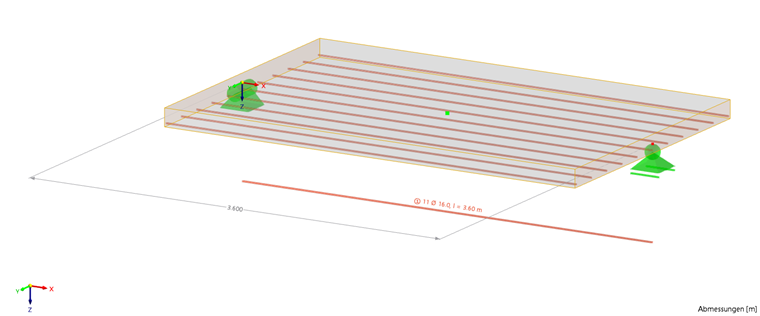
System: Single-span beam
Span: l = 3,600 m
Width: b = 2,360 m
Height: h = 0.150 m
Effective depth: d = 0.126 m
Materials
- Concrete C16/20
Characteristic compressive strength: fck = 16,000 N/mm2
Mean tensile strength: fctm = 1,900 N/mm2
Modulus of elasticity: Ecm = 29000.0 N/mm2
- Reinforcing steel
Characteristic yield strength: fyk = 410,000 N/mm2
Modulus of elasticity: Es = 200000.0 N/mm2
Reinforcement quantity: 11 bars
Reinforcement area: As,prov = 2210 mm2
Reinforcement ratio: ρ = 0.743 %
Actions
The single-span beam with a span of 3.6 m is subjected to the following uniform loads:
- Permanent load: gk = 12,000 kN/m
- Variable load: qk = 24,000 kN/m
Three characteristic action combinations are considered for the deformation analysis according to EC2:
Quasi-Permanent Combination
gk + ψ2·qk = 12,000 + 0.8 × 24,000 = 31.2 kN/m
Frequent Combination
gk + ψ1·qk = 12,000 + 0.9 × 24,000 = 33.6 kN/m
Characteristic Combination
gk + qk = 12,000 + 24.0 = 36.000 kN/m
2. Internal Forces
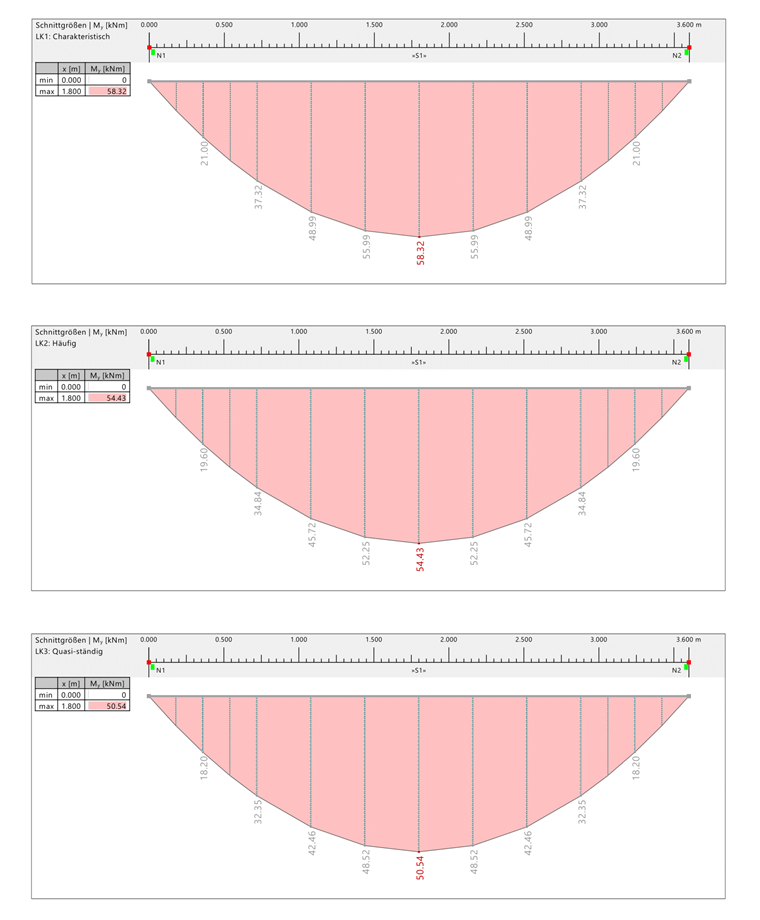
The bending moments in mid-span are calculated as follows:
Characteristic: MEd = 58.320 kNm
Frequent: MEd = 54.430 kNm
Quasi-permanent: MEd = 50.540 kNm
3. Time-Dependent Concrete Properties
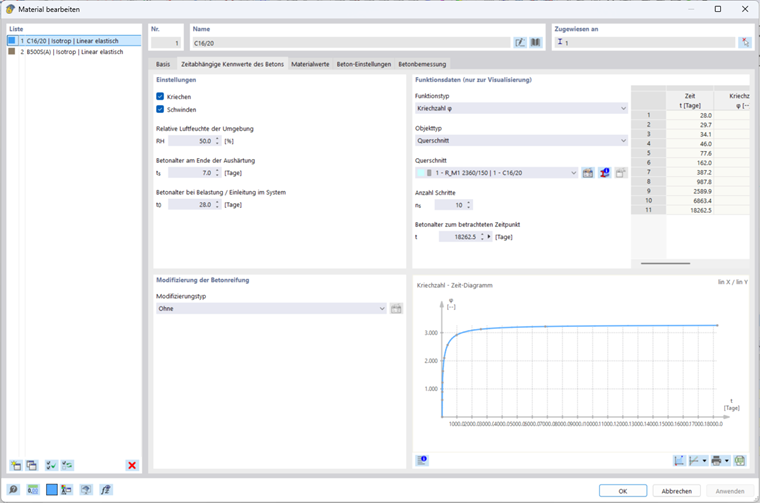
To include the effects of creep and shrinkage in the design, it is necessary to activate them in the concrete material properties.
To enter the creep and shrinkage values manually, it is necessary to activate the time-dependent properties of concrete in the beam cross-section.
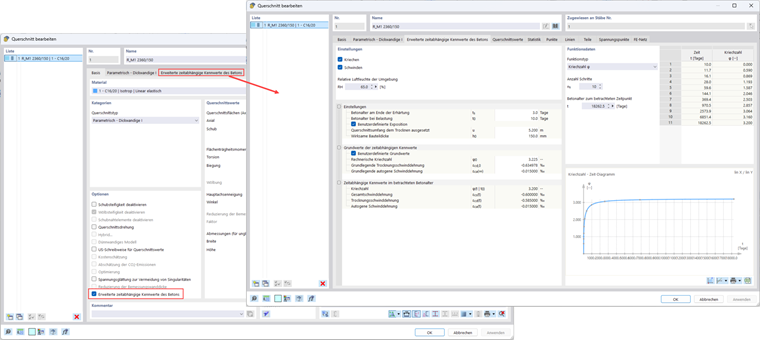
The manually entered properties of the calculated creep coefficient φ0 and the basic drying shrinkage strain εcd,0 results in an effective creep ratio of φ(t|t₀) = 3.2 and a resulting total shrinkage of εcs(∞) = −0.6‰. These values are used as input parameters for the subsequent analysis of long-term concrete deformations.
4. Deflection Requirements
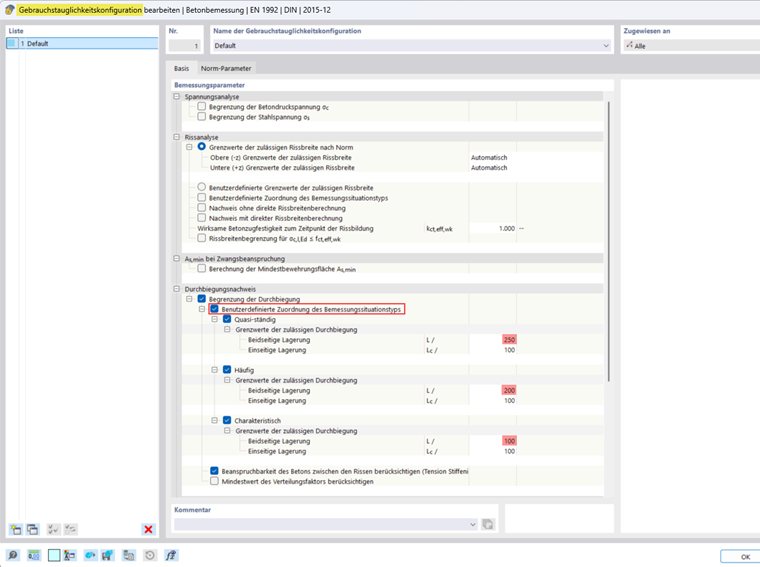
The allowable limits for deflection are:
- Long-term deflection under quasi-permanent action:
flim,qp = l/250 = 3600/250 = 14.4 mm
- Short-term deflection under frequent load combination:
flim,freq = l/200 = 3600/200 = 18.0 mm
- Short-term deflection under characteristic load combination:
flim,char = l/100 = 3600/100 = 36.0 mm
By default, the deflection analysis is only performed for the quasi-permanent design situation. To enable the design for frequent and characteristic design situations, it is necessary to activate the User-defined assignment of design situation type option in the serviceability configuration. After activating this option, you need to specify the limit values of the allowable deflection for each activated design situation.
5. Detection of Crack Conditions
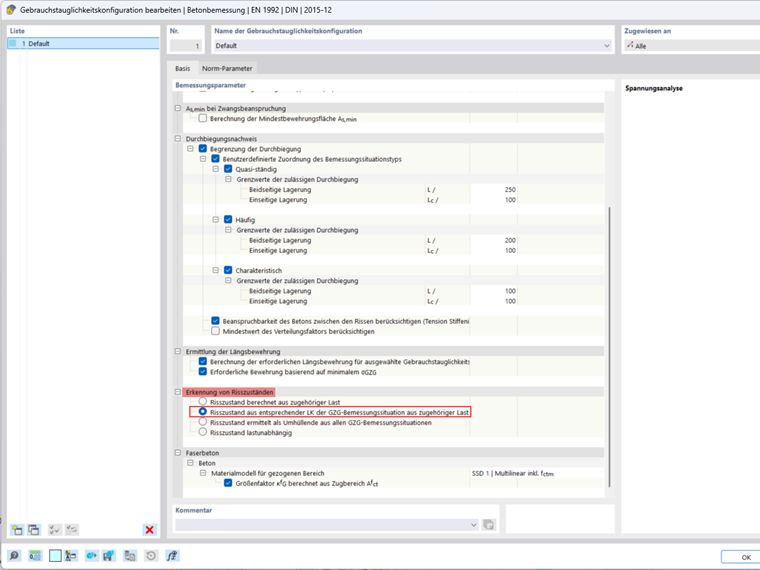
The detection of the crack condition can be set in the serviceability configuration.
The crack state influences the calculation of the distribution coefficient ζd:
- If activating the Crack state calculated from associated load option, ζd is calculated exclusively on the basis of the current load (load combination).
- If activating the Crack state from corresponding CO of SLS design situation from corresponding load option, ζd is calculated as the maximum of all corresponding loads. In this example, this option is selected.
6. Deflection Analysis for Quasi-Permanent Load Combination
6.1. Curvature for Uncracked State
a) E-Moduli and E-Modulus Ratios
- Effective modulus of elasticity of concrete:
\(
\mathrm{E_{c,eff}} = \dfrac{\mathrm{E_{cm}}}{1 + \varphi} = \dfrac{29000.000\,\mathrm{N/mm^2}}{1 + 3.200} = 6904.6\,\mathrm{N/mm^2}
\)
The effects of creep are taken into account by reducing the modulus of elasticity. The effect of creep is included via the final creep coefficient φ.
- Ratio of E-moduli for the uncracked and cracked state:
\(
\mathrm{\alpha_{e,I}} = \mathrm{\alpha_{e,II}} = \dfrac{\mathrm{E_{s}}}{\mathrm{E_{c,I}}} = \dfrac{200000.000\,\mathrm{N/mm^2}}{6904.6\,\mathrm{N/mm^2}} = 28.97
\)
- Design bending moment for deflection analysis:
\(
\mathrm{M_{y,Ed,def}} = \left| \mathrm{M_{y,Ed,def}} \right| = \left| 50.54\,\mathrm{kNm} \right| = 50.54\,\mathrm{kNm}
\)
b) Cross-Section Properties in State I
- Centroidal distance of the ideal cross-section from the concrete surface under compression (determined for the uncracked state):
\(
\mathrm{z_{I}} = \dfrac{\mathrm{b} \cdot \mathrm{h} \cdot \dfrac{\mathrm{h}}{2} + \mathrm{\alpha_{e,I}} \cdot \left( \mathrm{A_{s,def,+z (unten)}} \cdot \mathrm{d_{def,+z (unten)}} + \mathrm{A_{s,def,-z (oben)}} \cdot \mathrm{d_{def,-z (oben)}} \right)}{\mathrm{b} \cdot \mathrm{h} + \mathrm{\alpha_{e,I}} \cdot \left( \mathrm{A_{s,def,+z (unten)}} + \mathrm{A_{s,def,-z (oben)}} \right)}
\)
\(
\mathrm{z_{I}} = \dfrac{2360.0\,\mathrm{mm} \cdot 150.0\,\mathrm{mm} \cdot \dfrac{150.0\,\mathrm{mm}}{2} + 28.97 \cdot \left( 22.12\,\mathrm{cm^2} \cdot 126.0\,\mathrm{mm} + 0.00\,\mathrm{cm^2} \cdot 75.0\,\mathrm{mm} \right)}{2360.0\,\mathrm{mm} \cdot 150.0\,\mathrm{mm} + 28.97 \cdot \left( 22.12\,\mathrm{cm^2} + 0.00\,\mathrm{cm^2} \right)} = 82.8\,\mathrm{mm}
\)
- Effective cross-sectional area in the uncracked state:
\(
\mathrm{A_{I}} = \mathrm{b} \cdot \mathrm{h} + \mathrm{\alpha_{e,I}} \cdot \left( \mathrm{A_{s,def,+z (unten)}} + \mathrm{A_{s,def,-z (oben)}} \right)
\)
\(
\mathrm{A_{I}} = 2360.0\,\mathrm{mm} \cdot 150.0\,\mathrm{mm} + 28.97 \cdot \left( 22.12\,\mathrm{cm^2} + 0.00\,\mathrm{cm^2} \right) = 0.41806\,\mathrm{m^2}
\)
- Effective moment of inertia about the centroid in uncracked state:
\(
\mathrm{I_{y,I}} = \mathrm{b} \cdot \dfrac{\left(\mathrm{h}\right)^{3}}{12} + \mathrm{b} \cdot \mathrm{h} \cdot \left( z_{I} - \dfrac{\mathrm{h}}{2} \right)^{2} + \mathrm{\alpha_{e,I}} \cdot \mathrm{A_{s,def,+z (unten)}} \cdot \left( \mathrm{d_{def,+z (unten)}} - z_{I} \right)^{2} + \mathrm{\alpha_{e,I}} \cdot \mathrm{A_{s,def,-z (oben)}} \cdot \left( z_{I} - \mathrm{d_{def,-z (oben)}} \right)^{2}
\)
\(
\mathrm{I_{y,I}} = 2360.0\,\mathrm{mm} \cdot \dfrac{\left(150.0\,\mathrm{mm}\right)^{3}}{12} + 2360.0\,\mathrm{mm} \cdot 150.0\,\mathrm{mm} \cdot \left( 82.8\,\mathrm{mm} - \dfrac{150.0\,\mathrm{mm}}{2} \right)^{2} + 28.97 \cdot 22.12\,\mathrm{cm^2} \cdot \left( 126.0\,\mathrm{mm} - 82.8\,\mathrm{mm} \right)^{2} + 28.97 \cdot 0.00\,\mathrm{cm^2} \cdot \left( 82.8\,\mathrm{mm} - 75.0\,\mathrm{mm} \right)^{2} = \mathrm{I_{y,I}} = 0.00080\,\mathrm{m^4}
\)
- Eccentricity of the ideal center of gravity of the cross-section in the uncracked state:
\(
\mathrm{e_{z,I}} = z_{I} - \dfrac{\mathrm{h}}{2}
\)
\(
\mathrm{e_{z,I}} = 82.8\,\mathrm{mm} - \dfrac{150.0\,\mathrm{mm}}{2} = 7.8\,\mathrm{mm}
\)
c) Shrinkage – State I
- Additional force due to free shrinkage
\(
\mathrm{N_{sh}} = - \mathrm{E_{s}} \cdot \varepsilon_{\mathrm{sh}} \cdot \left( \mathrm{A_{s,def,+z (unten)}} \cdot \mathrm{d_{def,+z (unten)}} + \mathrm{A_{s,def,-z (oben)}} \cdot \mathrm{d_{def,-z (oben)}} \right)
\)
\(
\mathrm{N_{sh}} = -200000.000\,\mathrm{N/mm^2} \cdot -0.600\,\text{‰} \cdot \left( 22.12\,\mathrm{cm^2} \cdot 126.0\,\mathrm{mm} + 0.00\,\mathrm{cm^2} \cdot 75.0\,\mathrm{mm} \right) = 265.402\,\mathrm{kN}
\)
- Eccentricity of shrinkage force to the centroid of the ideal cross-section in the uncracked state
\(
\mathrm{e_{sh,z,I}} = \dfrac{\mathrm{A_{s,def,+z (unten)}} \cdot \mathrm{d_{def,+z (unten)}} + \mathrm{A_{s,def,-z (oben)}} \cdot \mathrm{d_{def,-z (oben)}}}{\mathrm{A_{s,def,+z (unten)}} + \mathrm{A_{s,def,-z (oben)}}} - \mathrm{z_{I}}
\)
\(
\mathrm{e_{sh,z,I}} = \dfrac{22.12\,\mathrm{cm^2} \cdot 126.0\,\mathrm{mm} + 0.00\,\mathrm{cm^2} \cdot 75.0\,\mathrm{mm}}{22.12\,\mathrm{cm^2} + 0.00\,\mathrm{cm^2}} - 82.8\,\mathrm{mm} = 43.2\,\mathrm{mm}
\)
- Bending moment due to the axial force \(N_{sh}\) for the uncracked state
\(
\mathrm{M_{sh,y,I}} = \mathrm{N_{sh}} \cdot \mathrm{e_{sh,z,I}}
\)
\(
\mathrm{M_{sh,y,I}} = 265.402\,\mathrm{kN} \cdot 43.2\,\mathrm{mm} = 11.46\,\mathrm{kNm}
\)
- Curvature coefficient for uncracked condition
The curvature coefficient indicates how the shrinkage moment acts in relation to the axial force and eccentricity. It shows how the distribution of the shrinkage force and the center of gravity position influence the deformations of the structural component. This value is crucial for fully describing the deformations of the cross-section due to shrinkage:
\(
\mathrm{k_{sh,y,I}} = \dfrac{\mathrm{M_{sh,y,I}} + \mathrm{M_{y,Ed,def}} - \mathrm{N_{Ed}} \cdot \mathrm{e_{z,I}}}{\mathrm{M_{y,Ed,def}} - \mathrm{N_{Ed}} \cdot \mathrm{e_{z,I}}}
\)
\(
\mathrm{k_{sh,y,I}} = \dfrac{11.46\,\mathrm{kNm} + 50.54\,\mathrm{kNm} - 0.000\,\mathrm{kN} \cdot 7.8\,\mathrm{mm}}{50.54\,\mathrm{kNm} - 0.000\,\mathrm{kN} \cdot 7.8\,\mathrm{mm}} = 1.227
\)
The curvature in the uncracked state, considering creep and shrinkage, is:
\(
\mathrm{\kappa_{y,I}} = \mathrm{k_{sh,y,I}} \cdot \dfrac{\mathrm{M_{y,Ed,def}} - \mathrm{N_{Ed}} \cdot \mathrm{e_{z,I}}}{\mathrm{E_{c,eff}} \cdot \mathrm{I_{y,I}}}
\)
\(
\mathrm{\kappa_{y,II}} = 1.227 \cdot \dfrac{50.54\,\mathrm{kNm} - 0.000\,\mathrm{kN} \cdot 7.8\,\mathrm{mm}}{6904.6\,\mathrm{N/mm^2} \cdot 0.00080\,\mathrm{m^4}} = 11.2\,\mathrm{mrad/m}
\)
6.2. Curvature for Cracked State
a) Cross-Section Properties in State II
- Centroidal distance of the ideal cross-section from the concrete surface under compression (determined for the cracked state):
\(
\mathrm{z_{II}} = \dfrac{\mathrm{b} \cdot \mathrm{x_{II}} \cdot \dfrac{\mathrm{x_{II}}}{2} + \alpha_{e,II} \cdot \left( \mathrm{A_{s,def,+z (unten)}} \cdot \mathrm{d_{def,+z (unten)}} + \mathrm{A_{s,def,-z (oben)}} \cdot \mathrm{d_{def,-z (oben)}} \right)}{\mathrm{b} \cdot \mathrm{x_{II}} + \alpha_{e,II} \cdot \left( \mathrm{A_{s,def,+z (unten)}} + \mathrm{A_{s,def,-z (oben)}} \right)}
\)
\(
\mathrm{z_{II}} = \dfrac{2360.0\,\mathrm{mm} \cdot 59.9\,\mathrm{mm} \cdot \dfrac{59.9\,\mathrm{mm}}{2} + 28.97 \cdot \left( 22.12\,\mathrm{cm^2} \cdot 126.0\,\mathrm{mm} + 0.00\,\mathrm{cm^2} \cdot 75.0\,\mathrm{mm} \right)}{2360.0\,\mathrm{mm} \cdot 59.9\,\mathrm{mm} + 28.97 \cdot \left( 22.12\,\mathrm{cm^2} + 0.00\,\mathrm{cm^2} \right)} = 59.9\,\mathrm{mm}
\)
- Effective cross-sectional area in the cracked state:
\(
\mathrm{A_{II}} = \mathrm{b} \cdot \mathrm{h} + \mathrm{\alpha_{e,II}} \cdot \left( \mathrm{A_{s,def,+z (unten)}} + \mathrm{A_{s,def,-z (oben)}} \right)
\)
\(
\mathrm{A_{II}} = 2360.0\,\mathrm{mm} \cdot 150.0\,\mathrm{mm} + 6.90 \cdot \left( 22.12\,\mathrm{cm^2} + 0.00\,\mathrm{cm^2} \right) = 0.36925\,\mathrm{m^2}
\)
- Effective moment of inertia about the centroid in the cracked state:
\(
\mathrm{I_{y,II}} = \mathrm{b} \cdot \dfrac{\left(\mathrm{h}\right)^{3}}{12} + \mathrm{b} \cdot \mathrm{h} \cdot \left( \mathrm{z_{II}} - \dfrac{\mathrm{h}}{2} \right)^{2} + \mathrm{\alpha_{e,II}} \cdot \mathrm{A_{s,def,+z (unten)}} \cdot \left( \mathrm{d_{def,+z (unten)}} - \mathrm{z_{II}} \right)^{2} + \mathrm{\alpha_{e,II}} \cdot \mathrm{A_{s,def,-z (oben)}} \cdot \left( \mathrm{z_{II}} - \mathrm{d_{def,-z (oben)}} \right)^{2}
\)
\(
\mathrm{I_{y,II}} = 2360.0\,\mathrm{mm} \cdot \dfrac{\left(150.0\,\mathrm{mm}\right)^{3}}{12} + 2360.0\,\mathrm{mm} \cdot 150.0\,\mathrm{mm} \cdot \left( 77.1\,\mathrm{mm} - \dfrac{150.0\,\mathrm{mm}}{2} \right)^{2} + 6.90 \cdot 22.12\,\mathrm{cm^2} \cdot \left( 126.0\,\mathrm{mm} - 77.1\,\mathrm{mm} \right)^{2} + 6.90 \cdot 0.00\,\mathrm{cm^2} \cdot \left( 77.1\,\mathrm{mm} - 75.0\,\mathrm{mm} \right)^{2} = 0.00070\,\mathrm{m^4}
\)
- Eccentricity of the ideal cross-sectional center of gravity in the cracked state:
\(
\mathrm{e_{z,II}} = \mathrm{z_{II}} - \dfrac{\mathrm{h}}{2}
\)
\(
\mathrm{e_{z,II}} = 77.1\,\mathrm{mm} - \dfrac{150.0\,\mathrm{mm}}{2} = -15.1\,\mathrm{mm}
\)
b) Shrinkage – State II
- Calculation of the eccentric distance in State II:
\(
\mathrm{e_{sh,z,II}} = \dfrac{\mathrm{A_{s,def,+z (unten)}} \cdot \mathrm{d_{def,+z (unten)}} + \mathrm{A_{s,def,-z (oben)}} \cdot \mathrm{d_{def,-z (oben)}}}{\mathrm{A_{s,def,+z (unten)}} + \mathrm{A_{s,def,-z (oben)}}} - \mathrm{z_{II}}
\)
\(
\mathrm{e_{sh,z,II}} = \dfrac{22.12\,\mathrm{cm^2} \cdot 126.0\,\mathrm{mm} + 0.00\,\mathrm{cm^2} \cdot 75.0\,\mathrm{mm}}{22.12\,\mathrm{cm^2} + 0.00\,\mathrm{cm^2}} - 59.9\,\mathrm{mm} = 66.1\,\mathrm{mm}
\)
- Calculation of the bending moment Msh,y,II :
\(
\mathrm{M_{sh,y,II}} = \mathrm{N_{sh}} \cdot \mathrm{e_{sh,z,II}}
\)
\(
\mathrm{M_{sh,y,II}} = 265.402\,\mathrm{kN} \cdot 66.1\,\mathrm{mm} = 17.54\,\mathrm{kNm}
\)
- Calculation of the curvature factor ksh,y,II :
\(
\mathrm{k_{sh,y,II}} = \dfrac{\mathrm{M_{sh,y,II}} + \mathrm{M_{y,Ed,def}} - \mathrm{N_{Ed}} \cdot \mathrm{e_{z,II}}}{\mathrm{M_{y,Ed,def}} - \mathrm{N_{Ed}} \cdot \mathrm{e_{z,II}}}
\)
\(
\mathrm{k_{sh,y,II}} = \dfrac{17.54\,\mathrm{kNm} + 50.54\,\mathrm{kNm} - 0.000\,\mathrm{kN} \cdot 15.1\,\mathrm{mm}}{50.54\,\mathrm{kNm} - 0.000\,\mathrm{kN} \cdot 15.1\,\mathrm{mm}} = 1.347
\)
The curvature in the cracked state, considering creep and shrinkage, is:
\(
\mathrm{\kappa_{y,II}} =\mathrm{k_{sh,y,II}} \cdot \dfrac{\mathrm{M_{y,Ed,def}} - \mathrm{N_{Ed}} \cdot \mathrm{e_{z,II}}}{\mathrm{E_{c,eff}} \cdot \mathrm{I_{y,II}}}
\)
\(
\mathrm{\kappa_{y,II}} = 1.347 \cdot \dfrac{50.54\,\mathrm{kNm} - 0.000\,\mathrm{kN} \cdot 15.1\,\mathrm{mm}}{6904.6\,\mathrm{N/mm^2} \cdot 0.00045\,\mathrm{m^4}} = 22.0\,\mathrm{mrad/m}
\)
6.3. Curvature for Uncracked and Cracked State
- Calculation of the maximum stress σmax,lt :
\(
\mathrm{\sigma_{max,lt}} = \dfrac{\mathrm{N_{Ed}} + \mathrm{N_{sh}}}{\mathrm{A_{I}}} + \dfrac{\mathrm{M_{y,Ed,def}} - \mathrm{N_{Ed}} \cdot \left( \mathrm{z_{I}} - \dfrac{\mathrm{h}}{2} \right) + \mathrm{M_{sh,y,I}}}{\mathrm{I_{y,I}}} \cdot \left( \mathrm{h} - \mathrm{z_{I}} \right)
\)
\(
\mathrm{\sigma_{max,lt}} = \dfrac{0.000\,\mathrm{kN} + 265.402\,\mathrm{kN}}{0.41806\,\mathrm{m^2}} + \dfrac{50.54\,\mathrm{kNm} - 0.000\,\mathrm{kN} \cdot \left( 82.8\,\mathrm{mm} - \dfrac{150.0\,\mathrm{mm}}{2} \right) + 11.46\,\mathrm{kNm}}{0.00080\,\mathrm{m^4}} \cdot \left( 150.0\,\mathrm{mm} - 82.8\,\mathrm{mm} \right) = 5.811\,\mathrm{N/mm^2}
\)
- Calculation of the distribution coefficient ζd :
\(
\mathrm{\zeta_{d}} = 1 - \mathrm{\beta} \cdot \left( \frac{\mathrm{f_{ctm}}}{\mathrm{\sigma_{max}}} \right)^{2}
\)
\(
\mathrm{\zeta_{d}} = 1 - 0.500 \cdot \left( \frac{1.900\,\mathrm{N/mm^2}}{5.811\,\mathrm{N/mm^2}} \right)^{2} = 0.947
\)
The distribution coefficient is also calculated for the corresponding load combinations (LC1 and LC2). The largest result is governing. In this case, the distribution coefficient of the quasi-permanent load combination LC3 is the largest and therefore governing:
\(
\mathrm{\zeta_{d}} = \mathrm{\zeta_{d,max}} = 0.947
\)
- Calculation of the curvature κy,f :
\(
\mathrm{\kappa_{y,f}} = \mathrm{\zeta_{d}} \cdot \mathrm{\kappa_{y,II}} + \left( 1 - \mathrm{\zeta_{d}} \right) \cdot \mathrm{\kappa_{y,I}}
\)
\(
\mathrm{\kappa_{y,f}} = 0.947 \cdot 22.0\,\mathrm{mrad/m} + \left( 1 - 0.947 \right) \cdot 11.2\,\mathrm{mrad/m} = 21.4\,\mathrm{mrad/m}
\)
6.4. Final Cross-Sections
The final cross-sectional area is calculated using the mean curvature and the distribution coefficient, taking creep and shrinkage into account:
- Calculation of the ideal cross-sectional area Af :
\(
\mathrm{A_{f}} = \dfrac{\mathrm{A_{I}} \cdot \mathrm{A_{II}}}{\mathrm{\zeta_{d}} \cdot \mathrm{A_{I}} + \left( 1 - \mathrm{\zeta_{d}} \right) \cdot \mathrm{A_{II}}}
\)
\(
\mathrm{A_{f}} = \dfrac{0.41806\,\mathrm{m^2} \cdot 0.20544\,\mathrm{m^2}}{0.947 \cdot 0.41806\,\mathrm{m^2} + \left( 1 - 0.947 \right) \cdot 0.21118\,\mathrm{m^2}} = 0.21252\,\mathrm{m^2}
\)
- Ideal moment of inertia relative to the ideal center of cross-section:
\(
\mathrm{I_{y,f}} = \dfrac{\mathrm{I_{y,I}} \cdot \mathrm{I_{y,II}}}{\mathrm{\zeta_{d}} \cdot \mathrm{I_{y,I}} \cdot \mathrm{k_{sh,y,II}} + \left( 1 - \mathrm{\zeta_{d}} \right) \cdot \mathrm{I_{y,II}} \cdot \mathrm{k_{sh,y,I}}}
\)
\(
\mathrm{I_{y,f}} = \dfrac{0.00080\,\mathrm{m^4} \cdot 0.00045\,\mathrm{m^4}}{0.947 \cdot 0.00080\,\mathrm{m^4} \cdot 1.347 + \left( 1 - 0.947 \right) \cdot 0.00045\,\mathrm{m^4} \cdot 1.227} = 0.00034\,\mathrm{m^4}
\)
- Eccentricity of the centroid ez,f :
\(
\mathrm{e_{z,f}} = \dfrac{\mathrm{\zeta_{d}} \cdot \mathrm{E_{c,eff}} \cdot \mathrm{I_{y,I}} \cdot \mathrm{e_{z,II}} + \left( 1 - \mathrm{\zeta_{d}} \right) \cdot \mathrm{E_{c,eff}} \cdot \mathrm{I_{y,II}} \cdot \mathrm{e_{z,I}}}{\mathrm{\zeta_{d}} \cdot \mathrm{E_{c,eff}} \cdot \mathrm{I_{y,I}} + \left( 1 - \mathrm{\zeta_{d}} \right) \cdot \mathrm{E_{c,eff}} \cdot \mathrm{I_{y,II}}}
\)
\(
\mathrm{e_{z,f}} = \dfrac{0.947 \cdot 6904.6\,\mathrm{N/mm^2} \cdot 0.00080\,\mathrm{m^4} \cdot (-15.1)\,\mathrm{mm} + \left( 1 - 0.947 \right) \cdot 6904.6\,\mathrm{N/mm^2} \cdot 0.00045\,\mathrm{m^4} \cdot 7.8\,\mathrm{mm}}{0.947 \cdot 6904.6\,\mathrm{N/mm^2} \cdot 0.00080\,\mathrm{m^4} + \left( 1 - 0.935 \right) \cdot 6904.6\,\mathrm{N/mm^2} \cdot 0.00045\,\mathrm{m^4}} = -14.4\,\mathrm{mm}
\)
- Ideal moment of inertia relative to the geometric center of the cross-section Iy,0,f :
\(
\mathrm{I_{y,0,f}} = \mathrm{I_{y,f}} + \mathrm{A_{f}} \cdot \left( \mathrm{e_{z,f}} \right)^{2}
\)
\(
\mathrm{I_{y,0,f}} = 0.00034\,\mathrm{m^4} + 0.21118\,\mathrm{m^2} \cdot \left( -14.4\,\mathrm{mm} \right)^{2} = 0.00039\,\mathrm{m^4}
\)
6.5. Final Stiffness
- Tangential membrane stiffness EAf :
\(
\mathrm{EA_{f}} = \mathrm{E_{c,eff}} \cdot \mathrm{A_{f}}
\)
\(
\mathrm{EA_{f}} = 6904.6\,\mathrm{N/mm^2} \cdot 0.21118\,\mathrm{m^2} = 1458100.000\,\mathrm{kN}
\)
- Tangential bending stiffness EIy,0,f :
\(
\mathrm{EI_{y,0,f}} = \mathrm{E_{c,eff}} \cdot \mathrm{I_{y,0,f}}
\)
\(
\mathrm{EI_{y,0,f}} = 6904.6\,\mathrm{N/mm^2} \cdot 0.00039\,\mathrm{m^4}
\)
\(
\mathrm{EI_{y,0,f}} = 2665.68\,\mathrm{kNm^2}
\)
- Factor for reducing shear stiffness rz :
\(
\mathrm{r_{z}} = \dfrac{\mathrm{I_{y,f}}}{\mathrm{I_{y,I}}}
\)
\(
\mathrm{r_{z}} = \dfrac{0.00034\,\mathrm{m^4}}{0.00080\,\mathrm{m^4}} = 0.425
\)
- Shear stiffness GAf
\(
\mathrm{GA_{y,f}} = \mathrm{G_{c,eff}} \cdot \mathrm{A_{c,y}} \cdot \mathrm{r_{z}}
\)
\(
\mathrm{GA_{y,f}} = 2876.9\,\mathrm{N/mm^2} \cdot 0.29500\,\mathrm{m^2} \cdot 0.425 = 360953.000\,\mathrm{kN}
\)
- Torsional stiffness GIT,F
\(
\mathrm{GI_{T,f}} = \mathrm{GI_{T,I}} = 5865.88\,\mathrm{kNm^2}
\)
- Eccentric stiffness element ESy
\(
\mathrm{ES_{y}} = \mathrm{EA_{f}} \cdot \mathrm{e_{z,f}}
\)
\(
\mathrm{ES_{y}} = 1458100.000\,\mathrm{kN} \cdot (-14.4)\,\mathrm{mm} = -20991.40\,\mathrm{kNm}
\)
6.6. Deflection Analysis
With the calculated final stiffnesses, RFEM 6 performs the deformation analysis for the characteristic load combination:
- Deflection uz
\(
\mathrm{u_{z}} = 30.1\,\mathrm{mm}
\)
- Limit deflection uz,lim
\(
\mathrm{u_{z,lim}} = \dfrac{\mathrm{L_{z,ref}}}{\dfrac{\mathrm{L_{z,ref}}}{\mathrm{u_{z,lim}}}}
\)
\(
\mathrm{u_{z,lim}} = \dfrac{3.600\,\mathrm{m}}{250.000} = 14.4\,\mathrm{mm}
\)
- Design criterion η
\(
\mathrm{\eta_z} = \left|\dfrac{\mathrm{u_{z}}}{\mathrm{u_{z,lim}}}\right|
\)
\(
\mathrm{\eta_z} = \left|\dfrac{30.1\,\mathrm{mm}}{14.4\,\mathrm{mm}}\right| = 2.090 > 1
\)
The calculated deflection is twice the allowable limit deflection. The design is therefore not fulfilled in the quasi-permanent design situation.
7. Deflection Analysis for Frequent Load Combination
Since only permanent loads (quasi-permanent design situations) cause creep, the creep effects are not taken into account in the calculation of cross-section properties for short-term loads (frequent and characteristic design situations). Therefore, the average modulus of elasticity of concrete (Ecm = 29,000 N/mm²) is used for these calculations:
- Ratio of moduli of elasticity for the uncracked state (short-term load):
\(
\mathrm{\alpha_{e,I,st}} = \dfrac{\mathrm{E_{s}}}{\mathrm{E_{cm}}} = \dfrac{200000.000\,\mathrm{N/mm^2}}{29000.000\,\mathrm{N/mm^2}} = 6.90
\)
The ratio αe,I,st describes the ratio of the stiffness of steel to concrete under short-term loading and is used in the calculation of the cross-section properties.
| Uncracked State | |||
| Parameter | Description | Value | Unit |
| αe,I | Ratio of E-moduli for the uncracked state | 6.90 | [-] |
| Mᵧ,Ed,def | Design bending moment for the deflection analysis | 54.43 | kNm |
| zI | Centroidal distance of the ideal cross-section from the concrete surface under compression (uncracked) | 77.1 | mm |
| AI | Effective cross-sectional area in the uncracked state | 3692.53 | cm2 |
| Iy,I | Effective moment of inertia relative to the ideal center of gravity in the uncracked state | 70178.40 | cm4 |
| ez,I | Eccentricity of the ideal center of gravity of the cross-section in the uncracked state | 2.1 | mm |
| κy,I | Curvature for the uncracked state | 2.7 | mrad/m |
| Cracked State | |||
| Parameter | Description | Value | Unit |
| αe,II | Ratio of E-moduli for the cracked state | 6.90 | [-] |
| zII | Centroidal distance of the ideal cross-section from the concrete surface under compression (cracked) | 34.4 | mm |
| AII | Effective cross-sectional area in the cracked state | 964.57 | cm2 |
| Iy, II | Effective moment of inertia relative to the ideal center of gravity in the cracked state | 16000.40 | cm4 |
| ez,II | Eccentricity of the ideal center of gravity of the cross-section in the cracked state | -40.6 | mm |
| κy,II | Curvature for the cracked state | 11.7 | mrad/m |
- Distribution coefficient ζd :
\(
\sigma_{\text{max}} = \dfrac{N_{\text{Ed}}}{A_{\text{I}}} + \dfrac{M_{y,\text{Ed,def}} - N_{\text{Ed}} \cdot \left( z_{\text{I}} - \dfrac{h}{2} \right)}{I_{y,\text{I}}} \cdot \left( h - z_{\text{I}} \right)
\)
\(
\sigma_{\text{max}} = \dfrac{0.000 \, \text{kN}}{3692.53 \, \text{cm}^2} + \dfrac{54.43 \, \text{kNm} - 0.000 \, \text{kN} \cdot \left( 77.1 \, \text{mm} - \dfrac{150.0 \, \text{mm}}{2} \right)}{70178.40 \, \text{cm}^4} \cdot \left( 150.0 \, \text{mm} - 77.1 \, \text{mm} \right) = 5.654 \, \text{N/mm}^2
\)
Under short-term loads, the load duration or the repetition coefficient β according to DIN EN 1992-1-1, 7.4.3 (3) is 1.0:
\(
\zeta_d = 1 - \beta \cdot \left( \dfrac{f_{\text{ctm}}}{\sigma_{\text{max}}} \right)^2
\)
\(
\zeta_d = 1 - 1.000 \cdot \left( \dfrac{1.900 \, \text{N/mm}^2}{5.654 \, \text{N/mm}^2} \right)^2 = 0.887
\)
Since the distribution coefficient of the frequent load combination is smaller, the distribution coefficient of the quasi-permanent load combination is the governing one:
\(
\zeta_d = \zeta_{\text{max}} = 0.947
\)
The distribution coefficient is used for the calculation of the curvature from the uncracked and cracked state, the final cross-section properties, and the resulting final stiffnesses:
| Final Cross-Sections and Final Stiffnesses for Frequent Load Combination | |||
| Parameter | Description | Value | Unit |
| κy,f | Curvature from the uncracked and cracked state | 11.2 | mrad/m |
| Af | Ideal cross-sectional area | 1004.23 | cm2 |
| Iy,f | Ideal moment of inertia relative to the ideal center of the cross-section | 16689.20 | cm⁴ |
| ez,f | Eccentricity of the centroid | -40.0 | mm |
| Iy,0,f | Ideal moment of inertia to the geometric center of the cross-section | 32796.10 | cm4 |
| EAf | Tangent membrane stiffness | 2912260.000 | kN |
| EIy,0,f | Tangent bending stiffness | 9510.86 | kNm² |
| rz | Factor for reducing shear stiffness | 0.238 | |
| GAf | Shear stiffness | 847697.000 | kN |
| GIt,f | Torsional stiffness | 24637.30 | kNm² |
| ESy | Eccentric stiffness element | -116633.00 | kNm |
RFEM calculates the deformation of the frequent load combination using these final stiffnesses:
\(
\mathrm{u_{z,tot,st}} = 14.4\,\mathrm{mm}
\)
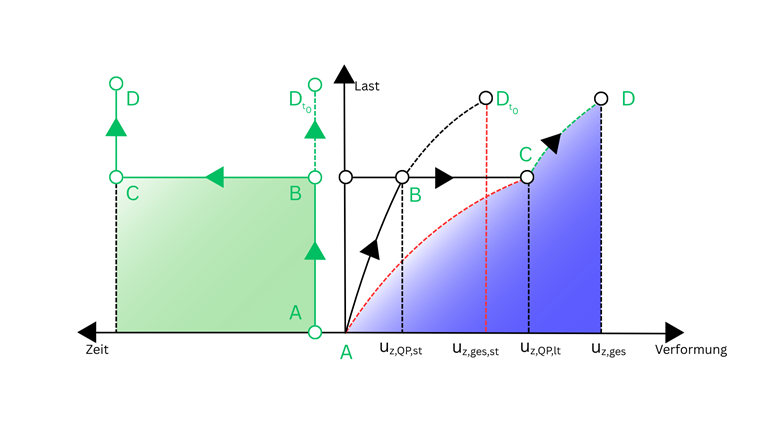
The calculation of the total deflection of the structural component under frequent loads requires consideration of the various deformation contributions caused by different types of loads and their respective effects on the component. Long-term and short-term deformations have to be treated differently in order to correctly determine the actual deflection:
\(
u_{z,tot} = u_{z,QP,lt} + \left( u_{z,tot,st} - u_{z,QP,st} \right)
\)
- Long-term deformation uz,QP,lt : This deformation is caused by creep-inducing loads and takes into account the creep effects that the structural component will encounter over a long period of time. uz,QP,lt = 15.6mm (calculated in Section 6).
- Short-term deformation uz,tot,st : This deformation occurs immediately after the frequent load is applied. uz,tot,st = 14.4mm.
- Immediate deformation from the creep-inducing load uz,QP,st : This deformation occurs immediately after applying the creep-inducing loads and is the immediate response of the structural component before the creep arises.
The total deflection uz,total consists of the long-term deformation uz,QP,lt and the difference between the short-term deformation uz,total,st and the immediate deformation of the creep-inducing loads uz,QP,st. The latter is subtracted, as it is already included in the short-term deformation uz,tot,st. The following diagram illustrates this, with the different areas showing the individual types of deformation and their distribution over time:
\(
u_{z,tot} = 30.1 \, \text{mm} + \left( 14.4 \, \text{mm} - 13.3 \, \text{mm} \right) = 31.2 \, \text{mm}
\)
- Limit deflection uz,lim
\(
u_{z,lim} = \dfrac{L_{z,ref}}{L_{z,ref} / u_{z,lim}}
\)
\(
u_{z,lim} = \dfrac{3.600 \, \text{m}}{200.000} = 18.0 \, \text{mm}
\)
- Design criterion η
\(
\eta = \left| \dfrac{u_{z}}{u_{z,lim}} \right|
\)
\(
\eta = \left| \dfrac{31.2 \, \text{mm}}{18.0 \, \text{mm}} \right| = 1.733
\)
The design is not fulfilled for the frequent design situation.
8. Deflection Analysis for Characteristic Load Combination
The calculation is carried out as for the frequent load combination:
| Uncracked State | |||
| Parameter | Description | Value | Unit |
| αe,I | Ratio of E-moduli for the uncracked state | 6.90 | [-] |
| Mᵧ,Ed,def | Design bending moment for the deflection analysis | 58.32 | kNm |
| zI | Centroidal distance of the ideal cross-section from the concrete surface under compression (uncracked) | 77.1 | mm |
| AI | Effective cross-sectional area in the uncracked state | 3692.53 | cm2 |
| Iy,I | Effective moment of inertia relative to the ideal center of gravity in the uncracked state | 70178.40 | cm4 |
| ez,I | Eccentricity of the ideal center of gravity of the cross-section in the uncracked state | 2.1 | mm |
| κy,I | Curvature for the uncracked state | 2.9 | mrad/m |
| Cracked State | |||
| Parameter | Description | Value | Unit |
| αe,II | Ratio of E-moduli for the cracked state | 6.90 | [-] |
| zII | Centroidal distance of the ideal cross-section from the concrete surface under compression (cracked) | 34.4 | mm |
| AII | Effective cross-sectional area in the cracked state | 964.57 | cm2 |
| Iy, II | Effective moment of inertia relative to the ideal center of gravity in the cracked state | 16000.40 | cm4 |
| ez,II | Eccentricity of the ideal center of gravity of the cross-section in the cracked state | -40.6 | mm |
| κy,II | Curvature for the cracked state | 12.6 | mrad/m |
The calculation of the distribution coefficient is also performed in a similar way:
\(
\sigma_{\text{max}} = \dfrac{N_{\text{Ed}}}{A_{\text{I}}} + \dfrac{M_{y,\text{Ed,def}} - N_{\text{Ed}} \cdot \left( z_{\text{I}} - \dfrac{h}{2} \right)}{I_{y,\text{I}}} \cdot \left( h - z_{\text{I}} \right)
\)
\(
\sigma_{\text{max}} = \dfrac{0.000 \, \text{kN}}{3692.53 \, \text{cm}^2} + \dfrac{58.32 \, \text{kNm} - 0.000 \, \text{kN} \cdot \left( 77.1 \, \text{mm} - \dfrac{150.0 \, \text{mm}}{2} \right)}{70178.40 \, \text{cm}^4} \cdot \left( 150.0 \, \text{mm} - 77.1 \, \text{mm} \right) = 6.058 \, \text{N/mm}^2
\)
\(
\zeta_d = 1 - \beta \cdot \left( \dfrac{f_{\text{ctm}}}{\sigma_{\text{max}}} \right)^2
\)
\(
\zeta_d = 1 - 1.000 \cdot \left( \dfrac{1.900 \, \text{N/mm}^2}{6.058 \, \text{N/mm}^2} \right)^2 = 0.902\) > 0.947
\(
\zeta_d = \zeta_{\text{max}} = 0.947
\)
| Final Cross-Sections and Final Stiffnesses for Characteristic Load Combination | |||
| Parameter | Description | Value | Unit |
| κy,f | Curvature from the uncracked and cracked state | 12.0 | mrad/m |
| Af | Ideal cross-sectional area | 1004.23 | cm2 |
| Iy,f | Ideal moment of inertia to the ideal center of the cross-section | 16689.20 | cm⁴ |
| ez,f | Eccentricity of the centroid | -40.0 | mm |
| Iy,0,f | Ideal moment of inertia to the geometric center of the cross-section | 32796.10 | cm4 |
| EAf | Tangent membrane stiffness | 2912260.000 | kN |
| EIy,0,f | Tangent bending stiffness | 9510.86 | kNm² |
| rz | Factor for reducing shear stiffness | 0.238 | |
| GAf | Shear stiffness | 847697.000 | kN |
| GIt,f | Torsional stiffness | 24637.30 | kNm² |
| ESy | Eccentric stiffness element | -116633.00 | kNm |
With these final stiffnesses, RFEM calculates the deformation of the frequent load combination:
\(
\mathrm{u_{z,tot,st}} = 15.5\,\mathrm{mm}
\)
The total deflection is then:
\(
u_{z,tot} = 30.1 \, \text{mm} + \left( 15.5 \, \text{mm} - 13.3 \, \text{mm} \right) = 32.3 \, \text{mm}
\)
- Limit deflection uz,lim
\(
u_{z,lim} = \dfrac{L_{z,ref}}{L_{z,ref} / u_{z,lim}}
\)
\(
u_{z,lim} = \dfrac{3.600 \, \text{m}}{100.000} = 36 \, \text{mm}
\)
- Design criterion η
\(
\eta = \left| \dfrac{u_{z}}{u_{z,lim}} \right|
\)
\(
\eta = \left| \dfrac{32.3 \, \text{mm}}{36.0 \, \text{mm}} \right| = 0.897
\)
The design is fulfilled for the characteristic design situation.