


The partial internal forces method (PIFM) is an innovative method for the calculation of the plastic cross-section resistance of structural components. Developed at Ruhr University Bochum, based on the work of Rolf Kindmann and Jörg Frickel, this method has proven to be extremely valuable for modern steel structures. It provides a more precise and efficient alternative to traditional design methods by dividing the cross-sectional areas into smaller partial cross-sections and evaluating them individually. This allows even complex load scenarios and cross-sectional shapes to be calculated efficiently and accurately.
This article provides a detailed overview of the PIFM, explains its application, and shows how the method is integrated and used in the RFEM 6 software to achieve even more accurate results. The method is examined both with and without redistribution, and we take a look at the advantages and disadvantages of the two variants.
What is the partial internal forces method (PIFM)?
The partial internal forces method (PIFM) allows for the precise calculation of the plastic cross-section resistance of structural components in steel structures. Instead of considering the entire cross-section as a whole, it is divided into several rectangular cross-sections. These partial cross-sections are then evaluated individually according to the principles of elasticity theory and plasticity theory. This detailed approach ensures a more accurate and efficient design of structural components that are subject to uneven loading.
The method was developed by Rolf Kindmann and Jörg Frickel at the Ruhr University Bochum and is recognized as an important method in professional circles. Further explanations and mathematical principles can be found in the technical literature, in particular in the publication “Elastic and Plastic Cross-Section Resistance – Principles, Methods, Calculation Methods, Examples.”
Allowability of PIFM
The partial internal forces method fulfills all requirements of EN 1993-1-1 (Eurocode 3). It is even mentioned in the Eurocode commentary as a valuable addition to the classic design methods. In addition, FAQ 5709 explicitly notes that PIFM can be used without restriction in practice.
Steps for Applying Partial Internal Forces Method
There are two variants of the partial internal forces method: with redistribution and without redistribution. Both variants allow for a detailed analysis and calculation of the plastic resistance, but with different assumptions and calculation steps. The respective methods are explained in more detail below.
1. PIFM Without Redistribution
In the variant without redistribution, the calculation of the partial internal forces is first carried out according to the elasticity theory. The load-bearing capacity of each partial cross-section is then determined according to the plasticity theory. This calculation comprises four main steps:
- Calculation of stresses on the gross cross-section: First, the stresses in the entire cross-section are calculated according to the elasticity theory.
- Integration of stresses on the partial cross-sections: The calculated stresses are then converted to the individual partial cross-sections.
- Design of shear stresses: This is followed by the design of shear stresses for the partial cross-sections.
- Design of axial stresses: Finally, the axial stress design is carried out using a reduced yield stress, which is influenced by the previously calculated shear stresses.
2. PIFM with Redistribution
The variant with redistribution goes one step further and includes an additional internal force transformation. Here, the internal forces are transformed from an original coordinate system (u-v) to a new reference system (u'-v'). The reference point is located in the web center of the cross-section. The procedure for the redistribution method consists of several precise steps:
- Internal force transformation: The first calculations involve transforming the internal forces into a new coordinate system in order to determine the relevant internal forces in the new reference system.
- Design of shear stresses: After the transformation, the shear stresses are designed at the partial cross-section, whereby the relevant shear stress components result from the lateral forces Vy/Vz, primary torsional moment Mxp and secondary torsional moment Mxs.
- Design of axial stresses: Similar to the variant without redistribution, the design of axial stresses is carried out on the partial cross-sections, but with a reduced yield stress based on the shear stresses. Relevant axial stress components result from the bending moment Mz and the warping bimoment Mw.
- Interaction between axial force and bending moment: Finally, there is an interaction between the axial force N and bending moment Mz. Since there is no closed analytical solution for this interaction, an interaction formula is used that allows for a precise calculation of the combination of axial force and bending moment.
When is the partial internal forces method (PIFM) advantageous?
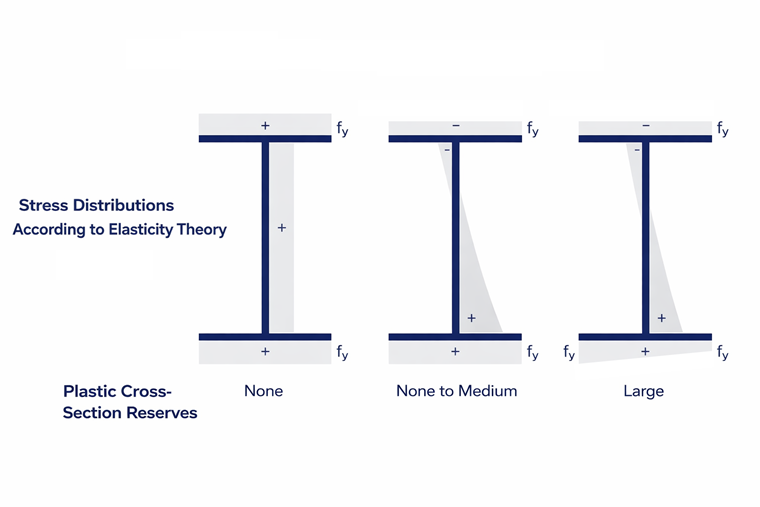
The partial internal forces method is particularly useful when certain plastic reserves are available in the cross-section that are not fully utilized by classic elastic design. It is particularly useful in the following cases:
1. Uneven stress distributions: The PIFM is particularly advantageous when a structural component is subjected to complex loading, such as a combination of axial force and bending moment. In this case, different areas of the cross-section may be subjected to different stresses, which highlights the need to use plastic reserves in the cross-section.
2. Simultaneous effect of several internal force components: Depending on the applicable standard, plastic cross-section design checks are only regulated for certain combinations of internal forces. The partial internal forces method, on the other hand, allows for plastic cross-section design check with the simultaneous effect of all internal forces, including primary torsion, secondary torsion, and warping bimoment.
3. Efficient optimization: The PIFM can lead to more efficient solutions, as it allows for more precise utilization of cross-section reserves. This is particularly advantageous when the maximum design ratios in the elastic range are too high and the potential for plastic deformation has not yet been fully exploited.
4. Complex cross-section shapes: The method is also suitable for more complex cross-sectional shapes, such as I-sections or L-sections, where more detailed results can be achieved by decomposing them into smaller partial cross-sections. In such cases, the application of PIFM leads to a better determination of the actual load-bearing capacity and a better adaptation to the actual loads.
5. Steel structures with thin-walled structural components: The PIFM is particularly advantageous for thin-walled cross-sections, as these often provide plastic reserves that are not always fully exploited by conventional design checks. The partial internal forces method helps to make better use of these reserves and increase safety and efficiency.
In summary, the PIFM is particularly useful when the plastic reserves of the cross-section can be used to achieve a more efficient and precise design. This is especially the case for complex load cases, uneven stress distributions, and thin-walled cross-sections.
Application Limits of PIFM
The partial internal forces method is not suitable for all types of cross-sections. The application limits depend on whether the method is performed with or without redistribution:
- With redistribution: This variant is suitable for cross-sections consisting of 2-3 plates arranged orthogonally to each other. In addition, RHS (rectangular hollow sections) and CHS (circular hollow sections) can be used. A further requirement is that the cross-sections should be thin-walled, hot-rolled, or welded.
- Without redistribution: This variant can be used for all thin-walled cross-sections, including hot-rolled, welded, and cold-formed cross-sections.
Practical Example in RFEM 6
To illustrate the partial internal forces method in practice, let's look at an example from the RFEM 6 software, which provides a complete implementation of the partial internal forces method. Within the software, users can configure the method with or without redistribution.
Example: Calculation of a beam with a Z-section subjected to an axial force and a torsional moment. The aim is to design the cross-section using the partial internal forces method according to both variants and to compare the differences in load-bearing capacity.
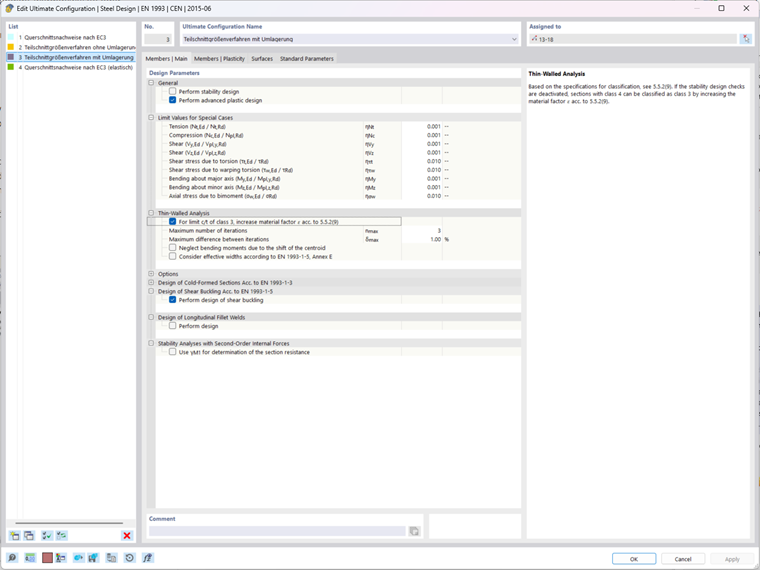
- Activating the PIFM: The partial internal forces method is activated in the ultimate limit state settings. The user can select the variant with or without redistribution.
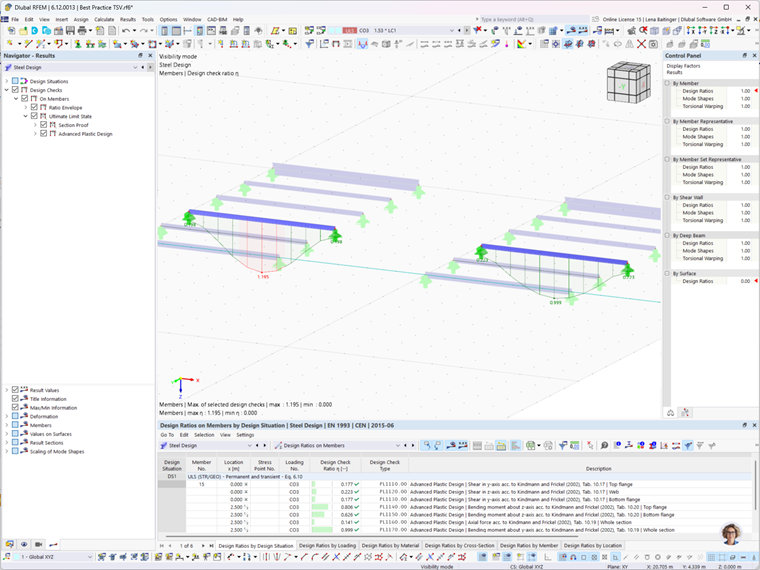
- Calculation of load-bearing capacity and comparison of results: The calculation shows that the method with redistribution allows for a 1.53 times higher load-bearing capacity before the cross-section is fully utilized. In comparison, the method without redistribution reaches maximum design ratio at a lower value. The method with redistribution leads to an efficient solution, as it can make better use of the plastic reserves of the cross-section.
Conclusion and Recommendations
The partial internal forces method (PIFM) provides an efficient and economical way to plastically design steel components. It allows for more precise utilization of cross-section reserves, especially in complex load scenarios. While the method is particularly advantageous for uneven stress distributions, it may be less advantageous for uniformly distributed stresses, as the plastic reserves are then small.
However, it is important to continue to consider stability analyses even when using the PIFM for cross-section resistance. The RFEM 6 software provides a detailed and user-friendly platform for applying the PIFM. Overall, the PIFM is a powerful method for increasing efficiency and accuracy in the design of steel structures.