1. Input Data
1.1 Geometry
Beam length l = 5.50 m
Beam height h = 3.50 m
Beam width b = 0.30 m
Dimensions of the support b = 0.50 m
Span l = 5.50 m
1.2 Loading
Permanent load (gk):
\(
g_{\mathrm{k}} = 0.3 \cdot 3.5 \cdot 25 = 26.25 \; \mathrm{kN/m}
\)
Variable load (qk):
\(
q_{\mathrm{k}} = 150 \; \mathrm{kN/m}
\)
1.3 Materials
- Concrete: C20/25:
fck: 20 N/mm²
fcd: 11.33 N/mm²
- Reinforcing steel: B500S(A)
fyk = 500.0 N/mm2
fyd = 434.8 N/mm2
2. Design of Truss Model
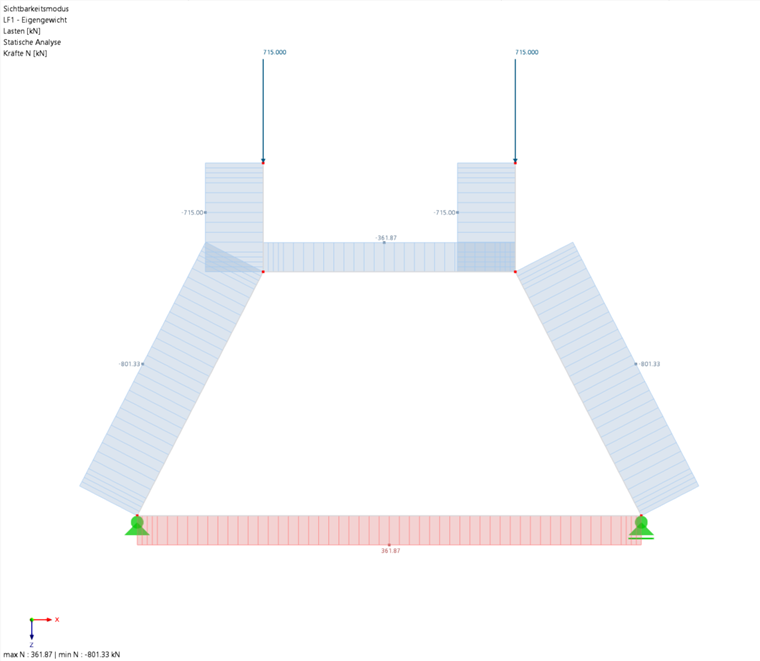
The distribution of forces in the structural component is important for the design of structural frame models. In structures made of uncracked concrete, the distribution of forces is displayed by resultants that form straight stress fields. This leads to a truss of compressive and tensile stresses in which the direction of the forces is changed at the nodal points. This assumption is based on a homogeneous-elastic material behavior. However, as concrete has a lower tensile strength than compressive strength, cracks occur when small loads are applied. As soon as tensile stresses occur, the idealized tension members would fail at cracks and the truss would lose its load-bearing capacity. In order to ensure the load-bearing capacity, it is necessary to insert reinforcement at the appropriate points that can absorb the tensile forces.
For modeling the frame structure, line loads are displayed in simplified form as concentrated loads, as only concentrated loads can be considered in a truss model:
3. Calculation According to DAfStb Booklet 631
3.1 Approximation Method According to DAfStb Booklet 631
For the application of the approximation method according to DAfStb Heft 631 [1], the bending moment for the single-span deep beam is calculated according to the beam structural analysis:
\(
M_{\mathrm{F}} = \frac{(g_{\mathrm{ed}} + q_{\mathrm{ed}}) \cdot l^2}{8} = \frac{260.0 \cdot 5.0^2}{8} = 812.5 \; \mathrm{kNm}
\)
The internal lever arm \( z_{\mathrm{f}} \) can be calculated for single-span beams with a ratio of 1/3 < \( \frac{h}{l} = \frac{3.5}{5.0} = 0.7 \) > 1.0 as follows:
\(
z_{\mathrm{f}} = 0.3 \cdot \left(3.5 - \frac{3.5}{5}\right) = 2.42 \; \mathrm{m}
\)
Since the value of \( z_{\mathrm{f}} \) is less than the theoretical value according to beam structural analysis \( z \approx 0.9 \cdot h \) (with \( z \approx 2.80 \; \mathrm{m} \)), the value of \( z_{\mathrm{f}} \) is used for the calculation.
The resultant longitudinal tensile force \( F_{\mathrm{s,F}} \) is calculated using the bending moment and the lever arm:
\(
F_{\mathrm{s,F}} = \frac{M_{\mathrm{F}}}{z_{\mathrm{f}}} = \frac{812.5}{2.42} = 335.7 \; \mathrm{kN}
\)
For the calculation of the required reinforcement, the resultant longitudinal tensile force \( F_{\mathrm{s,F}} \) is divided by the strength of the reinforcement \( f_{\mathrm{yd}} \):
\(
A_{\mathrm{s,erf}} = \frac{F_{\mathrm{s,F}}}{f_{\mathrm{yd}}} = \frac{335.7 \; \mathrm{kN}}{43.5 \; \mathrm{kN/cm}^2} = 7.7 \; \mathrm{cm}^2
\)
3.2 Plate Theory According to DAfStb Booklet 631
In contrast to the approximation method according to DAfStb booklet 631, the calculation of the resulting tensile force using the plate theory does not involve determining the internal lever arm. Instead, the resulting tensile force is derived directly from the structural system and loading. Various tables are used to determine these forces for single-span beams, which are displayed in the following image:
![Table 4.2 of Heft 631: Resulting Tensile Forces in Deep Beams [1]](/en/webimage/060381/4996552/Image.png?mw=760&hash=ec9a55cdca40d30b4481aa04757df3b01dc1fa64)
The calculation is based on the following parameters:
- Structural system: Single-span beam → Table 4.2 Booklet 631
- Loading: Uniform distributed load
- Ratio \( \frac{h}{l} \): \(\frac{h}{l} = \frac{3.5}{5.0} = 0.7\)
- Ratio \( \frac{c}{l} \): \(\frac{c}{l} = \frac{0.5}{5.0} = 0.1\)
Read from Table 4.12:
\(
\frac{F_{\mathrm{s,F}}}{F_{\mathrm{E}}} = \frac{F_{\mathrm{s,F}}}{(g_{\mathrm{Ed}} + q_{\mathrm{Ed}}) \cdot l} = 0.27
\)
\(
F_{\mathrm{S,F}} = 0.27 \cdot 260 \cdot 5.0 = 351 \; \mathrm{kN} \quad (\text{Compare approximation method: } F_{\mathrm{S,F}} = 336 \; \mathrm{kN})
\)
\(
A_{\mathrm{s,erf}} = \frac{F_{\mathrm{s,F}}}{f_{\mathrm{yd}}} = \frac{351 \; \mathrm{kN}}{43.5 \; \mathrm{kN/cm}^2} = 8.07 \; \mathrm{cm}^2
\)
4. Calculation with RFEM6
4.1 Calculation with Concrete Design Add-on
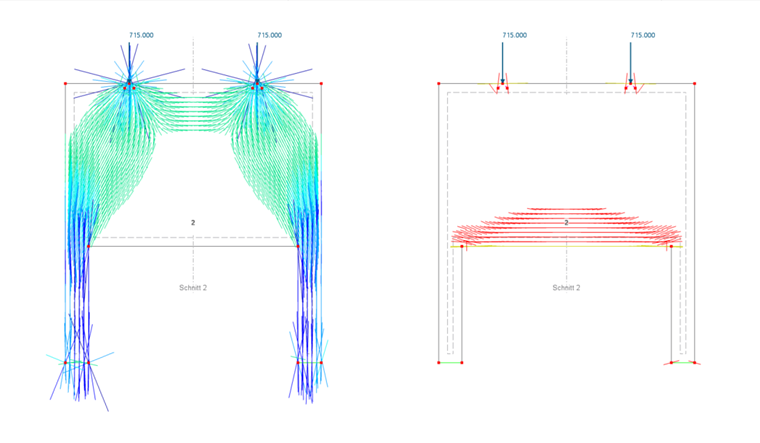
This method should be applied especially when the ratio h/l > 0.5. After determining the necessary reinforcement with the add-on, a vertical cut is inserted at the relevant points in the model (here, in the middle of the wall).
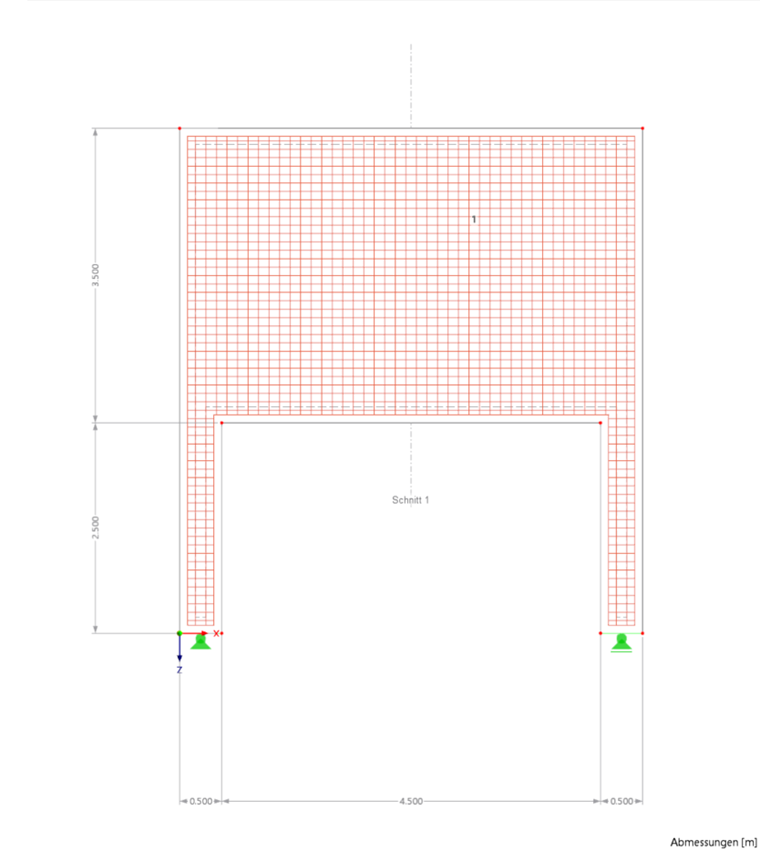
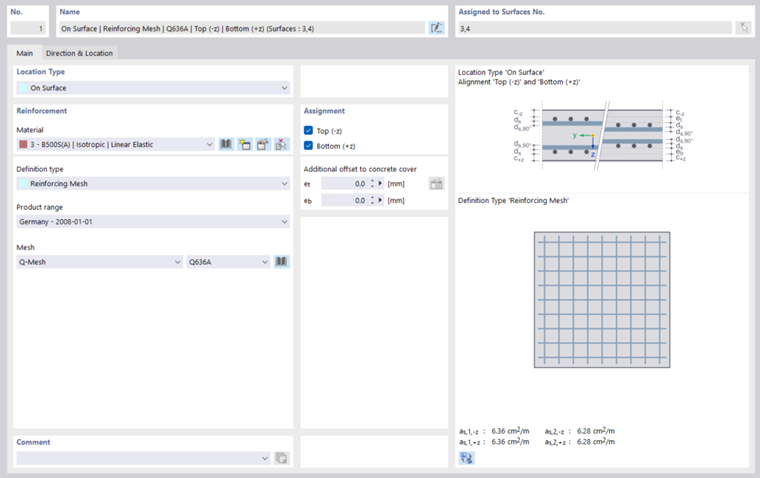
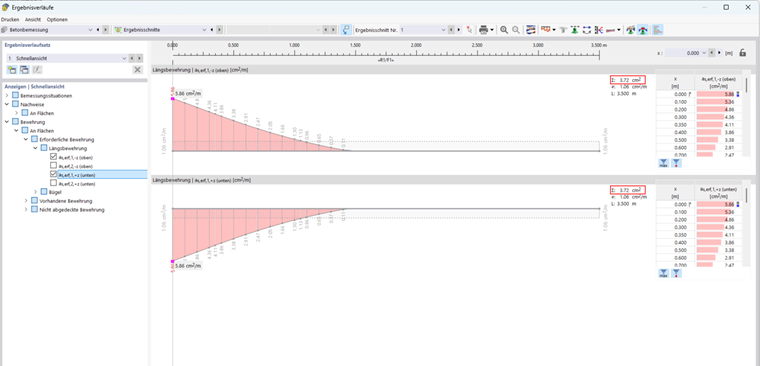
- Evaluation Using Result Cross-Sections:
For the bending reinforcement, the constant smoothing option can be activated in the dialog box of the cut to interpret the results. The sums of the horizontal reinforcements must be calculated:
\(A_{\mathrm{s,erf}} = 3.72 + 3.72 = 6.72 \; \mathrm{cm}^2\)
| Required Reinforcement [cm2] | ||
| Concrete Design Add-on | Approximation Method | Plate Theory |
| 7.44 | 7.70 | 8.07 |
4.2 Nonlinear Design
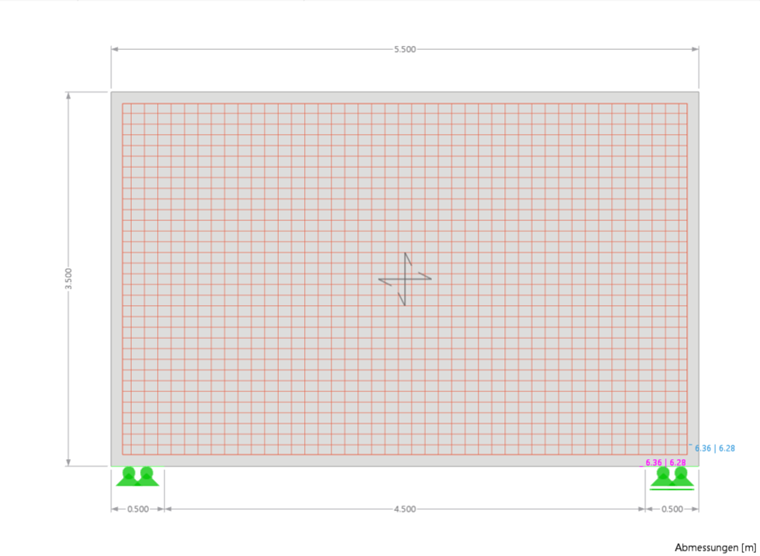
For the nonlinear calculation, the model is simplified as follows:
4.2.3 Nonlinear Concrete Material Model
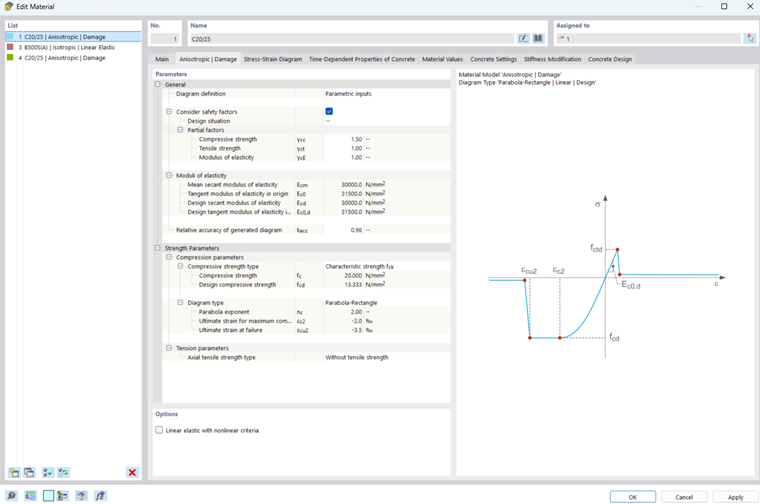
For Concrete C20/25, a material model of the Anisotropic Damage type is created. In the diagram definition, the Parametric Input option is selected. The design strength fcd = fck / γc is assumed as the compressive strength. The diagram type in the compressive area is set as Parabola-Rectangle. The material model does not consider tensile strength. (For numerical reasons, a low tensile strength is considered.)
4.2.4 Reinforcing Steel Material Model and Reinforcement Arrangement
Two different modeling approaches are used to represent the reinforcement in the nonlinear model:
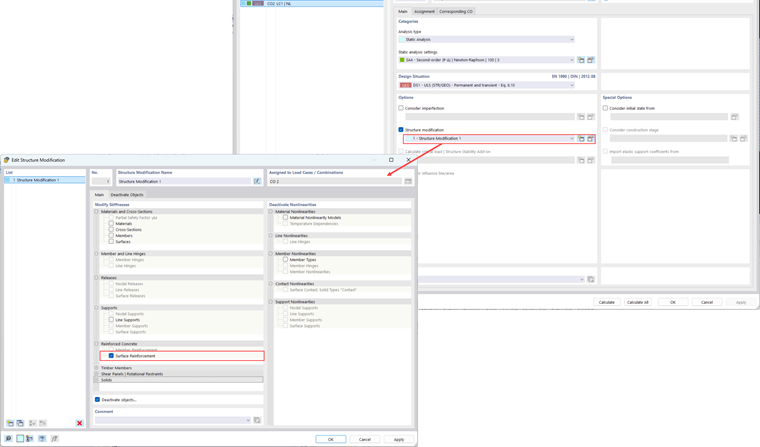
- Reinforcement as Surface Property: The reinforcement (Mesh Q636A) is defined as a surface property and included in the calculation via structure modifications:
- Reinforcement as Explicit Member Reinforcement:
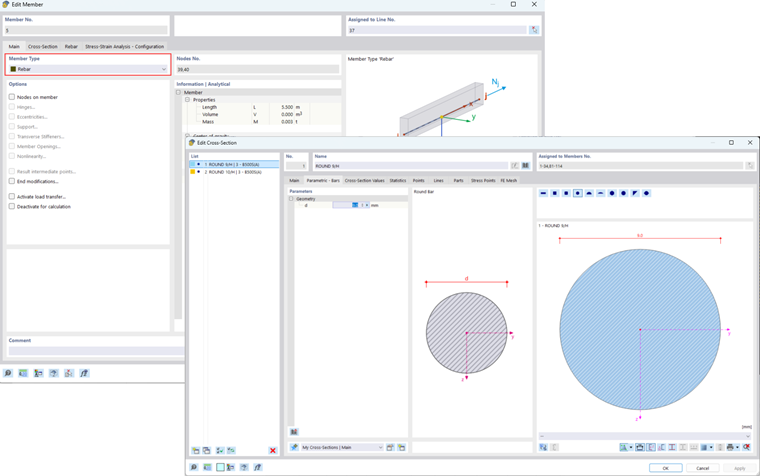
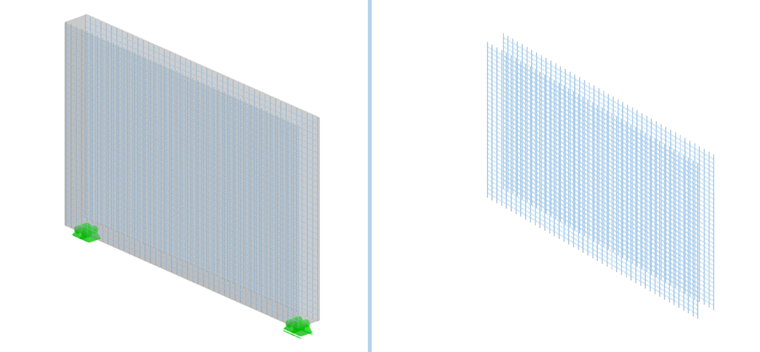
Alternatively, the reinforcement within the surface thickness can be displayed using members of the “rebar” type. The Q636A mesh is split into individual round bars for this purpose.
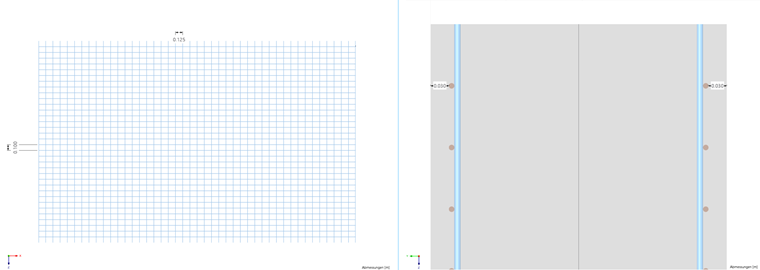
The mesh is made up of longitudinal bars with a diameter of 9 mm and transverse bars with a diameter of 10 mm; two round steel sections are defined accordingly.
The longitudinal bars are arranged with a bar spacing of 0.100 m and the transverse bars with 0.125 m. The required concrete cover of 30 mm is maintained both at the top and bottom.
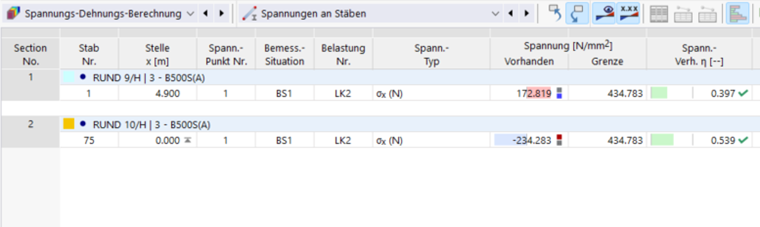
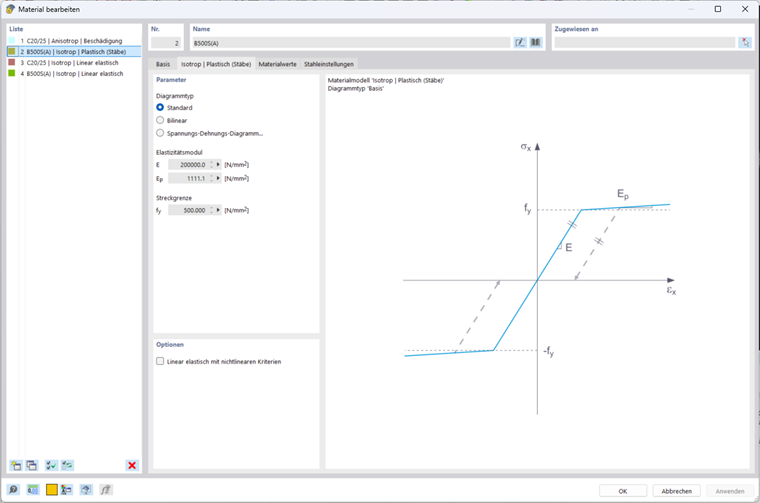
As it is evident from the results that the yield stress is not exceeded, the linear-elastic material model of the reinforcement can continue to be used here.
4.2.4 Results
- Model with Reinforcement as Surface Property:
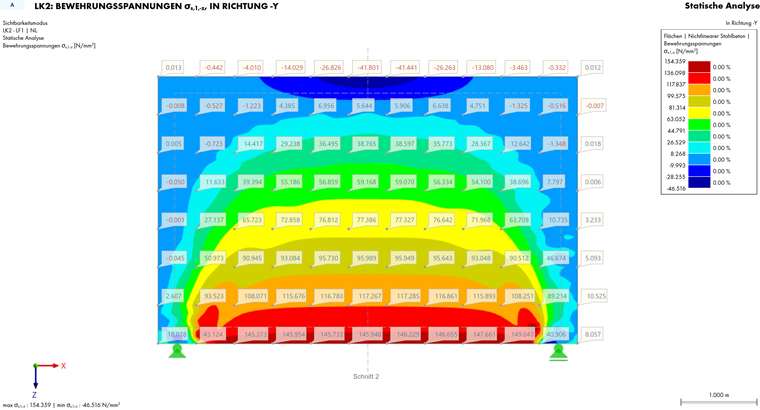
The stress occurring in the reinforcement remains below fyd = 435 N/mm², which fulfills the ultimate limit state design of the wall.
- Model with Reinforcement as Rebars:
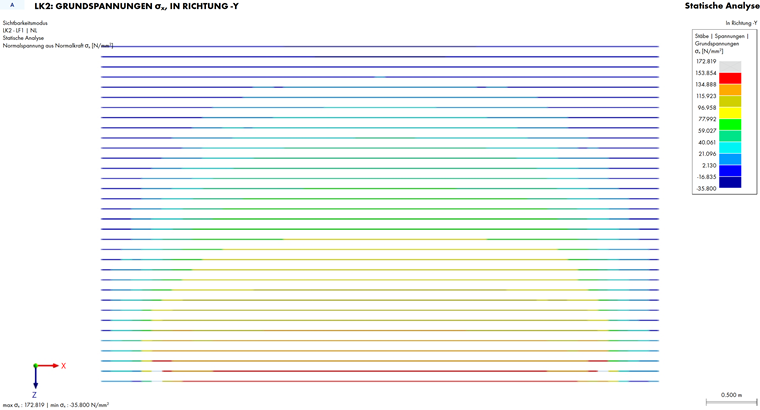
The Stress-Strain Analysis add-on was used to perform the ultimate limit state design. All members were checked for exceeding fyd, resulting in a maximum design ratio of 0.539.