


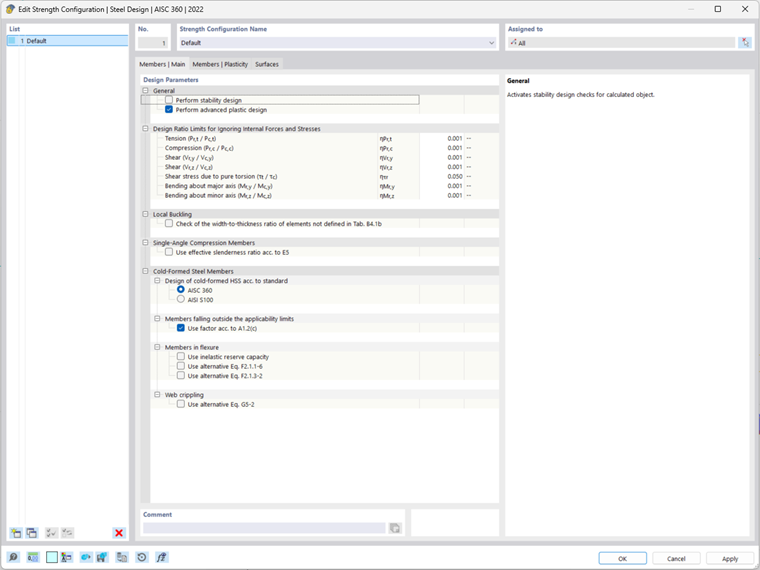
In steel structures, cross-sections that satisfy certain criteria may be designed plastically. In American practice, this applies in particular to compact cross-sections as defined in AISC 360, which are capable of developing their full plastic resistance and sufficient rotational capacity. This allows stresses within the cross-section to be redistributed through yielding of the base material. While the equations provided in commonly used US steel design standards for calculating plastic section capacities are limited to selected cross-section shapes and specific combinations of internal forces, or are not provided at all, the partial internal forces method is almost universally applicable. For example, structural members subjected to axial force, bending, and torsion, including warping torsion, can also be designed efficiently using this approach. The partial internal forces method is available to users of RFEM 6 and RSTAB 9 under the extended plastic design rules in the ultimate limit state settings of the Steel Design add-on.
The partial internal forces method (TSV) was developed by Kindmann and Frickel at Ruhr University Bochum (Germany) and is described in detail in [1]. Two different variants are implemented in the program:
1. Partial Internal Forces Method with Redistribution
The redistribution method is suitable for 2- and 3-metal sheet cross-sections with orthogonally oriented cross-section parts and thus covers the most important open cross-section shapes in steel structures. Additional solutions are implemented for rectangular and circular hollow cross-sections, so that the following cross-section types can be designed using this method:
- Double / single / unsymmetric I-sections
- Channel / T- / Z- / L-sections
- PI sections (Type A)
- Double-symmetric rectangular (RHS) / square (SHS) hollow and box sections
- Circular hollow sections (CHS)
The procedure for plastic design using the partial internal forces method with redistribution is as follows:
- Transformation of the internal forces from the structural analysis into a special (ȳ-z̄) reference system (the origin for I-sections is set in the web center, for example)
- Distribution and design of internal forces that cause shear stresses (transverse forces and torsional moments) at the cross-section level
- Distribution and design of internal forces that cause local bending in cross-section parts orthogonal to the reference cross-section part (for example, a web for an I-section). The yield strength is reduced due to the acting shear stresses mentioned in the previous point.
- Design of the residual load-bearing capacity of the cross-section for internal forces that cause bending in the cross-section parts parallel to the reference cross-section part—for example, a web for an I-section (with reduced yield strength due to shear) plus axial force.
Please note that the cross-section resistance design is not carried out using the fully plastic state of the cross-section. Instead, in Step 4, a case distinction is used to check whether the internal forces are within a certain value range and can be absorbed by the cross-section. The resulting design ratio of the cross-section check is, therefore, generally not proportional to the action and only provides information about the success (design ratio less than or equal to 1) or failure (design ratio greater than 1) of the cross-section checks.
2. Partial Internal Forces Method Without Redistribution
The partial internal forces method without redistribution [1] is generally suitable for all thin-walled cross-section types. The procedure for this design variant is as follows:
- Division of the cross-section into its elements. Limit values for the length-to-width ratio can be defined. Elements exceeding this limit are considered in the design.
- Determination of internal forces in each cross-section part, based on the elastic stresses at the ends of the cross-section parts.
- Verification of the determined internal forces against the plastic limit values of the cross-section part.
The partial internal forces are, therefore, calculated depending on the elastic stress distribution in each cross-section part. A plastic redistribution of the stress is only taken into account within and not between the cross-section parts. Nevertheless, significantly more efficient results can often be achieved as compared to a purely elastic design.
To avoid excessive output, only the design result of the cross-section part with the highest utilization ratio is displayed at each design location in steel design.
Example of Cross-Section Check with PIFM
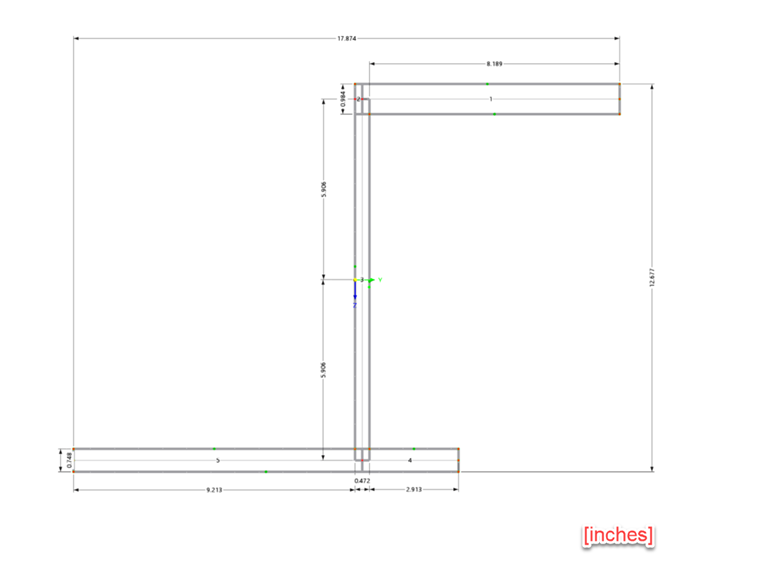
The given example is also described in [1] under Section 10.7.6 and clearly shows the efficiency of the partial internal forces method. Even for unsymmetric cross-sections (here IU 12.677/0/8.189/9.213/2.913/0.472/0.984/0.748/0/0/0/0 [inches], fy = 34.8 ksi) with general stress (axial force + double bending + mixed torsion), it is possible to perform a plastic cross-section design check:
The original example is given in metric units. For the purposes of this article, all values were converted directly to imperial units without rounding.
| Load Principal Axis System (100%) | ||
| N | 89.9 | kips |
| Vu | "-89.9" | kips |
| Vv | 45 | kips |
| MT,pri | 2,950 | lb·ft |
| MT,sec | 36,878 | lb·ft |
| Mu | 221,268 | lb·ft |
| Mv | 29,502 | lb·ft |
| Mω | 6,050 | lb·ft² |
1. PIFM with Redistribution
Based on slight deviations in load and cross-section geometry, the bending design of the lower flange is slightly exceeded in steel design, while in [1], it results in a design ratio of 100%. In order to fully explain the design concept at this point, the internal forces from Table 1 are reduced by 2.5% and calculated with a load factor of 97.5%.
In the first step, the internal forces from the (u-v) principal axis system are transformed into the (ȳ-z̄) reference system. The reference system has its origin at the center of gravity of the web plate and also corresponds to the orientation of the global (Y-Z) coordinate system in Image 2. The main axis inclination α is 35.5°:
Vȳ = Vu * cos(α) - Vv * sin(α) = -96.9 kips
Vz̄ = Vv * cos(α) + Vu * sin(α) = -15.2 kips
Mx̄s = Mxs - Vu * vM-D + Vv * uM-D = 51,926 lb·ft
Mȳ = Mu * cos(α) - Mv * sin(α) + N * z̄S-D = 160,349 lb·ft
Mz̄ = Mv * cos(α) + Mu * sin(α) - N * ȳS-D = 146,937 lb·ft
Mω̄ = - Mω + Mu * uM-D + Mv * vM-D + N * ω̄k = 7,623 lb·ft²
In the second step, the shear stresses in the separate cross-section parts are designed. To do this, the relevant internal forces (shear forces and primary and secondary torsional moments) are first distributed to the flange and web plates (as an example here and reduced for the lower flange):
Vy,u = - (Vȳ * z̄o + Mx̄s) / (z̄u - z̄o) = -101.7 kips
Mxp,u = Mxp * IT,u / IT = 1,076 lb·ft
where IT,u / IT describes the proportion of the torsional stiffness of the lower flange relative to the torsional stiffness of the entire cross-section (here 37.6%). Subsequently, the relevant plastic resistances (Vpl,y,u and Mpl,xp,u) of the cross-section part are determined and the utilization is evaluated.
ητ,u = |Mxp,u| / (2 * Mpl,xp,u) + √((Mxp,u / (2 * Mpl,xp,u))² + (Vy,u / Vy,u)²) = 0.64
In the third step, the local bending moments of the flanges are verified. The partial internal force is composed of the bending moment Mz̄ and the warping bimoment Mω̄. Again, only the lower flange is considered as an example.
MSa,z,u = (- Mz̄ * z̄o + Mω̄) / (z̄u - z̄o) = 82,007 lb·ft
The design is performed with a reduced yield stress due to shear stress (see above) and considering an eccentricity parameter δ:
Mpl,z,u,τ = Mpl,z,u * fy,d,u * √(1 - (τu / τu,Rd)²) = 66,228 lb·ft
ηMz̄ = (|MSa,z,u| / Mpl,z,u,τ) / (1 + δu²) = 0.99
Finally, it is checked whether the effective axial force N and the bending moment Mȳ can be absorbed by the “remaining” cross-section. A closed analytical solution is not available for this last step. Instead, a 2-dimensional solution space is determined, and a check is performed as to whether the acting N-Mȳ combination lies within or outside the limit (= interaction diagram) of this solution space. The limit curve is described for the positive and negative moment ranges using two linear and one parabolic equation. The case differentiation is used to check which sections of the limit curve are relevant for design for the given axial force. The exact calculation steps can be found in [1] or in the results details of the steel design. The resulting limit curve with the different sections for the example is displayed in the following:
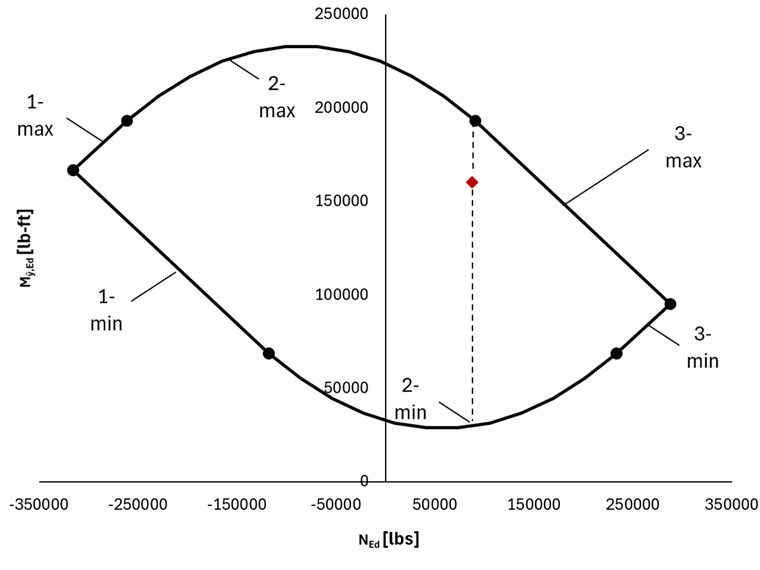
Image 3 shows the limit curve and the N-Mȳ combination acting in the example (red diamond). It is immediately apparent that the applied load is within the solution space of the limit curve, meaning that the cross-section check is fulfilled. However, it is unclear how large the remaining “true” capacity of the cross-section is; that is, what increase in the applied internal force combination would be possible until the ultimate limit state is reached. Due to the nonlinear conditions (in Step 2) the proportionality between load effect and utilization ratio no longer holds. The actual utilization ratio can, therefore, only be determined iteratively; that is, in several calculation steps with varying load levels.
2. PIFM Without Redistribution
For comparison purposes, the cross-section is also designed using the PIFM without redistribution. First, the elastic normal and shear stresses at the initial, middle, and final nodes are determined in each cross-section part (each thin-walled element is considered a separate cross-section part). Here, the calculation (as in steel design) is only presented for the governing cross-section part (Element 5 in Image 2):
| Edge stresses Element 5, internal forces according to Table 1 | ||
| σx,A | 10.33 | ksi |
| σx,E | 40.55 | ksi |
| τA | 13.99 | ksi |
| τM | 15.67 | ksi |
| τE | 0.0 | ksi |
The plastic partial internal forces of the cross-section parts (here, cross-section part i = 5) are then calculated from the stresses, taking into account the dimensions:
N5 = t * l * (σx,A + σx,E) / 2 = 179.6 kips
M5 = t * l² * (σx,A - σx,E) / 12 = 14,031 lb·ft
V5 = t * l * (τA + 4 * τM + τE) / 6 = 90.5 kips
Mxp,5 = Mxp * IT,5 / IT = 814 lb·ft
Then, the shear capacity of the cross-section part is designed:
ητ,5 = |Mxp,5| / (2 * Mpl,xp,5) + √((Mxp,5 / (2 * Mpl,xp,5))² + (V5 / Vpl,5)²) = 0.74
Finally, the axial force-moment interaction is checked. As in the case of PIFM with redistribution, the resistances are calculated with a reduced yield stress:
fy,5,red = fy,5 * √(1 - (τ5 / τRd,5)²) = 23.39 ksi
ηN+M,5 = (N5 / Npl,τ,5)² + |M5| / Mpl,τ,5 = 1.611
Based on the initial load in Table 1, the cross-section verification is not met. Iterative calculations indicate that the verification can barely be met if the load is reduced to 86%.
3. Elastic Cross-Section Check
The elastic cross-section check is clearly exceeded in Element 5 with a maximum utilization ratio of 129%. The corresponding maximum load factor can be obtained directly as the reciprocal of this maximum utilization ratio, i.e. 77.5%.
Conclusion
Plastic design according to the partial internal forces method (PIFM) allows a significantly more economical design compared to the elastic cross-section verification, if permitted. In the example, a limit load increase of 11% (PIFM without redistribution) or 25.8% (PIFM with redistribution) can be achieved.