


1 – Considering Manufacturer-Specific Parameters
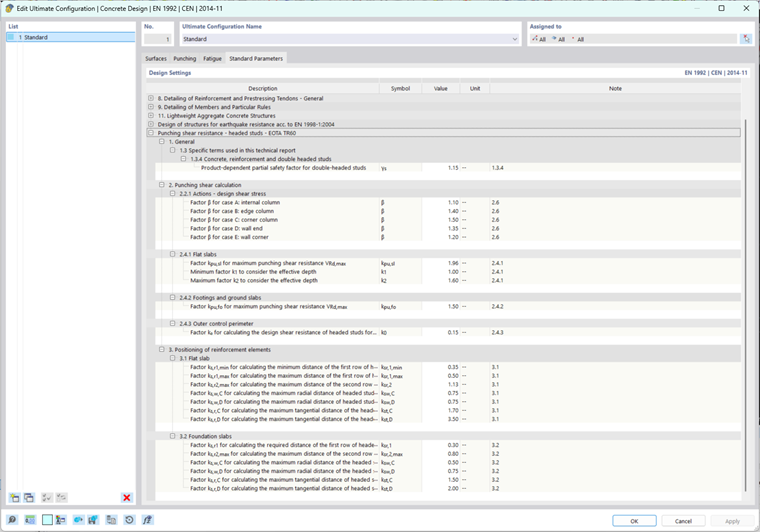
In RFEM 6, the EOTA TR 060 technical guideline [1] is implemented in such a way that the product-specific parameters can be individually adjusted. The various properties from the manufacturers’ approvals (ETA) can be found in the ultimate configurations under the standard parameters.
The following parameters may vary:
- γs – partial safety factor for double-headed anchors
- kpu,sl – factor for calculation of VRd,max for slabs
- η (k1,k2) – considering the effective depth for slabs
- kpu,fo – factor for the calculation of VRd,max for foundations
2 – Concrete Resistance Values
Slabs
The vRd,c calculation for slabs without punching reinforcement is similar to the calculation in EC 2 according to Equation 6.47. In [1], this equation is referred to as Equation 2.10.
To calculate the maximum resistance value vRd,max, the normal compressive stresses are neglected by default (as recommended in [1]). However, as also mentioned in Chapter 1, they can be taken into account by enabling this option in the ultimate configuration.
The resistance value for the maximum allowable punching load is calculated according to Equation 2.17.
Foundations
To calculate the resistance value for the foundation design, the initial value CRd,c is assumed to be 0.18/γc (for foundation slabs and slender foundations). The spacing a is determined iteratively and results in the governing design ratio of vEd,red/vRd,c. However, the upper limit here is 2d. A detailed explanation can be found in the following technical article:
The resistance value vRd,max is calculated using Equation 2.19.
3 – Applicability Limits of Punching Reinforcement
In principle, punching failure cannot be prevented simply by using arbitrarily high levels of punching reinforcement. As a prerequisite, it is necessary to fulfill the design requirement for maximum resistance vEd ≤ vRd,max. Only then can the punching shear design be fulfilled by selecting the appropriate punching reinforcement.
Therefore, the factors kpu,sl and kpu,fo mentioned in Chapter 1 have a significant influence. The concrete’s resistance value vRd,c is multiplied by the corresponding factor depending on the member type. Higher factors thus allow for a greater allowable punching load.
4 - Resistance Values for Double-Headed Anchors
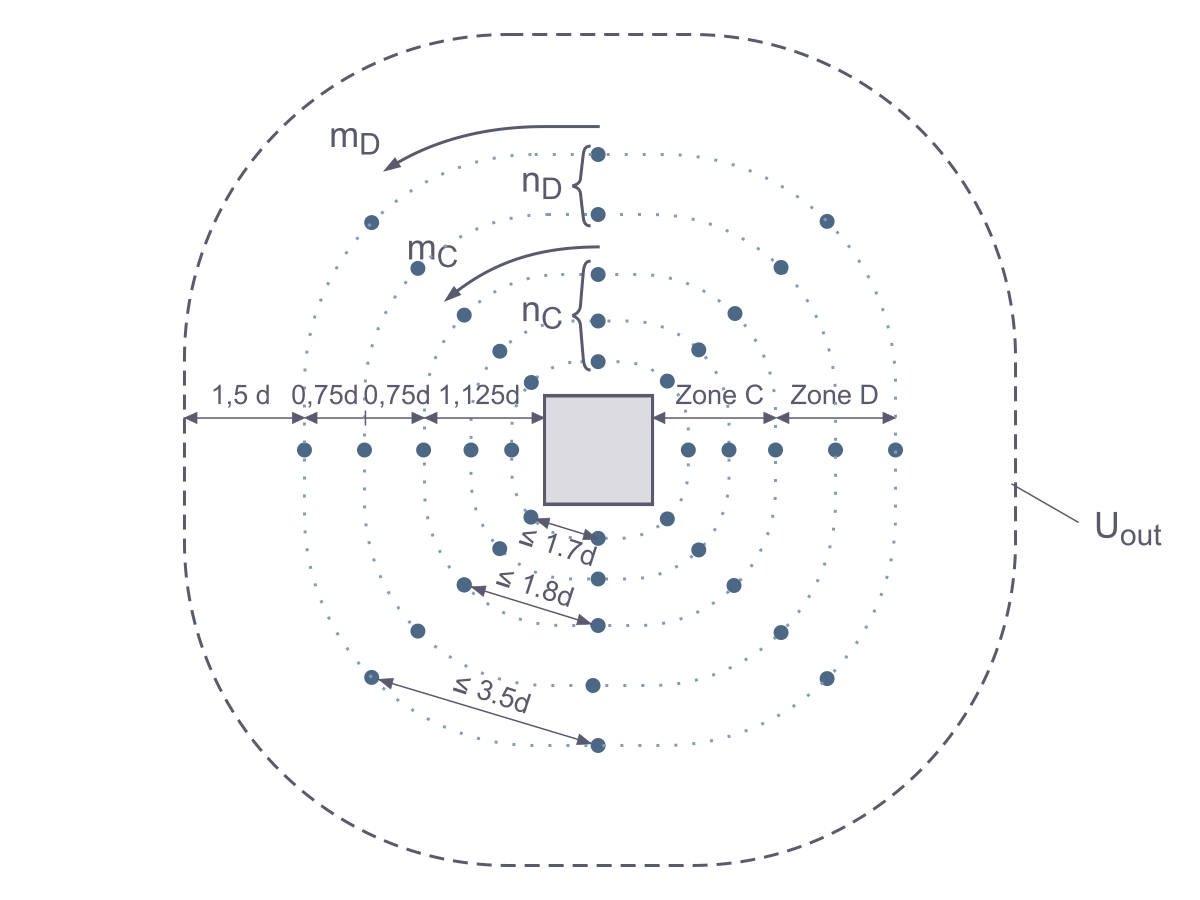
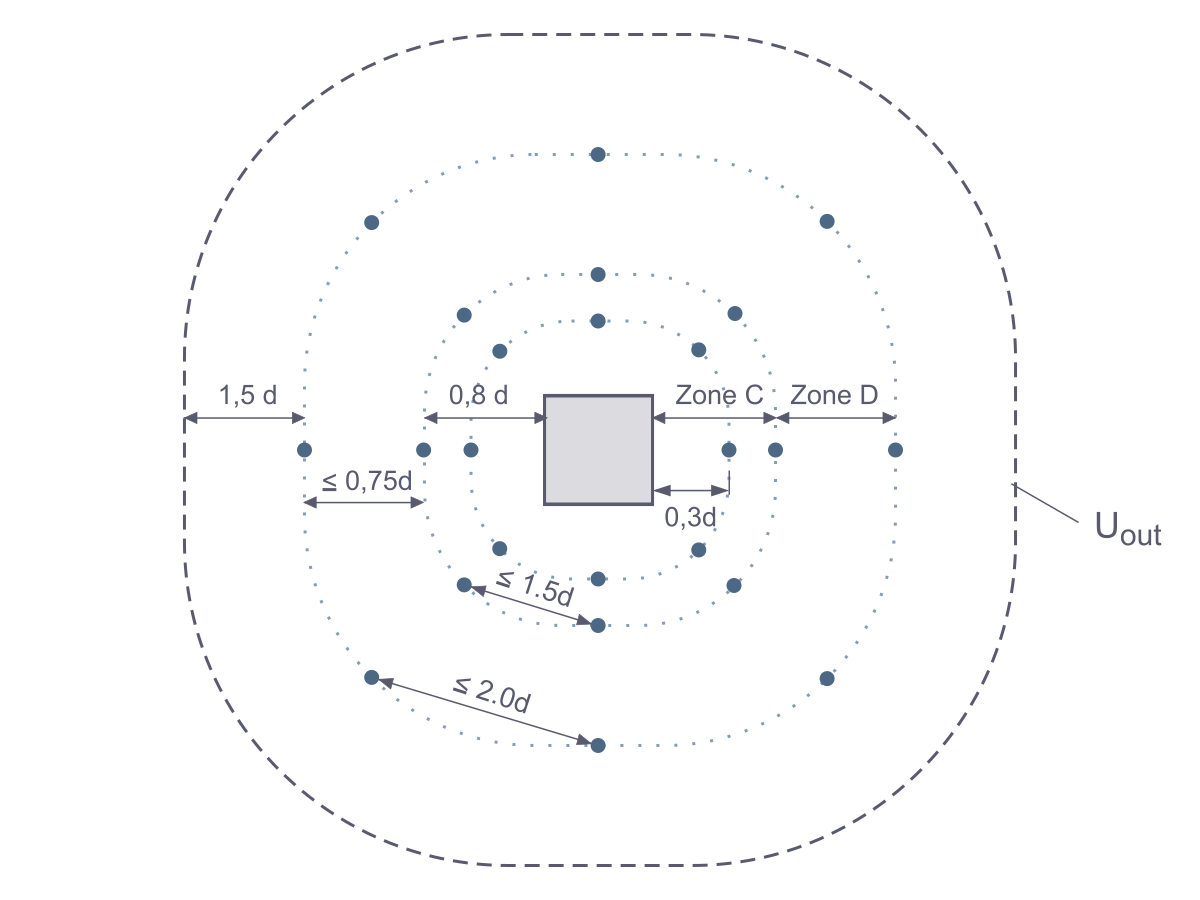
Unlike in the Eurocode, the reinforcement value for double-headed anchors is not calculated per perimeter section. The guideline [1] distinguishes between two zones (see images for distance regulations).
Zone C is the area located 1.125d from the column edge, wall end, or wall corner for slabs, and 0.8d for foundations. All cross-sectional areas of the double-headed anchor shafts in Zone C are added together to yield the effective reinforcement value. In slab calculations, there is also an η-factor that accounts for the effective depth.
Zone D is located between the outer perimeter and Zone C.
5 – Outer Control Perimeter
The outer perimeter is located at a distance of 1.5d from the last perimeter section reinforced with double-headed anchors. The design requirement is fulfilled when the force acting on the outer perimeter no longer requires punching reinforcement—that is, when the concrete strength is sufficient. This design requirement is proven by comparing the required perimeter of the outer perimeter with its actual perimeter.
6 – Detailing Rules
Slabs
The following applies to radial distances:
- It is necessary to locate the first perimeter section between 0.35d and 0.5d (from the edge of the punching shear section).
- The second perimeter section may be located at a maximum distance of 1.125d (from the edge of the punching shear section); this is the boundary line of Zone C.
- Subsequent perimeter sections must not exceed a radial distance of 0.75d from the previous perimeter section.
The following applies to tangential distances:
- Up to a radial distance of 1.0d (from the edge of the punching shear section), the tangential distance must be less than or equal to 1.7d.
- At the boundary line of Zone C at 1.125d (from the edge of the punching shear section), the tangential distance must be less than or equal to 1.8d.
- In Zone D, the tangential distance must be less than or equal to 3.5d.
Single Foundations and Foundation Slabs
The following applies to radial distances:
- The first perimeter section must be located at 0.3d (from the edge of the punching shear section).
- The second perimeter section must not be located more than 0.8d (from the edge of the punching shear section); this is the boundary line of Zone C.
- Subsequent perimeter sections must not exceed a radial distance of 0.5d to 0.75d (depending on the foundation type) from the previous perimeter section.
The following applies to tangential distances:
- At the boundary line of Zone C at 0.8d (from the edge of the punching shear section), the tangential distance must be less than or equal to 1.5d.
- In Zone D, the tangential distance must be less than or equal to 2.0d.
7 – Design Checks
To fulfill the punching shear design requirement, four conditions must be met.
 As mentioned in Chapter 3, it is necessary to fulfill the VRd,max design in order to perform the punching shear design in general. kETA are the manufacturer-specific values in this context. They differ for slabs (kpu,sl) and for foundations or foundation slabs (kpu,fo).
VEd ≤ kETA ⋅ VRd,c
 If the applied force V < sub > Ed < /sub > ≤ V < sub > Rd,c < /sub > (at the basic control perimeter), then no punching reinforcement is required and the design requirement is fulfilled. It is necessary to increase the punching reinforcement if V < sub > Ed < /sub > ≥ V < sub > Rd,c < /sub>, until the resistance value V < sub > Rd,s < /sub > ≥ V < sub > Ed < /sub > is reached.
VEd ≤ max (VRd,c ; VRd,s)
 The outer perimeter is located at a distance of 1.5d times the distance from the last perimeter section installed with double-headed anchors. The existing perimeter of this outer perimeter must be greater than or equal to the required perimeter.
uout,req ≤ uout,prov
 Furthermore, it is necessary to observe the construction rules, and the following conditions must be fulfilled:
- At least two perimeter sections in Zone C
- Radial distances between the perimeter sections
- Tangential distances between the double-headed anchors on a perimeter section