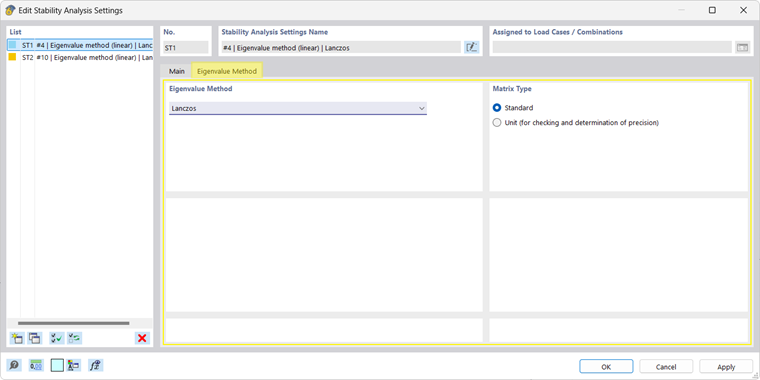
Image of the settings in the "Eigenvalue Method" tab:
The settings in the "Eigenvalue Method" tab are organized into several sections:
Tab Section: Eigenvalue Method
| Lanczos
|
|
|
|
- Default setting for direct determination of eigenvalues
|
|
|
- The calculations converge quickly and provide very good results for low eigenvalues of small to medium-sized models with 10,000 to 100,000 degrees of freedom.
|
|
|
|
| Roots of characteristic polynomial
|
|
|
|
- Method with high accuracy for the calculation of higher eigenvalues
|
|
|
- Suitable for small to medium-sized models (like Lanczos), but often with better performance
|
|
|
|
| Subspace iteration method
|
|
|
|
- Method with high stability/robustness for poorly conditioned (numerically unstable) matrices
|
|
|
- Not suitable for complex systems; negative load factors may occur.
|
|
|
|
| Shifted inverse iteration
|
|
|
|
- Method with short calculation time due to fast convergence
|
|
|
- Results between the largest and smallest eigenvalue of the given matrix can also be determined.
|
|
|
|
Tab Section: Matrix Type
| Standard
|
- Calculation using the geometric stiffness matrix of the linear equation system
|
| Unit (for checking and determination of precision)
|
- Calculation without consideration of the physical properties of the model by using the unit matrix
|
|
|
- Use as a reference for numerical and kinematic analyses
|