


On December 5, 2025, another of the great architectural legends passed away. Frank Gehry died at the age of 96. He left the world some of the most exciting and probably also the most bizarre buildings ever. The courage to create shapes, a radical rejection of previous schemes, and absolutely iconic buildings: Frank Gehry combines all of this in his life's work.
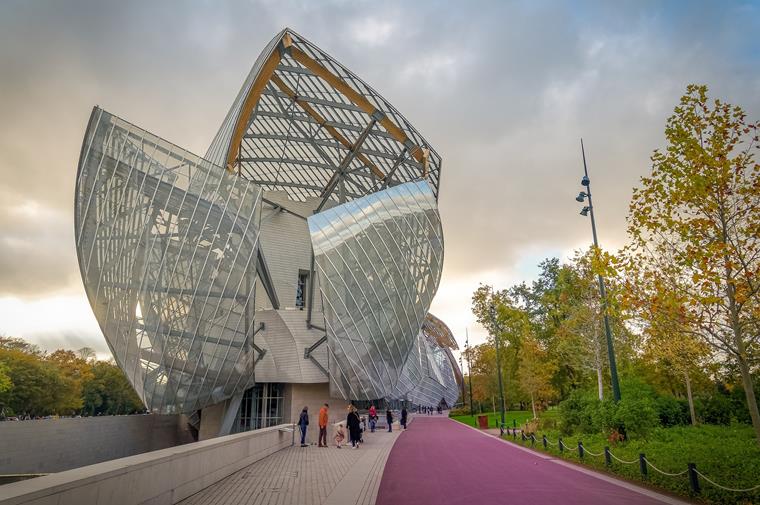
We would like to take his death as an opportunity to take a closer look at his works and his career. His designs and buildings were so hotly debated that an entire episode of The Simpsons was dedicated to him. The “Bilbao” effect is still a well-known term in architecture today. Already curious? Then stay tuned and find out more about Frank Gehry!
Frank Gehry: Childhood and Studies
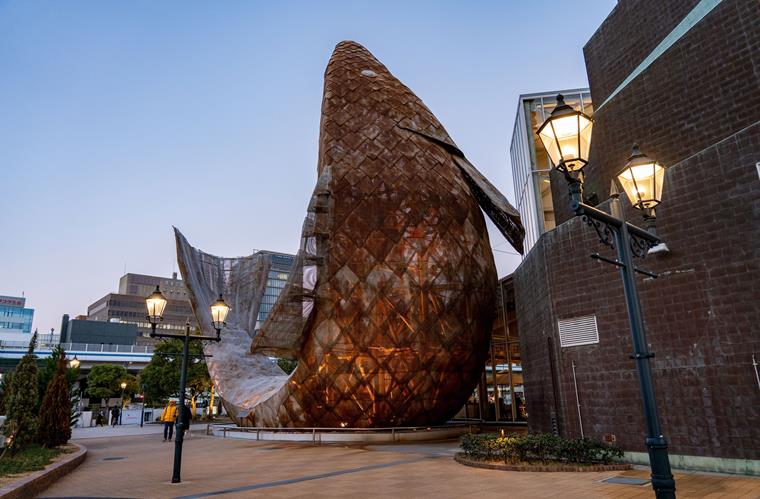
Frank Gehry was born in Toronto and was already interested in art and design at an early age. As a child, he built his first small buildings and mini-cities in his grandmother's store - from scraps of wood from his grandfather's DIY store. He already loved the wavy shapes of the wood chips. The form of a swimming carp in the bathtub, especially before the feast at Christmas, also greatly inspired his later works.
In 1947, his family moved to Los Angeles, where he began studying architecture at City College. He graduated from the School of Architecture at the University of Southern California in 1954.
For a short time, he even studied at Harvard for a postgraduate course in urban planning, but dropped out. Too conservative, too rigid, too boring for him. Frank Gehry wanted more. More excitement, more life in buildings.
First Ideas and Curious Creative Processes
His radical views and design processes were often poorly received among colleagues in the industry. The world of architecture in the mid-20th century moved to the beat of symmetry, grids, and fixed patterns.
Something that Frank Gehry saw as rigid shackles. Shackles that held architecture in their clutches and prevented creative minds like his own from developing. Buildings had to be allowed to show a shape, to have their own character. To be alive.
The first to understand his views and support him were artists. His companions were Claes Oldenburg and Cooseje van Bruggen, for example. He probably drew inspiration from them from time to time for his unusual designs.
Frank Gehry: Rise to Star Architect
In 1962, after dropping out of Harvard, he returned to Los Angeles. Here, Frank Gehry founded his first own architectural office. From then on, he experimented with completely new shapes and unusual materials.
How Architect Frank Gehry Reinvented House Building
In 1977, for example, Gehry began remodeling his newly acquired home in Santa Monica. Take a simple bungalow, some plywood, wire mesh, and corrugated iron: the result was a jagged, seemingly improvised shell. This first major project was the result of Gehry's search for an answer to late modernism.
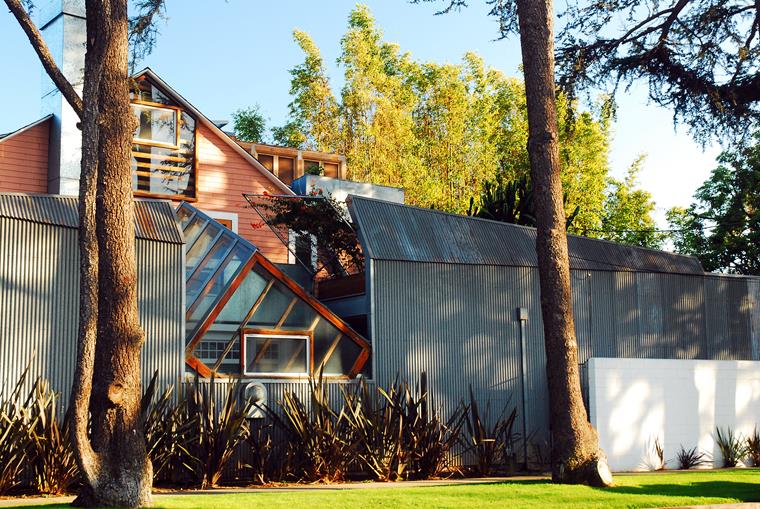
Many contemporary architects relied on postmodern quotes. Historicism was generally in vogue. We have already written a blog post for you about this, too. Take another look there! And Gehry? He literally went to the DIY store, picked up anything that looked interesting, and reinvented his house. Today, this approach is called deconstructivism. It's also a topic we've already dealt with here. You can read about it here: Deconstructivism: Architecture is Art!
Other examples of Gehry's approach are the Spiller Residence in Venice (1978/79), the California Aerospace Museum in Los Angeles (1982-84) and the Winton Guest House in Minnesota (1982-87). They are not particularly well known today, but they show very well how Gehry knew how to break buildings down into different shapes in order to rearrange them.
In his hands, architecture became almost sculptural: an art form that you either like or loathe. Buildings from the pen of Frank Gehry polarized. They remained a talking point – and this was ultimately rewarded.
In 1989, he was awarded the Pritzker Prize for his new understanding of architecture. If any of you don't already know, this is pretty much the highest award an architect can receive.
With his combination of organic shapes, such as the flowing movements of fish and expressive buildings, which created deep chasms to contemporary buildings, he set new standards. The world became aware of him.
Architectural Style of Frank Gehry
So we have looked at his career. But what characterizes the buildings by Frank Gehry? Is it even possible to describe them completely with just a few characteristics? In fact, no. Many buildings have similar elements, but no two are the same.
They all look as if they were test objects in an engineering test laboratory. And as if they had broken out of there to show themselves to the world. Nevertheless, we will try to compile the most concise recognizable features of Gehry's architectural style for you.
Architectural Features
When you stand in front of a Gehry building, the first thing that strikes you is the unusual structure. Gehry's works break with classical geometry and symmetry is often sought in vain.
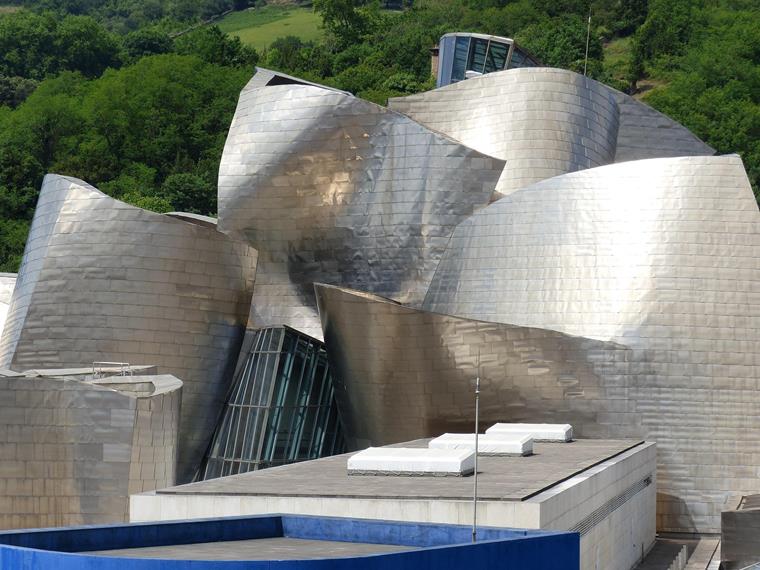
Curvy, dynamic shapes give the exterior an almost sculptural appearance. This turned architecture into art. Another famous female architect who pursued a very similar approach was Zaha Hadid. If you want to find out more about one of the few women who was renowned in high architectural circles, read on: Blog Post on Zaha Hadid .
Materials and Methods
The materials and methods used in Gehry's buildings are as unusual as their shape and structure. For example, he experimented with corrugated sheet metal, wire, titanium, and stainless steel.
Gehry needed more than just a calculator, pen, and paper to be able to implement his sometimes highly complex geometries. It was necessary to use technology. He was one of the first to use advanced software (CATIA) to create detailed 3D models.
He was also a strong advocate of collaboration between architecture and engineering. Someone who also closely intertwines architecture and engineering is the often controversial star architect Santiago Calatrava. We have already taken a closer look at him: Between Elegance and Escapade: Santiago Calatrava .
Philosophy Behind Frank Gehry's Architecture
You probably know this: architecture, especially when it is very special, wants and should be interpreted. What did the architect want to tell us with this? With Gehry, it's simple: his architecture should arouse emotions. To stimulate discussion. To get people to engage with his buildings.
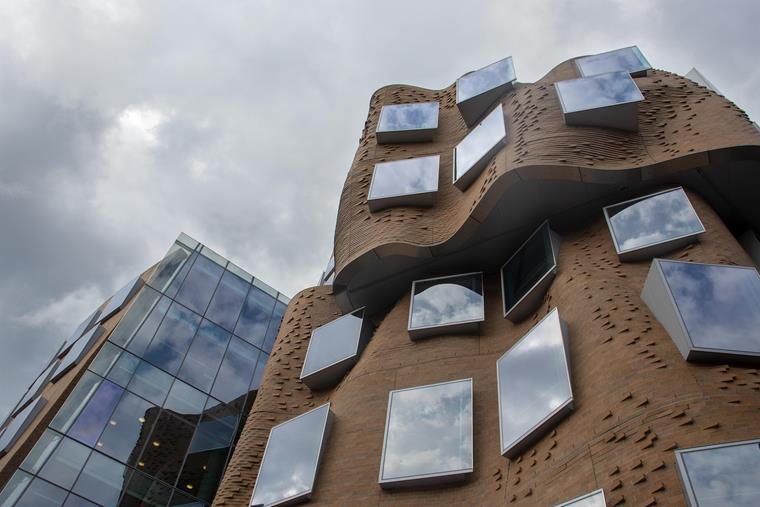
Despite the formal language, Gehry always remained feature-oriented. Not like architects of other famous buildings, where entire areas were unusable based on the unusual shapes.
Frank Gehry worked according to the strict principle of simply building buildings, not sculptures. Even if the imposing buildings do not appear so at first glance. He remained true to this idea.
Gehry's Iconic Works and Their Meaning
In this section, we take a closer look at perhaps the most iconic buildings from Gehry's sketchbook. At the same time, we categorize them: What made them so special at the time? What significance do they have from an engineering point of view today? Be curious!
Guggenheim Museum Bilbao (1997)
We start, of course, with what is probably Gehry's most famous building. A building so famous that it has coined an entire term in the construction industry. Have you already heard of the Bilbao effect? Here's a brief explanation.
The Bilbao effect is a phenomenon in which a single, iconic building in a city causes a comprehensive renewal. The main aspects here are efficient, cultural and urban reorientation.
The Guggenheim Museum Bilbao by Frank Gehry ensured that the former industrial city of Bilbao became internationally visible. The unusual building with its organic shape and solid titanium panels became a tourist magnet. And today? Today, the term rather ambivalent. After all, its success cannot easily be transferred to other cities.
Back to the imposing museum building: the construction of the Guggenheim Museum in Bilbao did indeed present the engineers involved with enormous challenges. In true Gehry style, hardly any wall or surface was rectangular. Calculations with pen, calculator and paper? Almost impossible!
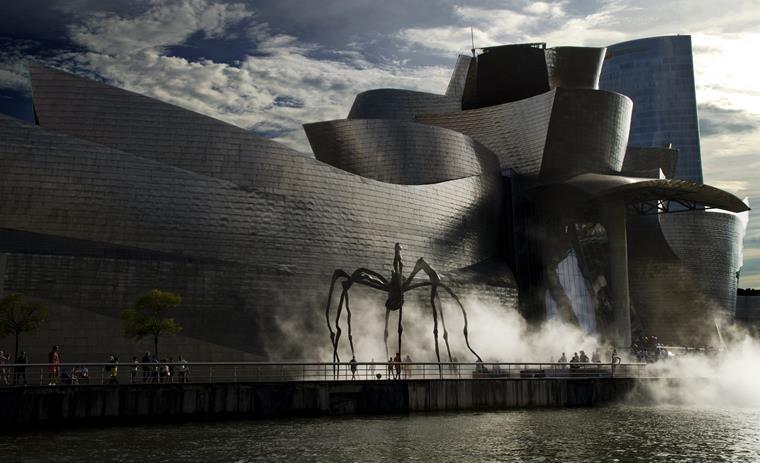
Gehry's team used CATIA to implement the complex shapes. At the time, the software was actually intended for aircraft construction. It made it possible to realize the complex construction of the museum. It was the first time that this software had been used on such a large scale for a building.
The most interesting and impressive feature is still the facade. It consists of around 33,000 wafer-thin titanium panels. At the time, titanium was an experimental material in construction: light, corrosion-resistant, and ideally suited to Bilbao's Drained climate.
In order to achieve the iconic shape, most of the details were custom-made. The Guggenheim Museum Bilbao was thus a huge milestone in the digitally supported structure of buildings. It still regularly hosts well-attended exhibitions today.
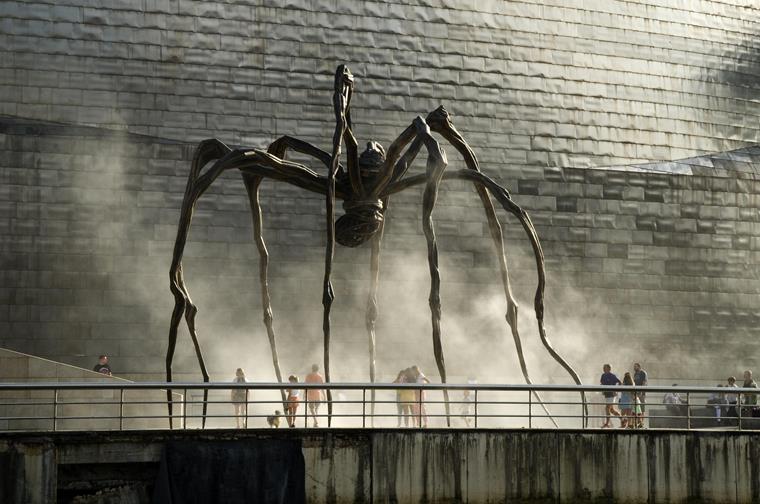
By the way: you're probably familiar with the big spider in front of the museum. Its name is “Maman” and was not designed by Frank Gehry himself. It was designed by the French-American artist Louise Bourgeois in 1999. The work was purchased by the Guggenheim Museum and is now, alongside the building itself, probably the largest and most impressive landmark in the city.
Walt Disney Concert Hall, Los Angeles (2003)
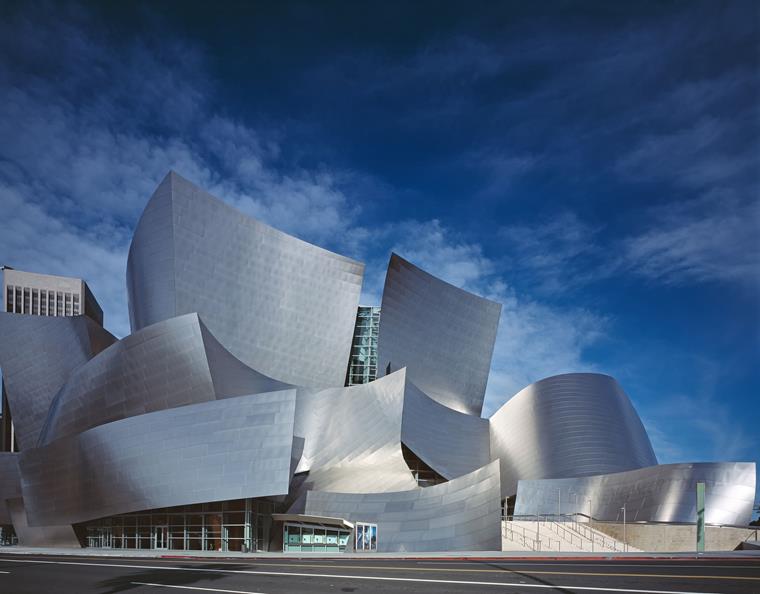
When we talk about unique buildings that set new standards, the Walt Disney Concert Hall in Los Angeles is clearly one of them. Opened in 2003, the building has become absolutely iconic. The sweeping facade alone is already a real eye-catcher.
Curved panels made of stainless steel stretch dynamically over the steel frame. The wide overhangs make the whole thing look almost alive already. Despite the complex geometry, which was also implemented using the 3D planning software CATIA, the building can easily withstand earthquakes up to magnitude 7.0 or higher.
The concert hall inside is decoupled from external vibrations so that the nearby subway or road traffic does not disturb performances. When building the Walt Disney Concert Hall, Gehry skillfully interlocked the expressive architecture with highly developed structural design. Here, architect and modern engineering worked hand in hand. And the result is still impressive today.
New Zollhof, Düsseldorf (1998)
Another building from Gehry's hand is the Neuer Zollhof in Düsseldorf. Strictly speaking, this is actually three buildings. The special feature: Despite their dynamic movements, the three different facades fit perfectly into the cityscape of Düsseldorf's Media Harbour without being disruptive.
Gehry didn't just create typical Gehry buildings here, but also precisely matched the character of their surroundings. They embody the transformation of the former customs port into a modern media location. An approach that the Elbphilharmonie in Hamburg may also have copied later. We have already written an article about it: Elbphilharmonie in Hamburg .
The three sculptural office buildings of the Neuer Zollhof were designed between 1996 and 1998, and officially opened in 1999. Gehry deliberately dispensed with classic cornices or plinths. Instead, the facades score points with curved shapes, as if they were leaning to one side.
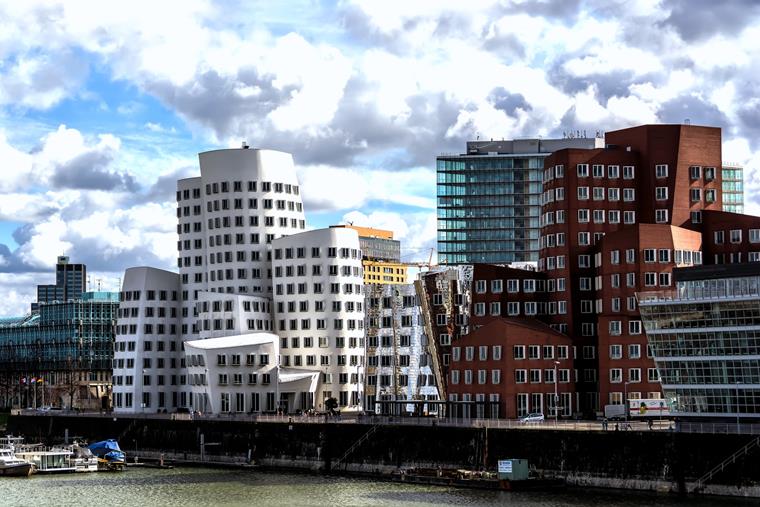
Each of the three buildings has a different facade: one made of stainless steel, the second of white plaster and the third traditionally made of red clinker brick. Depending on the sunlight, this creates interesting light reflections.
Here too, CATIA and CNC-supported formwork processes helped to make the free shapes technically feasible. It was necessary to connect the façade parts with millimeter precision. A real masterpiece on all sides!
What You Didn't Know About Gehry
Gehry's buildings are absolutely unique and still stand out from the crowd today. But what about Frank Gehry himself? He was also an absolutely interesting character. We have put together a few interesting facts for you that you may not have known.
His birth name was Frank Owen Goldberg – he later changed it. His wife feared that the German-sounding name would cause him problems in his career. Did you know that he was not alone in this? The creator of the Eiffel Tower also had his name changed. You can find out more about the Engineering Legend Gustave Eiffel in a further article.
Frank Gehry was not just an architect for buildings. He was an artist to the core. For example, he designed furniture made of corrugated cardboard (“Easy Edges”). He also deeply disliked the term star architect He never referred to himself as such.
Incidentally, his architecture was not well received everywhere. Even his own house caused conflicts in the neighborhood. It was too loud, too conspicuous, simply “too Gehry”. And here we are already at the next part of our article on Frank Gehry.
- image@060974
Criticism of Frank Gehry
Criticism of Gehry's designs was already voiced early on. And the critical voices continued throughout his life. He was accused of his buildings being too iconic, too expensive, too eager to stand out – at the expense of the people who would later use them.
The complex facades were often difficult to maintain. Repairs and cleaning were time-consuming. In addition, some of them, such as the Disney Concert Hall, had problems with high heat build-up from the metal facade. Despite all the controversy, Gehry has triggered discussions about the role of architecture in the cityscape like hardly any other architect.
What Remains: Conclusion on Frank Gehry
Frank Gehry had a great influence on a whole generation of architects. He stood like no other for the courage to embrace creative freedom without neglecting technical precision. With his buildings, he showed the entire industry that architecture can be emotion, chaos, movement and art – and still be masterfully constructed.
He deliberately took a different path from his contemporaries and was successful. He leaves us with a very important credo: Architectural creativity and modern engineering are not mutually exclusive. They benefit from each other. And the results will hopefully remain with us for a very long time.