


The design of cables within the “Steel Design” add-on is currently not implemented. However, you can already design cables in RFEM 6 or RSTAB 9 without the add-on. The following shows how to do this and what to consider.
Cable Section and Material
The cross-section library of RFEM 6 or RSTAB 9 contains a selection of cable cross-sections from various manufacturers. To access them, select the “Member Sections” category and filter by the “Cables” cross-section shape.
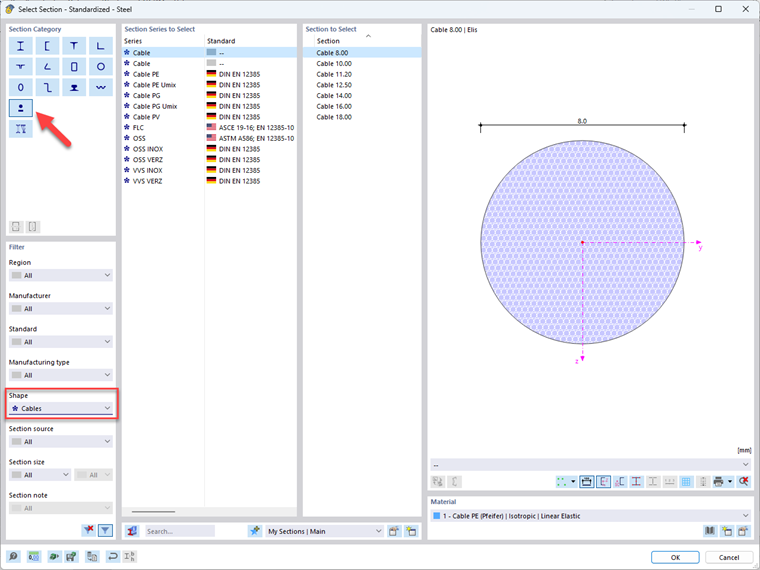
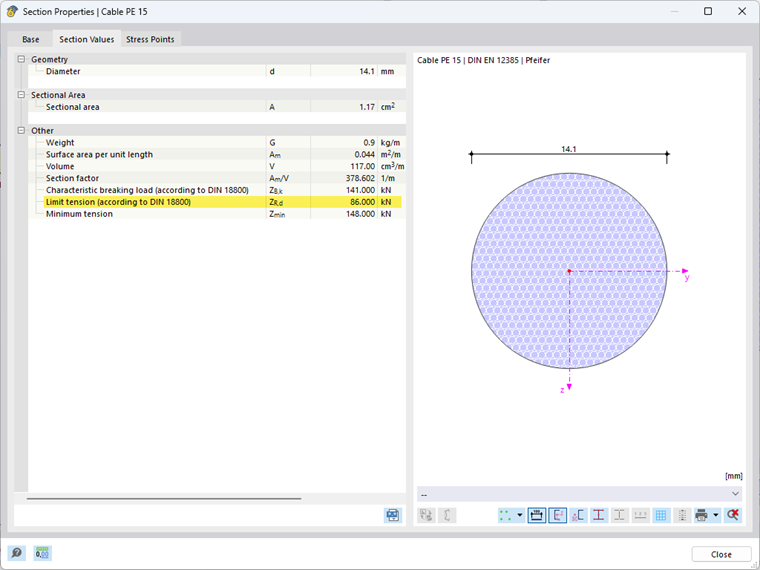
A special feature of the cable cross-sections is that a limit tension and other cable-specific cross-section parameters are already stored for them.
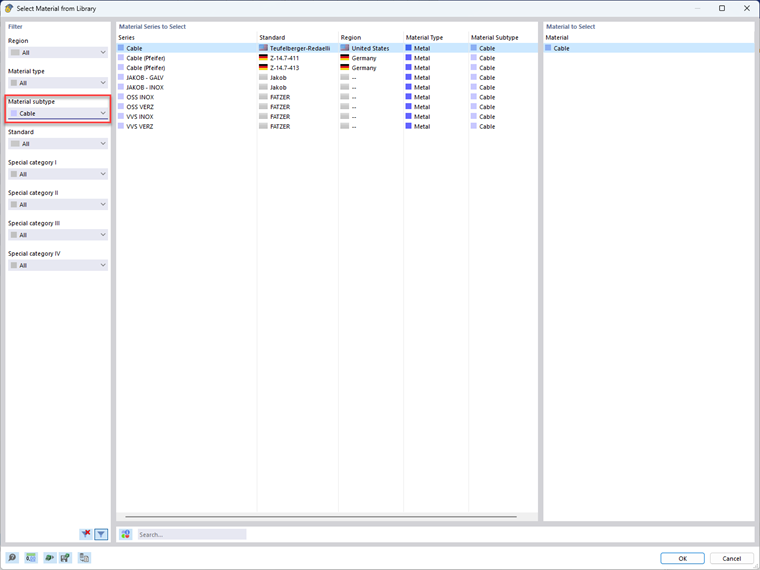
You can also find a selection of cable materials in the material library of RFEM 6 or RSTAB 9 by filtering for the “Cable” material subtype. Make sure that the cable cross-section and cable material always match, otherwise the specified limit tension cannot be guaranteed. If you want to use a different material, you can select a non-standard and manufacturer-independent cable cross-section.
Modeling of Cable Structure
Cables usually have a planned sag. However, since the exact deformation state of a cable subjected to a load is not known at first, the cable can be modeled as a straight bar. By applying a change in length as an external load, the cable sag and thus also the internal forces can be influenced. If a specific final state is desired, for example, a maximum sag of 1 m or a maximum tensile force of 10 kN, this can only be achieved iteratively by trial and error using the “Change in Length” load case.
The “Form-Finding” add-on provides a more elegant solution for this. It allows you to define and perform calculations of final states directly. Using the “Form-Finding” add-on, you can define the desired final state both geometrically and via force quantities.
Cable Design
In the ultimate limit state, it is necessary to verify the compliance with the ultimate tensile force. The design value of the maximum allowable ultimate tensile force can be found in the cross-section properties of the cable. The design value of the cable force corresponds to the maximum axial force in the cable. You can easily display this as a member section size within the structural analysis. The design of the maximum tensile stress is fulfilled if the maximum axial force in the cable is less than the limit tension of the cable.
Depending on the application, further design checks, such as fatigue, vibrations, or detailed design checks, may be required for cable connections. Please refer to the applicable standards.