


Introduction
The following section outlines the possibilities for simulating the interaction between wind, seismic events, and soil-structure interaction using a high-rise building as an example.
Model Description
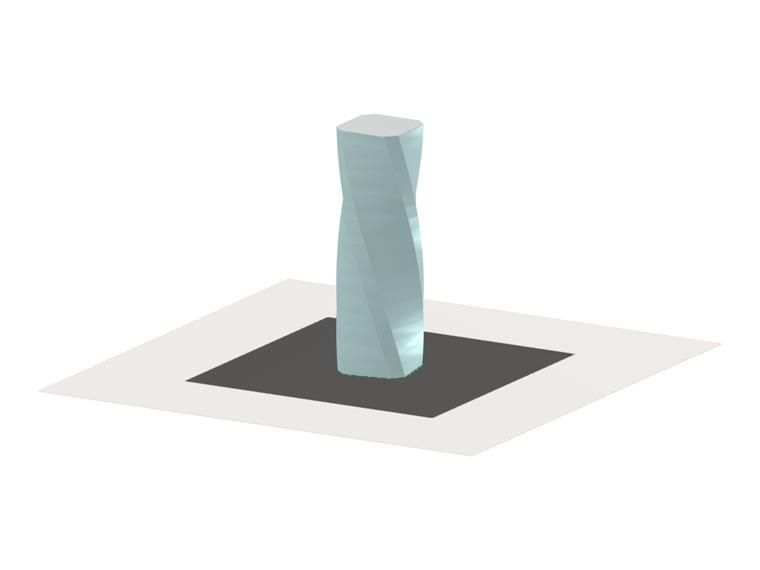
This technical article examines a fictional 20-story high-rise building with a curved design. The floor slabs, columns, and the stiffening core are made of reinforced concrete. The external surfaces are coated with glass. The in-situ soil with uneven stratification is accounted for using boreholes. This soil of the ground level consists of sand, gravel, and weathered solid rock on the bottom side of the examined ground section.
The loads considered include self-weight, live loads on the floor slabs at 2 kN/m², wind loads in one direction from RWIND 3, and seismic loads from the response spectrum analysis.
The model can be downloaded using the following link.
Soil-Structure Interaction
In this example, the subsoil is simulated using the constrained modulus method. Based on the three input borehole, this assigns a stiffness value to each element of the foundation slab that corresponds to the reaction of the in-situ soil to the applied contact pressure.
Here, the impact of the selected method for considering the soil shows itself first in the file size and, consequently, in performance. The largest component here is the calculation of the in-situ soil using a two-dimensional model rather than a 3D solid. However, considering the soil layers directly from the boreholes, without generating the solid models, further reduces the model’s memory requirements and leads to improved performance.
More information on input and the available options is available in the online manual at the following link:
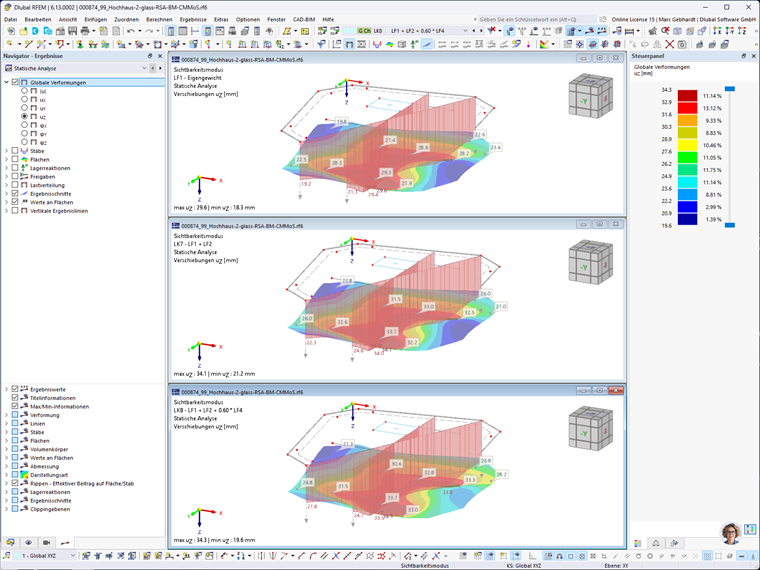
The image below compares settlements due to self-weight (top) with those resulting from the characteristic load combination of live load (middle) and accompanying wind action (bottom). It shows how greater settlement occurs beneath the reinforced concrete building core, which decreases toward the outer edge of the floor slab. When comparing the settlements resulting from the combination with wind (bottom) to the settlement without wind (middle), the wind load in the positive x-direction leads, as expected, to reduced settlement on the left and increased settlement on the right.
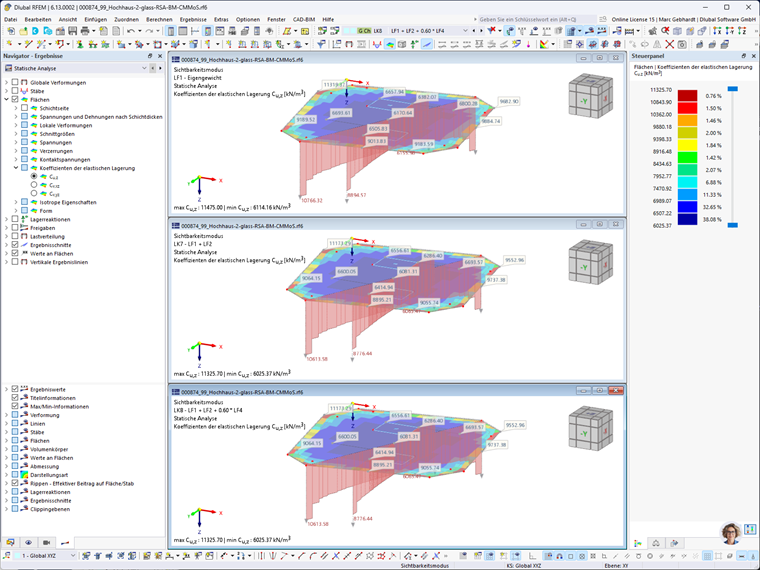
When comparing the coefficients of the elastic support, however, it shows that the two characteristic load combinations do not differ. The reason for this is that they were automatically imported from the corresponding quasi-permanent design combination using the combination wizard. This not only saves calculation time, but should also better correspond to the soil behavior due to the inertial soil reaction. More information on the transfer of the elastic support can be found in the manual at the following link.
Wind Simulation
The following animation shows the results of the wind simulation from RWIND. As can be seen here, air flows around the structure in the X-direction.
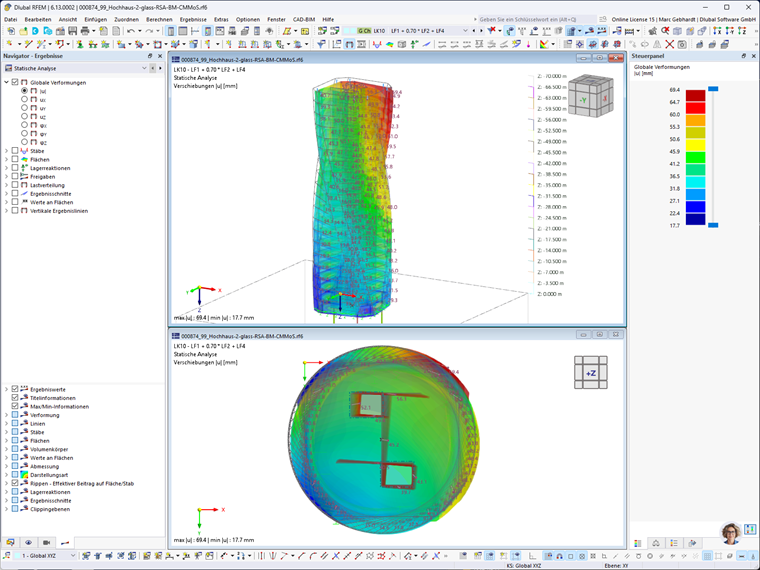
The torsional wind load resulting from the curved design also causes the high-rise building to twist around its vertical axis. This is shown in the following image using the characteristic load combination with dominant wind load (top: isometric view; bottom: plan view).
Earthquake
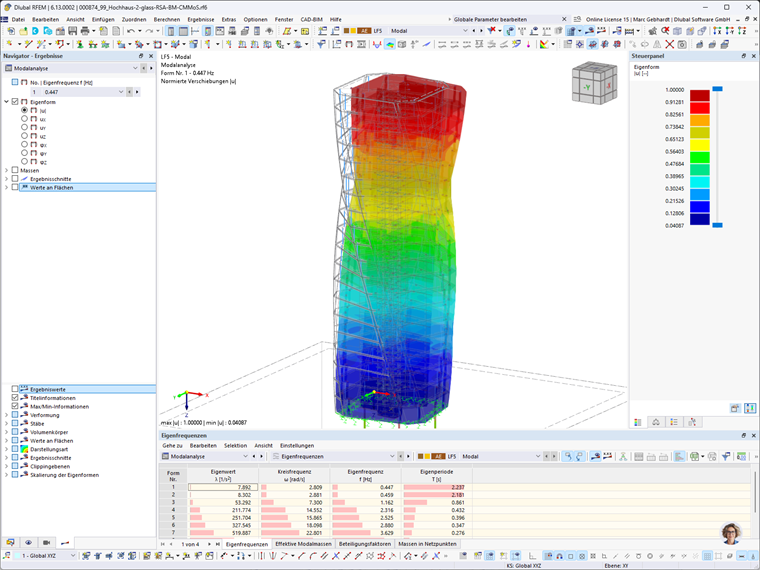
Since modal analysis, which serves as the basis for seismic design using response spectrum analysis, does not account for nonlinearities, it is necessary to pay special attention to the assumed support conditions in the case under consideration here. Under normal circumstances, the subsoil cannot absorb tensile forces. This is particularly true for shallow foundations, as planned here. This behavior is also modeled by the constrained modulus method. The results of the modal analysis are displayed in the following image as an example for the first eigenmode.
There are various approaches for simplified seismic design. The German National Annex to Eurocode 8, for example, refers to the comparison of the ratio of wind load to seismic load. If the wind load is more than 1.5 times as high as the seismic load, a separate approach is not required. In this example, this can be determined from the sum of the support forces of characteristic load combination 9 (self-weight and wind in X) and the acceleration in the X-direction of the first natural mode derived from the response spectrum. Here, however, the resulting ratio is greater, as shown in the following equation. The application of this limit value for a 70-meter-tall high-rise building would, however, be questionable in any case.
ASCE 7 provides a good guideline for the allowable fundamental natural period. According to Equation 12.8-8, the allowable natural period for this example is 2.13 s. However, since the first natural period determined by modal analysis is 2.24 s, a simplified design check cannot be performed in this case either.
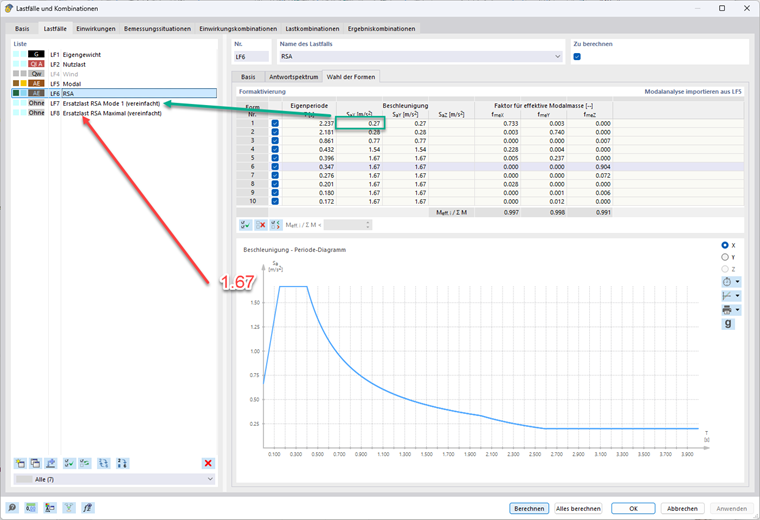
Nevertheless, a load case was considered here in which the horizontal acceleration of the first mode shape is simplified and assumed to be a factor of gravitational acceleration at every mass point. Additionally, a plateau value of 1.67 m/s² is assumed. A more accurate approach would be to use the mode shape rather than a uniform value at every mass point. However, this simplified analysis allows for the verification of the resulting contact pressures and the exclusion of buckling. The load case settings and the resulting contact stresses are shown in the following images.
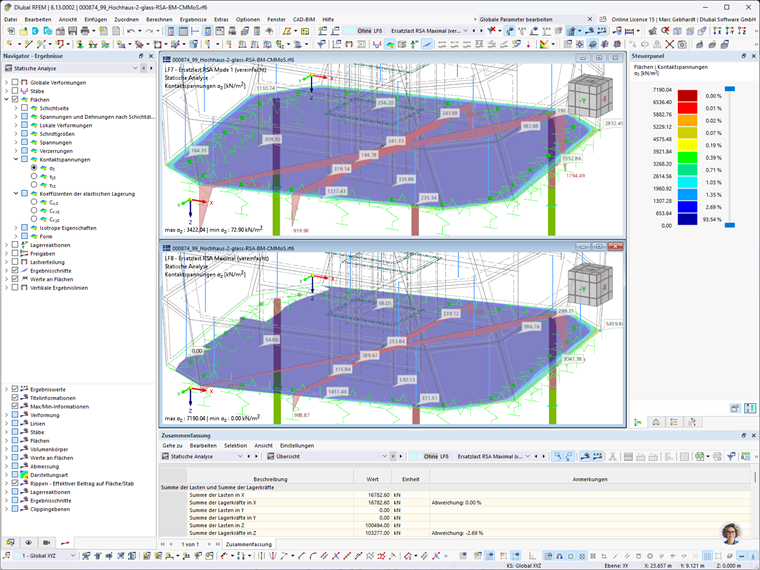
As can be seen here, a gap in the foundation base occurs only when the plateau acceleration is applied. In this case, the slab would fail under the combined load of its self-weight and horizontal forces caused by an earthquake.