Introduction
The key to good structural analysis is always stability. A detailed ground failure design may be necessary, especially in difficult soil conditions. In addition to classic slip circle or lamella methods, this can also be done by reducing the shear strength parameters.
A convenient option is to automatically determine the minimum strength required to find an equilibrium. This involves a successive reduction of cohesion and internal friction angle until no stable numerical state can be found. The result is a global safety factor. Further information is available in the Geotechnical Analysis manual at the following links:
- Online Manuals RFEM 6 | Geotechnical Analysis | Theory | Stability Analysis Using Reduction of Strength Parameters (ϕ-c-Reduction)
- Online Manuals RFEM 6 | Geotechnical Analysis | Input Data | Stability (Slope/Ground Failure)
Model Description
This article explains this method using a simple homogeneous slope according to Sysala et al. [#Ref [1]] and discusses the associated obstacles.
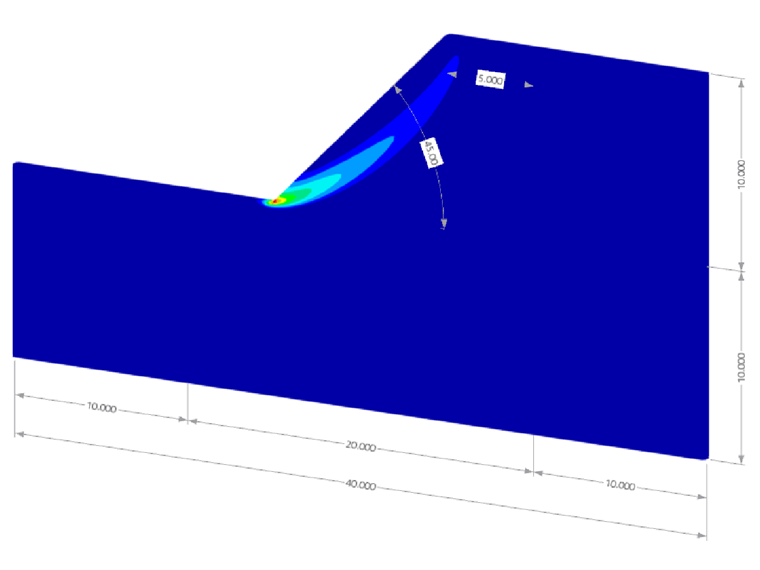
The model consists of a slope with a 45° inclination. An elastic modulus of 40 MPa, a Poisson's ratio of 0.3, and a weight of 20 kN/m³ are assumed for the soil material. The plastic failure model used is based on Mohr-Coulomb, specifically with an unregulated failure surface. The strength parameters are: a cohesion of 6 kPa, an internal friction angle of 45°, and a dilatancy angle that varies between 45, 15, and 0°. Since numerical problems may arise at a dilatancy angle of 0°, a minimum value of 0.01° was used instead. In addition, an angle of 1° was used to examine the behavior at these small angles in a closer manner. The dimensions are shown in the following image with a link to the model.
Mesh Convergence
One point that should not be disregarded is the impact of the mesh on the safety factor obtained. Due to its dependence on local failure (plasticization) of the soil, this factor shows a correlation with the mesh size that cannot be fundamentally disregarded. Further information on mesh convergence can be found in the following article.
In this example, the meshing was carried out with a rough mesh in the outer area and a mesh refined by a factor of 5 in the area of the expected slip cone. Here, one element was used to calculate the thickness. This means that a section of terrain was simulated according to the rougher element length. The following image shows the dependence of the safety factor on the length of the outer FE mesh elements, on the one hand for all dilatancy angles analyzed and, in the lower area, only for 15°.
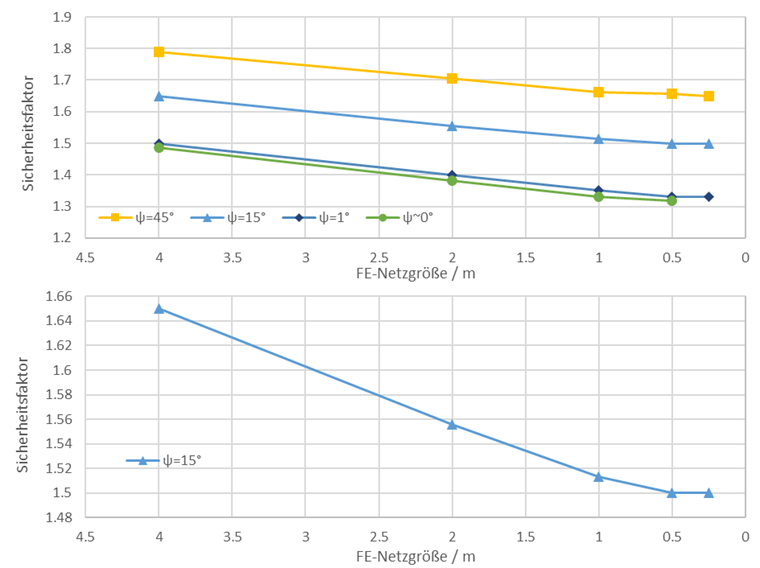
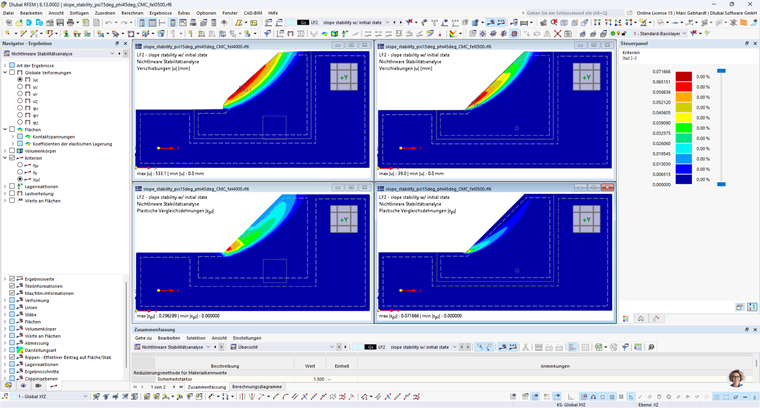
As expected, the safety factor decreases with increasing mesh refinement, regardless of the selected dilatancy angle. For this example, sufficient mesh refinement was found with an FE element size of 0.5 m for the outer, finer mesh. This corresponds to the expected state, as the load-bearing capacity depends heavily on the location of the failure. Since, in contrast to classical methods, the friction surface is not defined but results from the calculation, its location depends on the mesh. This applies both to the location of the first plastic zone and to the location of the friction surface itself. A rougher mesh thus results in “smeared” shear strips, while increasingly finer meshes result in more clearly defined shear strips. The safety factor obtained is thus closer to reality. This can be clearly seen in the following image, which compares the deformations and plastic comparative strains for a very rough mesh (lFE=4.00 m) on the left with a sufficiently fine meshed simulation (lFE=0.50 m, right). In addition to the deformation in the upper part, the plastic comparative strains are even more meaningful. Here, the more sharply defined shear strip can be seen very clearly with mesh refinement.
Literature Comparison
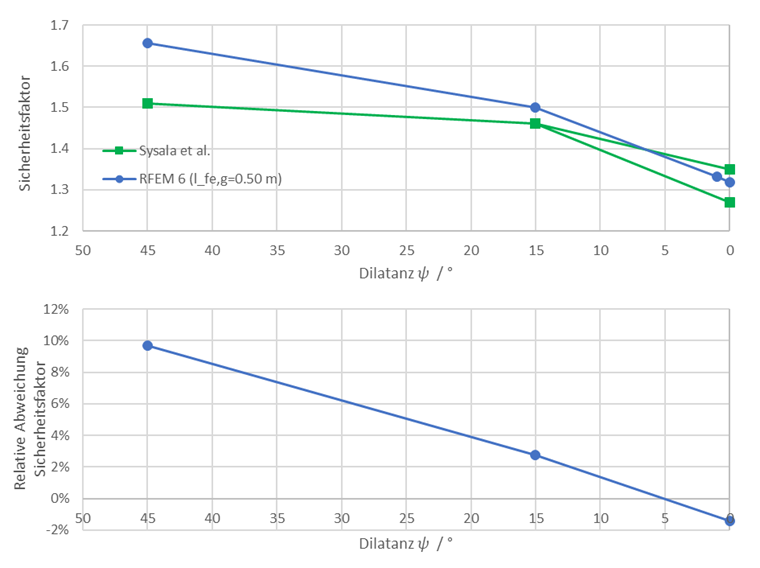
As mentioned at the beginning, the model is based on the publication by Sysala et al. [#Ref [1]]. The safety factors obtained in this study and using RFEM (with a mesh size of 0.25 m) are shown in the following diagram in relation to the assumed dilatancy angle. The second diagram shows the relative deviations in this regard. As can be seen here, these are within an acceptable range. The largest deviation was determined at a dilatancy angle of 45° with 9.3%. These deviations can be explained by different simulation software and meshing approaches.